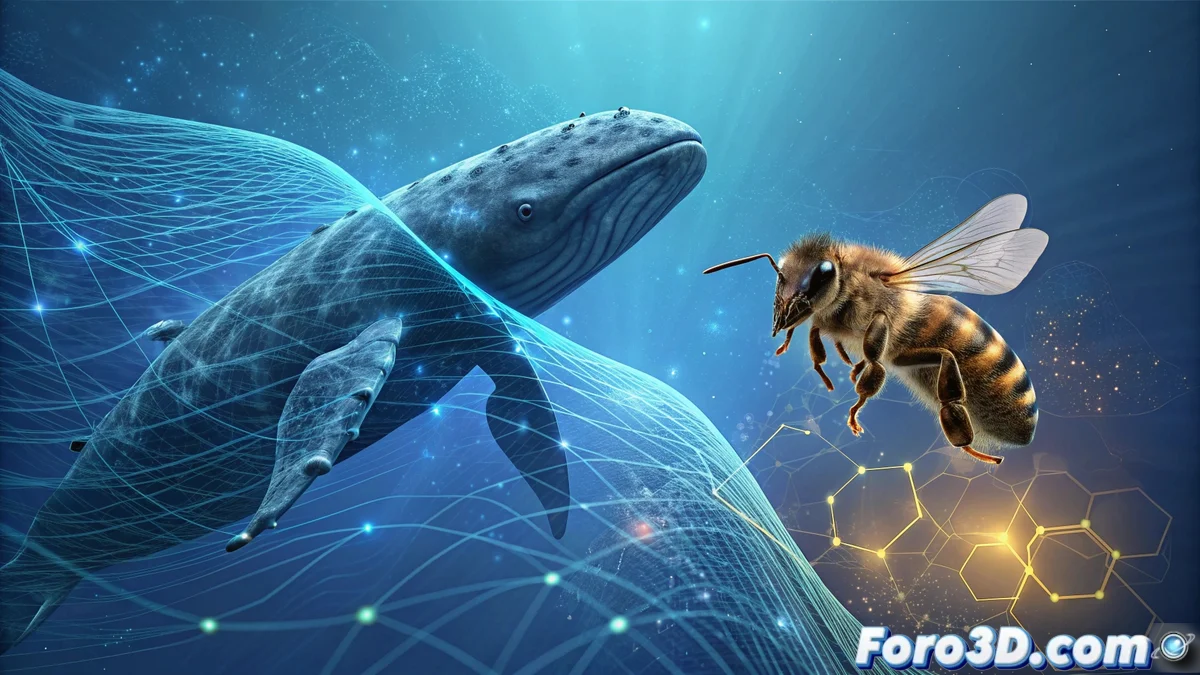
AI Algorithms Attempt to Decipher Animal Language
Artificial intelligence systems now interpret the vocalizations and behaviors of multiple species to understand how they communicate. Initiatives like CETI examine sperm whale clicks, while other projects investigate bee movements. These computational tools identify complex patterns that humans cannot perceive, employing neural networks that learn from extensive bioacoustic datasets. The goal is to build a model capable of translating these signals into basic concepts, which could radically alter how we relate to nature. 🐋
Processing Sounds and Gestures with Machine Learning
Scientists record thousands of hours of audio and video in natural environments. Then, machine learning algorithms isolate individual sounds from background noise and link them to specific actions, such as foraging for food or alerting to a threat. For bees, their dance is studied to interpret the direction and distance of a food source. This approach not only classifies sounds but also seeks to understand the syntax and context of each signal, a vital step toward reliable translation. 🐝
Key Approaches and Projects:- Project CETI: Focuses on deciphering sperm whale communication through analysis of their click sequences.
- Bee Studies: Decode the spatial information encoded in their dance movements within the hive.
- Context Analysis: Algorithms correlate specific sounds with observable behaviors, attempting to go beyond a simple sound catalog.
Perhaps soon an algorithm will reveal that a bird's song is not poetry, but a heated discussion about the quality of worms in the neighborhood.
Technical Obstacles and Ethical Issues
Although technology advances, the path is intricate. A main limitation is the absence of a Rosetta Stone for animal languages, a reference to validate proposed translations. Additionally, ethical debates arise about whether we should interfere or if absolute understanding is feasible, considering that other species' sensory experiences are radically different. Researchers emphasize that these projects are long-term collaborative efforts requiring biologists, ethologists, and AI engineers to collaborate. ⚖️
Main Challenges in Research:- Lack of Reference: There is no reliable dictionary or translator to verify the accuracy of AI interpretations.
- Sensory Barrier: Animals' perceptions of the world are different, complicating the translation of human concepts to their signals and vice versa.
- Interdisciplinary Collaboration: Success depends on integrating knowledge from biology, ethology, and data science.
The Future of Interspecies Communication
This emerging field combines advanced bioacoustics with deep learning algorithms to build communication bridges. The goal is not only to translate but to understand the structure and possible meaning behind animal interactions. As models process more data, we might begin to decipher basic layers of intention and context in non-human languages, redefining our place in the natural world. 🌍