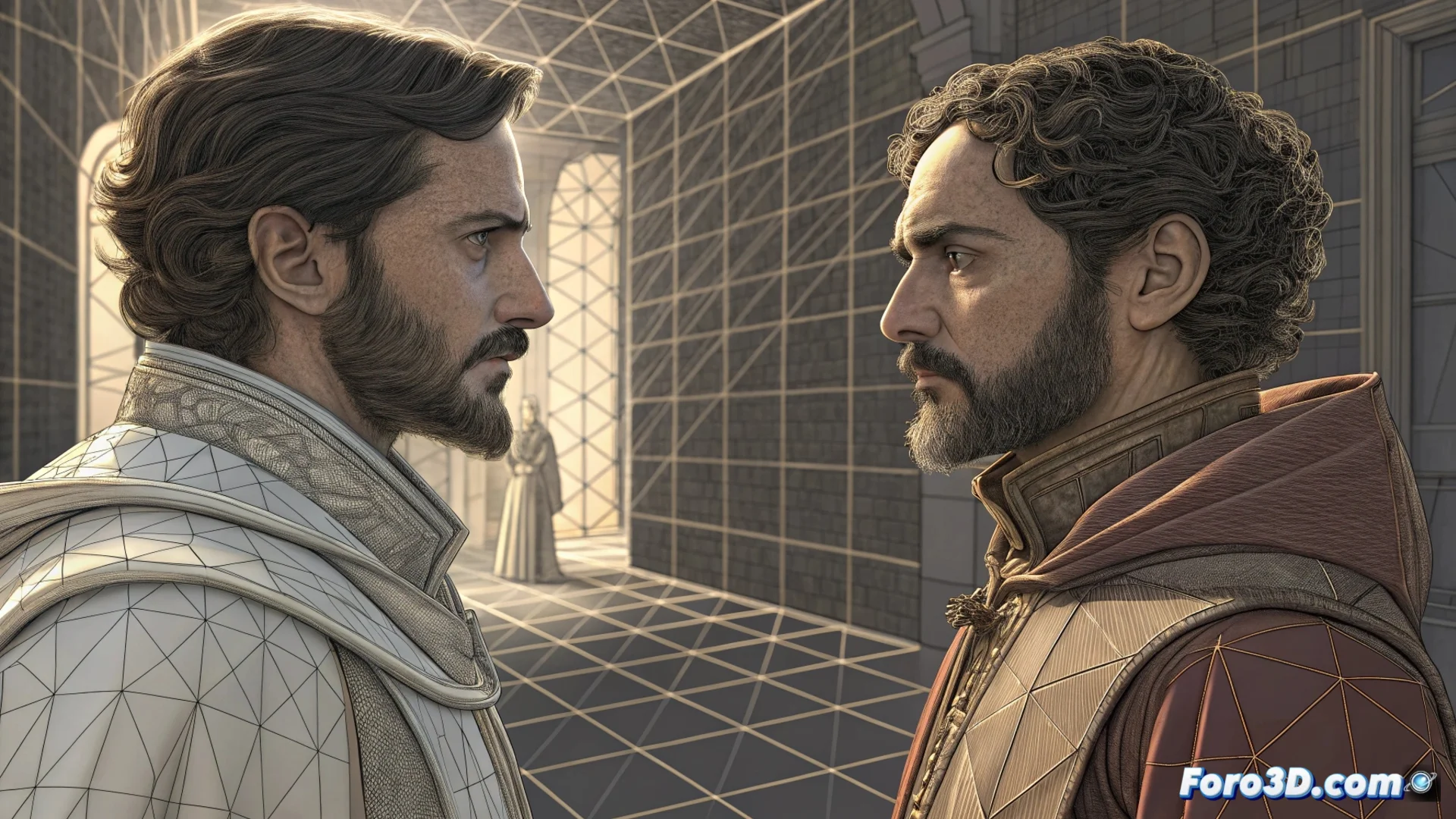
Algorithmic Strategies for Arbitrating Depth Conflicts or Z-Fighting
In computer graphics, a common problem known as z-fighting occurs when two or more surfaces have identical or extremely close values in the Z buffer. This competition for the same screen fragment produces annoying visual artifacts, such as flickering and twinkling pixels. To solve it efficiently, algorithmic methods are used that automatically decide which surface should be displayed, being crucial in complex scenes with overlapping procedural geometry. 🎯
Arbitrating with Stochastic Ordering
A powerful technique to break the symmetry of the tie uses stochastic ordering. Instead of relying solely on depth, the rendering engine calculates a unique hash value. This hash can be based on the pixel's screen coordinates or on an identifier of the geometry itself. By introducing this random but deterministic factor per frame, a consistent "win" is assigned for each conflicting pixel, eliminating temporal flicker and generating a stable visual result.
Key features of this method:- The hash calculation is deterministic per frame, avoiding time-varying artifacts.
- It breaks the direct correlation with depth values, solving conflicts where they are equal.
- It is especially useful for procedurally generated geometry where distances can be identical.
Stochastic ordering acts as an impartial judge, deciding which surface to render based on a consistent criterion unrelated to depth.
Improving Precision and Separating Planes
Another line of attack focuses on the depth buffer itself. Increasing its precision, for example, by migrating from a 32-bit format to a 64-bit one or using a W buffer with inverse precision, provides a wider range of distinct values. This allows differentiating planes that, with lower precision, would seem to occupy the same position. A complementary tactic is to dynamically separate conflicting planes. A small and non-uniform depth offset is applied that can depend on attributes such as the material, a layer ID, or the object, thus avoiding the creation of regular patterns that the eye can perceive.
Technical strategies for handling depth:- Use Z buffer formats with greater bit depth (e.g., 64 bits) to have more available values.
- Implement plane separation with offsets that vary non-uniformly, based on scene properties.
- Configure the depth bias or depth bias intelligently and per layer, not globally and constantly.
The Ultimate Solution: Defining Priorities
Sometimes, the most direct and effective approach is the simplest: do not render one of the surfaces when the conflict is inevitable and lacks visual importance. This requires the artist or the engine to define clear priority rules at the shader or object level. It is the digital equivalent of the law of the strongest, where the system decides which element is more important for the final scene and discards the other. This strategy saves processing resources and eliminates the problem at its root, although it requires careful planning. ✅