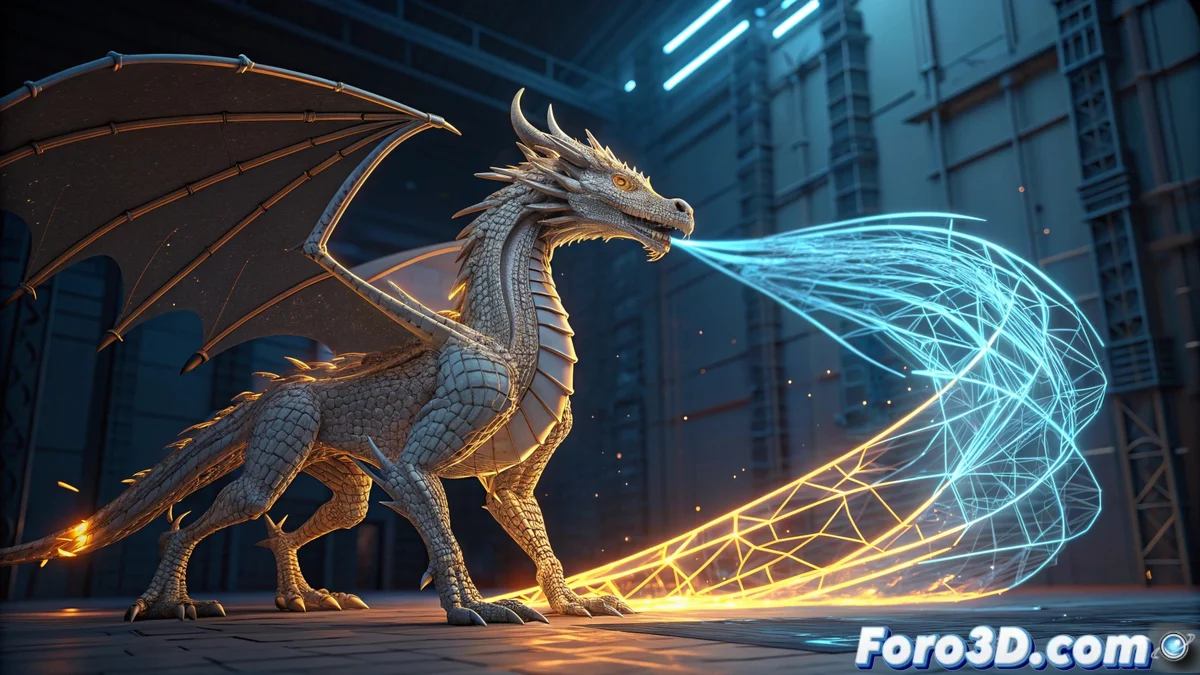
Alembic: the format that saves complex animations
In 3D graphics and visual effects production, exchanging animated scenes between different programs is often a challenge. Alembic (.abc) solves this problem by acting as a universal container for geometry that changes over time. Its main function is to bake or cache complex animations and simulations, transforming dynamic data into a sequence of static meshes that any compatible application can read. 🎬
How does it optimize the workflow?
The process is straightforward and powerful. An artist can animate a rigged character or simulate a particle system in software like Houdini or Maya. Instead of sending the entire scene with its heavy computation systems, they export the result to a single .abc file. This file contains the entire "baked" animation, ready to use. Another artist imports it into Blender, Cinema 4D, or any render engine, where they can focus on assigning materials, adjusting lighting, and rendering. The great advantage is that the render machine doesn't need to recalculate the simulation from scratch; it just reads the precomputed vertex data, saving huge amounts of time and processing resources.
Key advantages of using Alembic:- Seamless exchange: Allows moving complex animations between applications without depending on the plugins or native systems that created them.
- Faster rendering: By eliminating the need to calculate simulations on every frame during rendering, it significantly speeds up the process.
- Efficient collaboration: Facilitates studios with different tools working on the same project, standardizing animation delivery.
A .abc file is like a can of soup: it contains everything cooked, ready to heat and serve. You don't need to know the original recipe or have the kitchen.
Compatibility and stored data
Being an industry open standard, Alembic has native support in the vast majority of professional 3D software packages. This is not a marginal plugin, but an integrated feature in tools like those mentioned and many others. The format is capable of precisely storing the evolution of the mesh over time, saving essential attributes like the position of each vertex, normals, and UV coordinates for each frame of the animation.
What type of data can you bake into Alembic?- Vertex animation on character meshes (deformation cache).
- Dynamic simulations of cloths, fluids, or particles.
- Transformation and deformation animations of complex objects.
A pillar in modern pipelines
Implementing Alembic in a production pipeline is a strategic decision to optimize. It clearly separates the simulation/animation stages from lighting/rendering, allowing each specialist to use their preferred tool without creating bottlenecks. Its open file nature and wide compatibility make it an indispensable bridge for efficiently and collaboratively producing high-complexity 3D content. 🔗