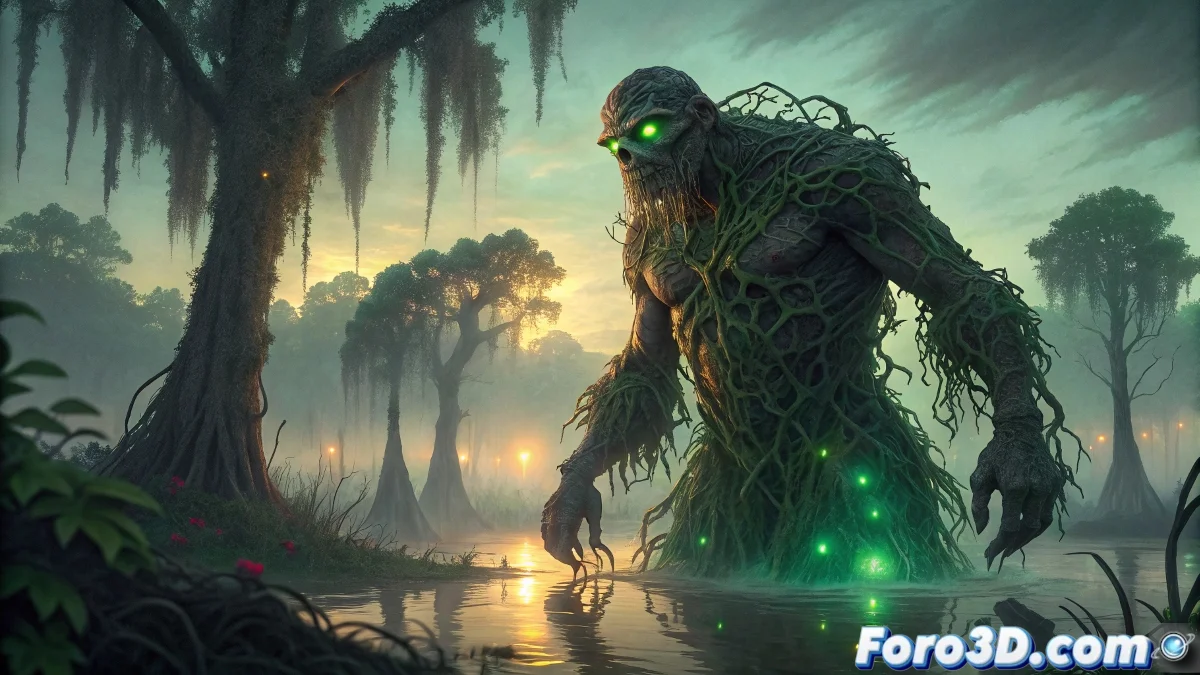
Swamp Thing: When the Swamp Found Its Poet
In 1984, a British writer named Alan Moore took the reins of a swamp creature that seemed doomed to oblivion and transformed it into one of the most innovative works of the ninth art. What began as a simple horror comic monster became, under his pen, a philosophical exploration of identity, ecology, and the nature of consciousness. Moore not only saved Swamp Thing from cancellation but elevated it to unimaginable literary heights for a character that is basically moss with legs. 🌿
The Copernican Turn That Changed Everything
The defining moment came in issue 21, The Anatomy Lesson, where Moore revealed that Alec Holland had never transformed into Swamp Thing, but rather the creature was an elemental entity that only believed it was Holland. This twist not only redefined the character but opened the doors to a universe of narrative possibilities. Suddenly, Swamp Thing was not a man turned into a plant, but a plant that thought it was a man —a difference as profound as the swamp it inhabited.
Key elements of Moore's reinvention:- transformation from monster to cosmic entity
- introduction of psychological and existential horror
- creation of the mythology of the elemental realms
- integration of ecological and spiritual themes
Horror as a Philosophical Vehicle
Moore used the horror genre not to scare, but to explore complex ideas about life, death, and what it means to be conscious. His stories ranged from astral journeys to confrontations with demons, passing through reflections on interstellar love. In a memorable arc, Swamp Thing literally dies and travels to the afterlife only to discover that heaven and hell are mental constructs. All this while maintaining a relationship with Abby Arcane that redefined what was possible in a superhero comic —or rather, antihero.
I am not a man turned into a plant. I am a plant that once dreamed it was a man
The Legacy That Endures in the Mud
Moore's run on Swamp Thing not only saved the series but laid the foundations for what would later become DC Comics' Vertigo imprint. It demonstrated that comics could tackle adult themes without falling into sensationalism, and that horror could be as poetic as it was terrifying. Its influence is felt in later works like Neil Gaiman's Sandman and Hellblazer, the latter emerging directly from his run when John Constantine made his first appearance.
Innovations that changed comics:- complex and mature serialized narrative
- integration of diverse mythologies
- exploration of sexuality and adult relationships
- innovative fusions of literary genres
In the end, Moore proved that even the most improbable character can become a vehicle for the highest art —as long as it has the right writer whispering in its ear from the depths of the swamp. And who would have thought that a mass of decaying vegetation could teach us more about humanity than most caped superheroes. 🐊