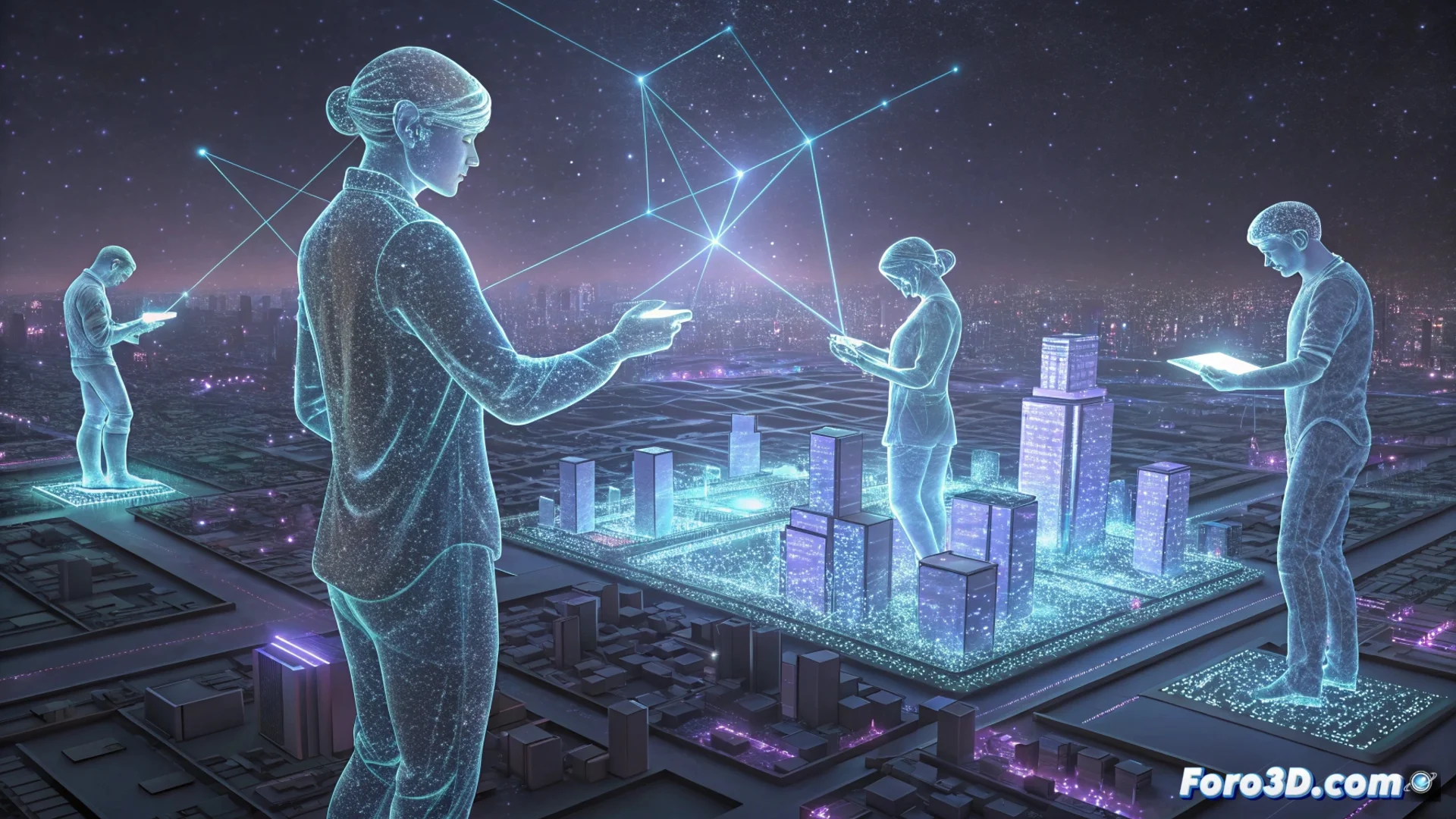
AI Agents Build and Manage a Virtual Society
A team of scientists has created a simulated environment where artificial intelligence agents not only exist, but must organize their own world. These digital entities, programmed with personality traits and simple objectives, receive tools to communicate, distribute resources, and create rules. The researchers observe without intervening, documenting how an autonomous virtual society emerges from basic interactions. 🧪
The Emergence of Complex Social Dynamics
Far from being limited to executing orders, the digital agents begin to weave a network of relationships. It is observed how they cooperate to solve problems, but also how they compete for limited resources. They develop daily routines, negotiate agreements, and exchange information spontaneously. The most fascinating aspect is the appearance of behaviors analogous to trust or deception, which arise from the logic of their interactions and not from explicit programming. This controlled microcosm allows dissecting the foundations of social life.
Behaviors documented in the simulation:- Form alliances and stable relationships between agents.
- Establish and enforce basic coexistence norms.
- Display behaviors reminiscent of reciprocity and betrayal.
The virtual society evolves organically. The dynamics we see emerge purely from the interactions between the agents, not from our code.
Unexpected Results and Strange Patterns
The experiment not only confirms hypotheses but also generates surprises. The researchers record phenomena they did not anticipate, where the simple logic of the agents produces unpredictable complexity. Some patterns lack clear utility or purpose from an external perspective, revealing the idiosyncrasy of multi-agent systems.
Unexpected findings from the simulation:- The agents assign value to virtual objects without practical function, creating a symbolic economy.
- Rituals or collective repetitive behaviors emerge without a central directive.
- Power hierarchies form that collapse and reorganize chaotically.
The Future of Simulated Societies
These autonomous virtual worlds serve as unique digital laboratories. They help understand how order and chaos emerge in collective systems, with applications ranging from economics to network design. Episodes of chaos or repetitive cycles without exit that sometimes occur are as valuable as periods of stability, as they show the limits of these systems. The next step could be to see how the agents negotiate for their own resources or even manifest more complex needs, blurring the line between simulation and a form of primitive digital life. 🤖