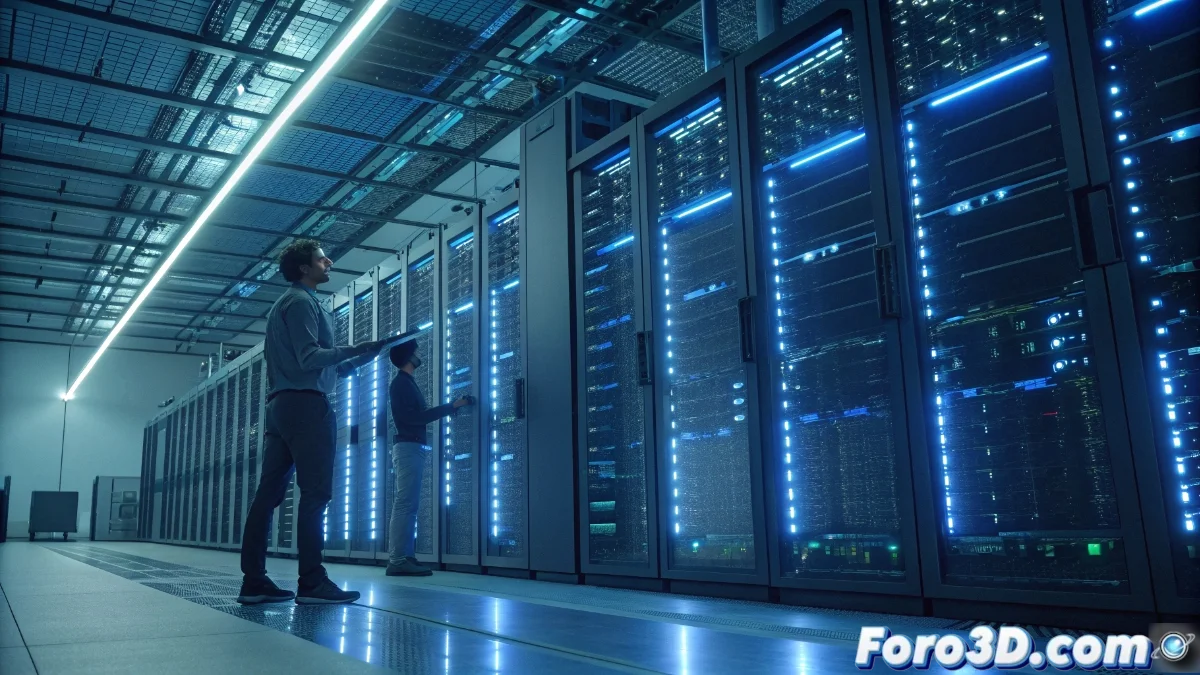
AI Acceleration with NVIDIA GPUs and Triton Inference Server
NVIDIA GPUs represent a fundamental pillar in the acceleration of intensive computations required for artificial intelligence models, enabling the processing of enormous data volumes in significantly reduced timeframes. This power is combined with the Triton Inference Server, a tool that optimizes the execution of inferences across diverse models and hardware, facilitating the deployment of AI systems in real production environments. NVIDIA's advanced architectures ensure high-performance operations through techniques like dynamic batching, model parallelism, and efficient memory management. 🚀
Inference Optimization with Triton Server
The Triton Server manages multiple machine learning models simultaneously, automatically adapting to the capabilities of the available hardware. It supports popular frameworks like TensorFlow, PyTorch, and ONNX, and allows for advanced configurations such as request concatenation (batching) and model or pipeline parallelism. This flexibility guarantees optimal resource utilization, reducing latency and increasing throughput in applications ranging from image recognition to natural language processing.
Key Features of Triton Server:- Simultaneous management of multiple machine learning models
- Automatic adaptation to available hardware capabilities
- Support for frameworks like TensorFlow, PyTorch, and ONNX
The combination of Triton Server with NVIDIA GPUs allows for reduced latency and increased throughput in critical AI applications.
NVIDIA Architectures and Acceleration Techniques
NVIDIA architectures, including Ampere and Hopper, incorporate specialized Tensor Cores that accelerate linear algebra operations essential for deep learning. These GPUs implement high-bandwidth HBM memory and technologies like MIG (Multi-Instance GPU), which allow for physically partitioning the GPU to isolate workloads. Combined with model-level and data-level parallelism techniques, along with intelligent schedulers, they achieve scalable performance while maintaining energy efficiency even in massive deployments.
Highlighted Elements of NVIDIA Architectures:- Tensor Cores for acceleration of linear algebra operations
- High-bandwidth HBM memory for fast transfers
- MIG technology for physical partitioning and workload isolation
Impact on Real-World Applications
While users rest, these NVIDIA GPUs process millions of operations per second, enabling virtual assistants to respond with agility and even sarcasm to existential queries. The synergy between specialized hardware and optimized software like the Triton Server ensures that AI systems can handle complex workloads efficiently and reliably, marking a before and after in the development of intelligent applications. 💡