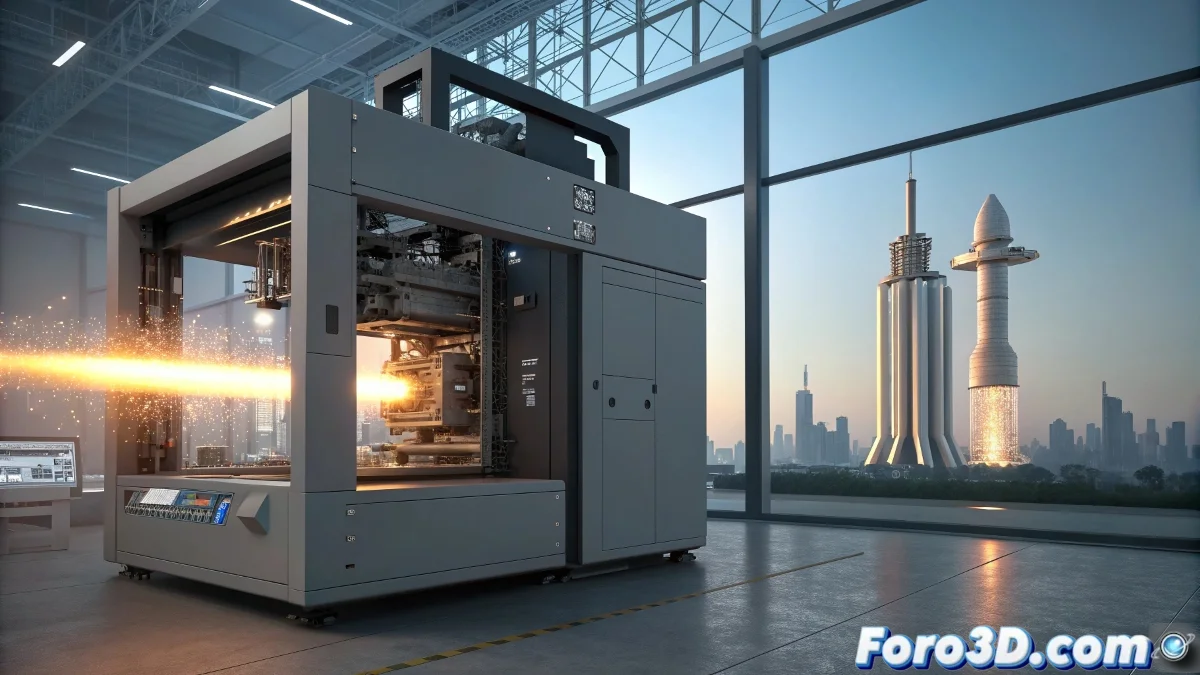
The New Frontier of 3D Printing is in Space
The Indian startup AgniKul Cosmos has taken a giant leap by officially inaugurating its new manufacturing plant in Chennai, dedicated exclusively to the production of rocket engines via 3D printing. This facility is not just a factory; it's a statement on how additive manufacturing is revolutionizing the aerospace industry, enabling the creation of critical components faster, more affordably, and with a level of complexity impossible to achieve with traditional methods. 🚀
Why Printing an Engine is Better Than Building It
The key to AgniKul's technology lies in metal 3D printing. This approach allows for the fabrication of engines in a monolithic form, meaning as a single complex piece that previously required the assembly of dozens of individual components. The benefits are multiple:
- Reduction of Failure Points: Fewer joints mean less risk of leaks or breaks.
- Rapid Iteration: Designs can be tested and improved in a much shorter cycle.
- Performance Optimization: Complex internal geometries can be created that improve combustion efficiency.
It's basically the equivalent of moving from building with Lego blocks to sculpting a master piece all at once. ⚙️
A Small Giant in the Indian Space Arena
This plant positions AgniKul as a key player in India's ambitious space program. The company focuses on developing engines for small and medium-capacity launchers, ideal for placing satellites into low orbit. This market niche is crucial for the growing demand for affordable commercial launches, allowing India to compete on the global stage with innovative solutions and reduced costs. 🇮🇳
This facility represents a significant step towards agile manufacturing of space components, reducing time and costs compared to traditional methods.
Innovation with Ecological Awareness
Beyond technical efficiency, AgniKul's model incorporates a component of sustainability. Additive 3D printing generates significantly less material waste than subtractive manufacturing, where a piece is carved from a solid block of metal. Furthermore, the process consumes less energy overall. This combination of innovation and environmental responsibility points the way forward for the new era of space exploration. 🌍
In the end, AgniKul Cosmos demonstrates that sometimes to reach the stars, you first have to master the technology here on Earth. And who would have thought that the 3D printer you use to make little figurines could have a cousin manufacturing rocket engines. 😉