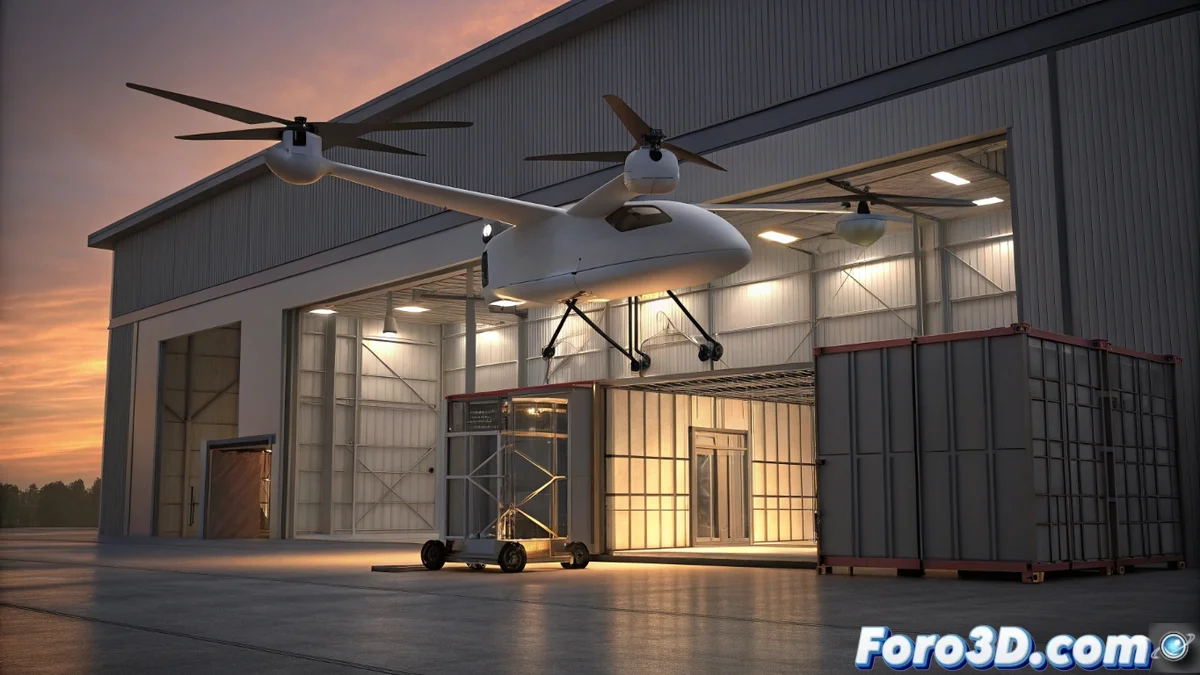
Aergility and the UDX Drone: Additive Manufacturing for Hybrid Logistics
The company Aergility is developing an innovative solution for autonomous aerial transport: the UDX drone. This unmanned aerial vehicle combines the versatility of vertical takeoff and landing (VTOL) with the aerodynamic efficiency of a fixed wing to cover long distances. A key element of its strategy is to employ 3D printing to produce a significant portion of its structure, accelerating the manufacturing process and enabling high customization. 🚁
Modular Architecture Powered by Additive Manufacturing
The UDX design is based on a modular architecture where different sections are assembled. Additive manufacturing is used to generate the internal structure, supports, and external housings that define the aerodynamic shape. This method drastically reduces the number of individual parts, simplifying the assembly and maintenance of the drone. For these parts, composite materials such as carbon fiber-reinforced thermoplastics are used, achieving exceptional rigidity with minimal weight. This strategy not only shortens prototype testing cycles but also allows for rapid design iterations to meet specific payload or range requirements.
Key Advantages of Modular Design with 3D Printing:- Component Integration: Multiple functions are combined into a single printed part, eliminating joints and screws.
- Weight Reduction: The ability to optimize internal geometry (with lattices or hollow structures) maximizes the strength-to-weight ratio.
- Production Flexibility: The same manufacturing system can be adapted to produce different modules or drone versions without costly tooling.
Additive manufacturing enables customization of the drone to adapt to different logistics missions, from transporting medical supplies to delivering goods in hard-to-reach areas.
Operational Capabilities and Logistical Adaptability
The UDX operates autonomously and can take off and land in confined spaces, without relying on a conventional runway. Its hybrid configuration allows it to fly efficiently in cruise mode, extending its range far beyond that of traditional multicopters. The cargo bay and attachment points can be customized using 3D-printed components, enabling the same basic chassis to transport everything from refrigerated containers and communications equipment to standard packages.
Logistics Applications Enabled by This Technology:- Delivery of Urgent Medical Supplies to remote or disaster areas.
- Goods Distribution in complex urban environments or with limited infrastructure.
- Transport of Specialized Equipment for sectors such as telecommunications or energy.
Final Consideration on the Manufacturing Process
Implementing 3D printing in an aerial vehicle requires rigorous control of manufacturing parameters. As a technical reflection notes, the greatest challenge is not always carrying the payload, but ensuring the printed structure is robust enough. This underscores the importance of optimizing the internal fill density and part orientation during the printing process to guarantee structural integrity. Aergility's approach demonstrates how additive manufacturing is transforming the development of advanced aerial vehicles, making it possible to create lighter, more versatile drones adapted to specific missions more quickly. ✈️