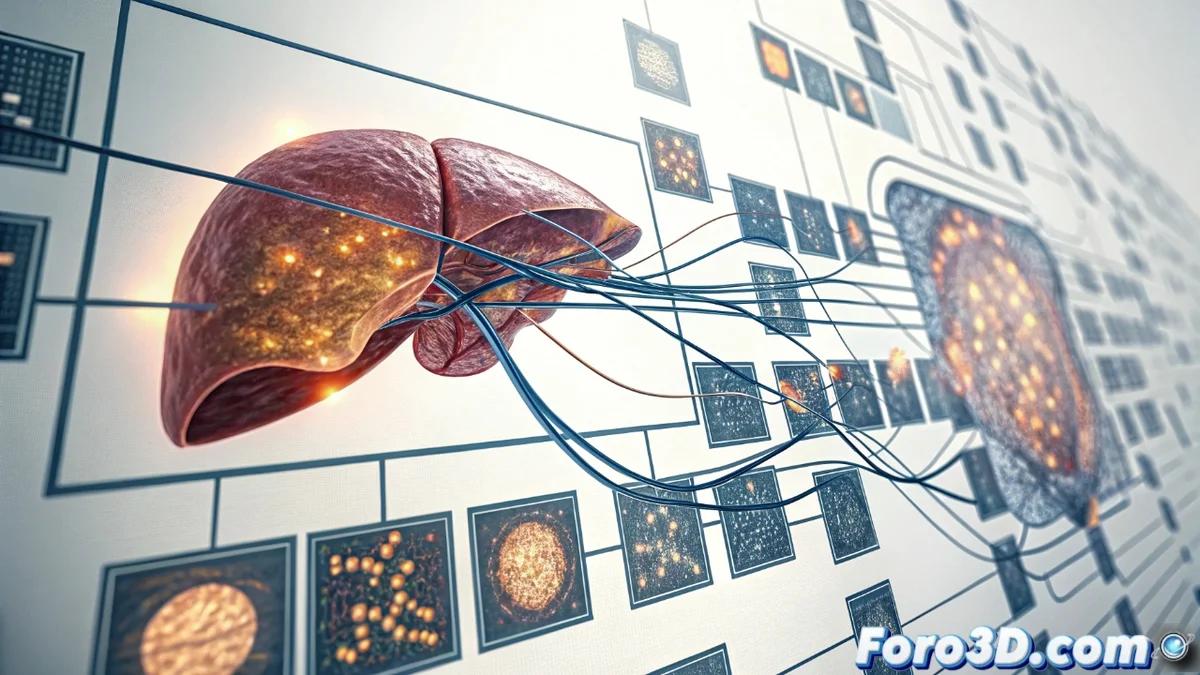
Advances in Hepatic Diagnosis with MTI-Net: Unified Segmentation, Regression, and Classification
Clinical evaluation of hepatic tumors has traditionally required addressing three critical components separately: lesion segmentation, dynamic enhancement regression, and pattern classification. This methodological fragmentation has hindered leveraging the natural synergies between these processes, mainly due to the technical complexity of integrating their workflows. We present MTI-Net, an adversarial neural architecture specifically designed to execute these functions in a coordinated and simultaneous manner 🧠.
Multimodal Integration with Entropy-Aware Spectral Fusion
The core of the architecture incorporates the MdIEF module, which uses high-frequency spectral information to fuse features from multiple domains. This mechanism overcomes the limitations of conventional methods that fail to fully exploit the informative richness of dynamic magnetic resonance imaging sequences. By operating simultaneously in frequency and spatial domains, the system generates more robust and detailed representations of tumor features 🔍.
Main features of the fusion module:- Entropy-aware processing to preserve critical information in multiple domains
- Efficient extraction of dynamic MRI data through advanced spectral analysis
- Generation of unified representations that simultaneously feed segmentation and classification
Entropy fusion enables capturing inter-domain relationships that conventional methods overlook, establishing new paradigms in medical image processing.
Adversarial Synergy and Task Consistency
Through a task interaction module, MTI-Net establishes high-order consistency between segmentation and regression, fostering continuous mutual improvement between these functions. The system incorporates a task-driven discriminator that captures complex internal relationships between the model's different objectives. For temporal processing of dynamic MRI sequences, a shallow Transformer network with positional encoding is employed to capture temporal and spatial dependencies within medical series ⚡.
Multitask interaction components:- Consistency mechanisms that align segmentation with dynamic enhancement regression
- Adversarial discriminator specialized in capturing complex inter-task relationships
- Medical Transformer for temporal-spatial modeling in dynamic MRI sequences
Experimental Validation and Clinical Perspectives
Experimental results on a dataset of 238 subjects demonstrate that MTI-Net achieves high simultaneous performance across all tasks, validating its potential to assist in the clinical diagnosis of hepatic tumors. This unified approach represents a significant advance over previous methods that treated each component in isolation. It seems that neural networks are finally learning to work as a team more efficiently than many traditional hospital departments 🏥.