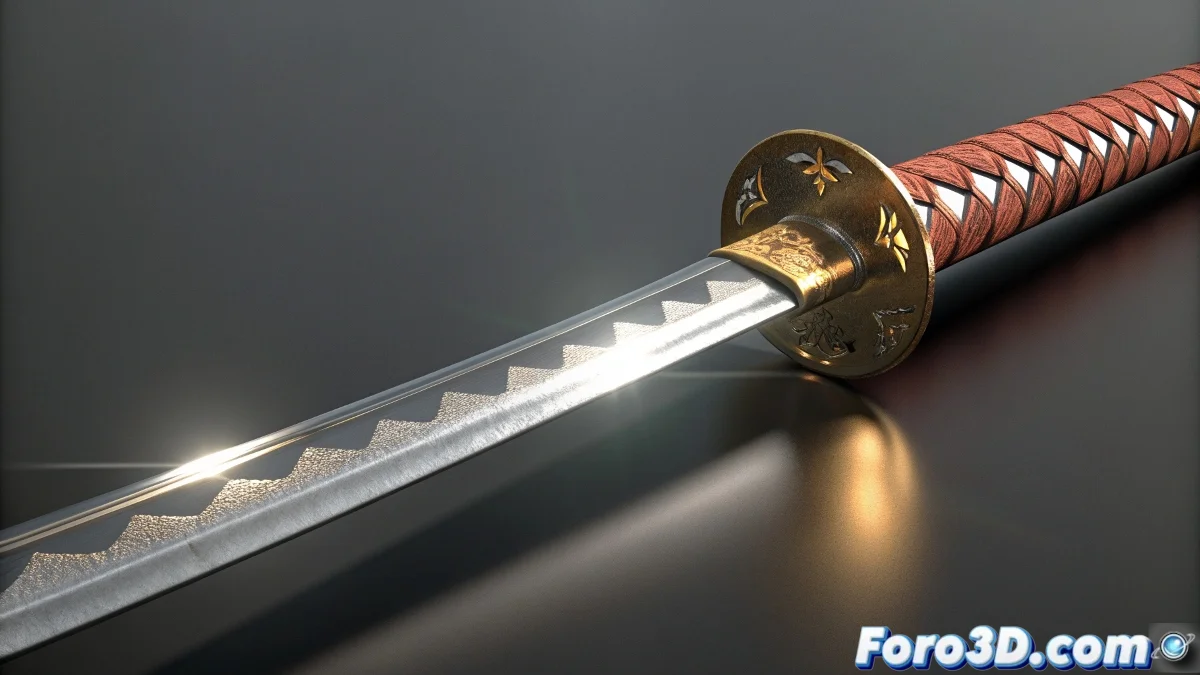
The art of creating edges that cut the eye
Modeling a sword with a convincing edge is like carving light into digital geometry ⚔️. The challenge goes beyond the physical shape – it requires understanding how light interacts with sharpened metal to create that edge illusion that seems capable of cutting the air itself. The combination of precise modeling, advanced materials, and strategic lighting separates generic weapons from those that truly impress.
Precise edge modeling
The foundation of a believable edge begins with intelligent topology. Instead of simply sharpening the edge, the professional approach involves creating a controlled bevel that maintains enough geometry to manipulate light correctly. The center of the blade retains volume while the edges taper gradually, creating the characteristic profile of an authentic katana without compromising the mesh's integrity during animation 🔪.
A good edge is not measured in polygons, but in how it interacts with light.
Hamon simulation: the soul of the katana
The hamon, that wavy temper line that characterizes traditional katanas, represents the visual soul of the weapon. Simulating it digitally requires a layered approach that combines procedural textures with intelligent shader manipulation.
- Fractal noise: Base for the organic hamon pattern
- Strategic masking: Isolation of areas with different reflectivity
- Controlled gradients: Smooth transitions between polished and matte zones
- Micro-details: Add imperfections for additional realism
PBR Shaders for Digital Metallurgy
The material makes or breaks the illusion of a cutting edge. A well-configured metallic PBR shader doesn't just look like metal – it looks like sharpened metal, with all the visual complexities that entails.
- Controlled anisotropy: Simulates the micro-grooves of traditional polishing
- Roughness map: Controlled variation of shine along the edge
- Specular highlights: Intense bright spots that emphasize the edge
- Edge wear: Slight wear on the edge to add credibility
Lighting that reveals the edge
The best sword in the world will look flat under bad lighting. The right lighting setup is what transforms a 3D model into a weapon that seems capable of cutting through the screen.
- Lateral area lights: Create longitudinal reflections along the edge
- Bounce light: Softens hard shadows without dulling reflections
- Strategic backlight: Isolates the weapon from the background and emphasizes silhouette
- Point highlights: Add intense bright spots in critical areas
Professional workflow
Creating realistic weapons requires following a specific methodology that ensures consistency and quality throughout the entire production pipeline.
- Base modeling with clean topology and appropriate edge flows
- Optimized UV unwrapping to leverage texture resolution
- Creation of layered PBR materials with procedural masks
- Setup of virtual studio lighting specific for weapons
- Render passes for compositing and final adjustment in post-production
The final touch of realism
The details that truly seal the illusion are often the subtlest – those small imperfections, reflectivity variations, and light interactions that transform a 3D model into an object that seems to really exist in space.
And when your sword shines so brightly that it blinds the viewer, you can always argue that it was forged by elven blacksmiths with magical technology 🧙. After all, in the 3D world, sometimes extreme realism becomes its own form of fantasy.