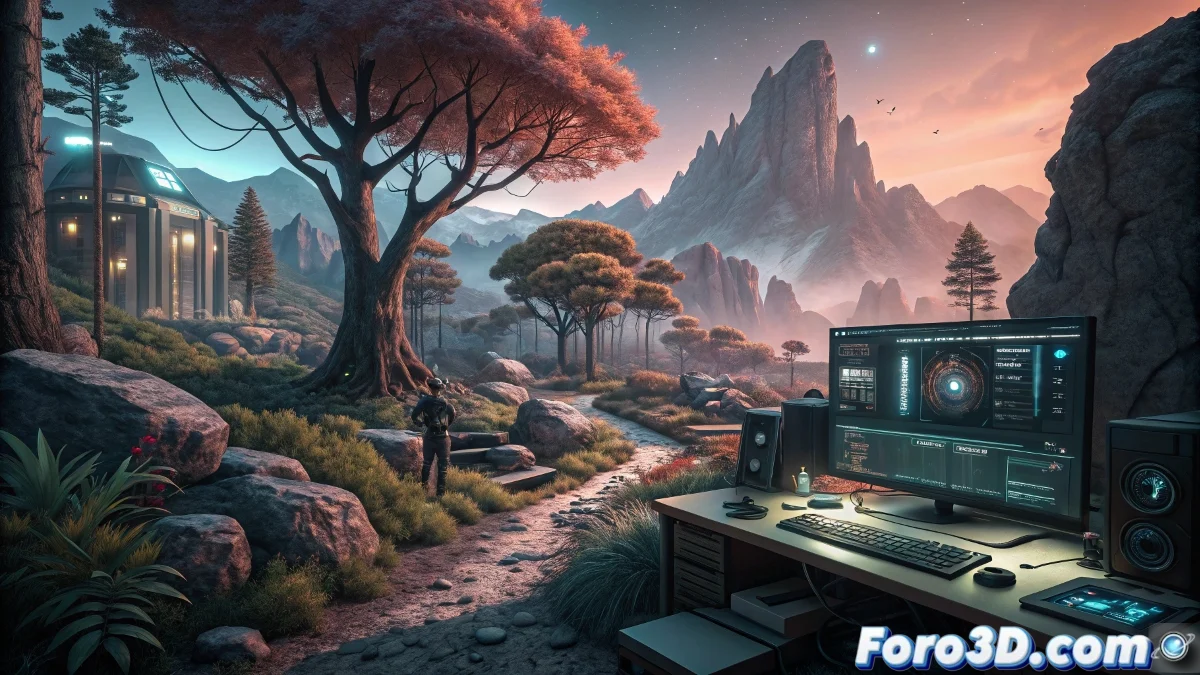
When AI Becomes Your Junior Modeling Team
Advanced AI-assisted procedural generation is radically redefining what it means to create 3D content, transforming artists from manual implementers to creative directors of generative systems. These new models don't just accelerate existing work, but create entirely new paradigms where specifying rules, parameters, and styles replaces vertex-by-vertex manual modeling. What previously required hours of meticulous work on repetitive elements like vegetation, rocks, or architectural props can now be generated in minutes, with coherent variations that maintain the project's stylistic integrity.
What makes this evolution particularly revolutionary is how it changes the temporal economy of content development. Where before the relationship between quantity and quality was fundamentally a trade-off - more assets meant less time per asset - AI procedural generation allows maintaining consistent quality regardless of scale. This is especially transformative for open-world projects or immersive experiences where content density and variety are crucial for credibility, but traditionally represented monumental logistical and temporal challenges.
Transformative Capabilities of AI Procedural Generation
- Automatic creation of coherent variations of base assets
- Generation of level layouts that respect gameplay rules
- Contextual adaptation of assets based on their environment and function
- Maintenance of stylistic coherence across thousands of elements
The New Division of Creative Labor
This technology doesn't eliminate the artist, but redefines their role toward higher-value creative activities. Instead of spending time modeling rock number 47 for a mountainous biome, the artist can focus on designing the system that generates all the rocks - defining variation parameters, placement rules, and ecological relationships between elements. This shift from creating individual objects to creating content ecosystems represents a fundamental evolution in the most valuable skills for 3D artists, privileging systemic thinking over manual execution.
The artist of the future doesn't create assets, they create the rules that create the assets
The ability to generate functional and playable level designs represents perhaps the most ambitious application. AI systems can now analyze game mechanics, difficulty balance, and player flow to propose layouts that are not only visually coherent but also functionally solid. This allows level designers to iterate quickly between different configurations, testing ideas that previously required weeks of manual implementation before they could be properly evaluated.
Impact on Production Pipelines
- 60-80% reduction in environmental content creation time
- Greater visual consistency across different artists and teams
- Ability to rapidly prototype different artistic directions
- Unprecedented scalability for background and ambient content
For the foro3d.com community, these advances mean that professional value gradually shifts from pure technical skill to systemic design capability and creative direction. Artists who can articulate coherent visions and translate them into generative parameters will be extraordinarily well-positioned in the future industry. Meanwhile, the ability to focus attention and resources on focal elements - main characters, narratively significant structures, key experiences - could raise the quality bar in projects of all sizes, creating more polished and memorable experiences for end users. 🌳
And so, between generative algorithms and variation parameters, we discover that the future of 3D modeling isn't in sculpting every vertex, but in cultivating digital ecosystems that grow according to rules we define - though we'll probably still miss that unique satisfaction of seeing a complex model take shape under our hands, vertex by precious vertex. 🏔️