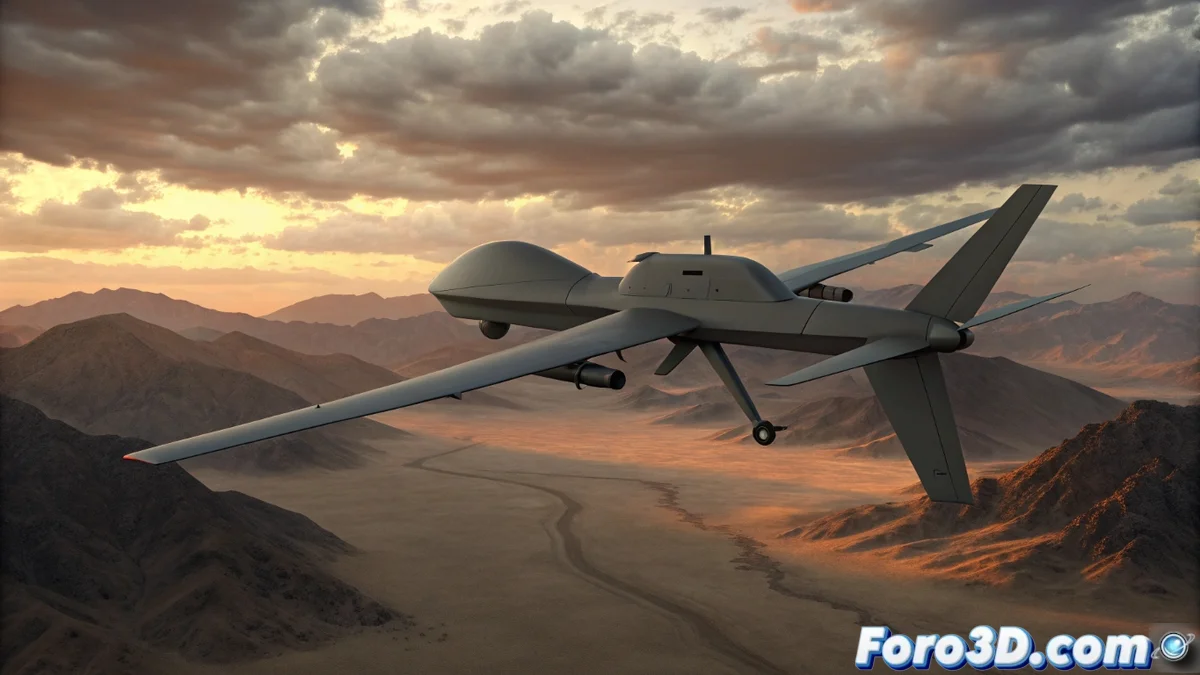
Additive Manufacturing Powers the Kratos Mako Drone for Military Training
The defense and aerospace sector is undergoing a radical transformation thanks to additive manufacturing. A paradigmatic example is the unmanned aerial system Kratos Mako, a high-performance target drone whose development and production rely on 3D printing. This methodology is not a complement, but the backbone of a process that prioritizes speed, cost reduction, and unprecedented maintenance logistics. 🚀
Operational Agility and Logistical Resilience: The Core of the Advantage
The main strength of the Mako system lies in its operational agility. By basing its production on digital files and specialized 3D printers, dependence on complex supply chains and expensive spare parts inventories is eliminated. For a vehicle specifically designed to be intercepted and destroyed in realistic training exercises, this capability is transformative. The ability to manufacture on demand a wing, a vertical stabilizer, or a complete fuselage section in a matter of hours turns this asset into a sustainable and high operational tempo training resource.
Key advantages of this approach:- Reduction in lead times and costs: Traditional manufacturing methods are replaced by additive processes that drastically shorten production time and minimize material waste.
- Simplified field maintenance: Parts damaged during simulation missions can be easily and quickly replaced in operational locations, even remote ones.
- Agile design updates: The digital nature of the process allows components to be modified and improved to emulate new aerial threats without needing to redesign the entire production infrastructure.
The 21st-century circular economy in defense: print, fly, intercept, collect the remains, and recycle to print again. An efficient and strategic training cycle.
Advanced Materials and Performance in Demanding Environments
The Mako drone's performance in adverse simulation environments is made possible by the advanced composite materials used in its 3D printing. These materials, which typically combine high-performance fibers such as carbon or Kevlar with polymeric matrices, provide an exceptional stiffness-to-weight ratio and resistance. These properties are critical to withstand high-acceleration maneuvers (high g) and to credibly emulate the flight characteristics of various potentially hostile aircraft, offering a challenging target for defense systems in training. ✈️
Performance and design features:- Threat emulation: Its architecture and capabilities allow simulating the behavior of different types of aerial threats, increasing training realism.
- Integrated complex geometries: 3D printing enables the creation of monolithic and optimized structures that would be impossible or extremely costly with subtractive methods, improving aerodynamics.
- Rapid customization: Adapting the drone for specific missions or scenarios is greatly accelerated, responding to changing tactical needs.
Conclusion: A New Paradigm for the Defense Industry
The Kratos Mako drone project represents much more than an unmanned aerial vehicle; it symbolizes a paradigm shift in production philosophy and logistical sustainability within the military sector. Additive manufacturing demonstrates its maturity here, moving from prototyping to the production of high-end operational systems. This approach not only optimizes economic resources but also provides a tangible strategic advantage through resilience and response speed. The future of military training and aerial systems development undoubtedly lies in the deep integration of these digital manufacturing technologies. 🛡️