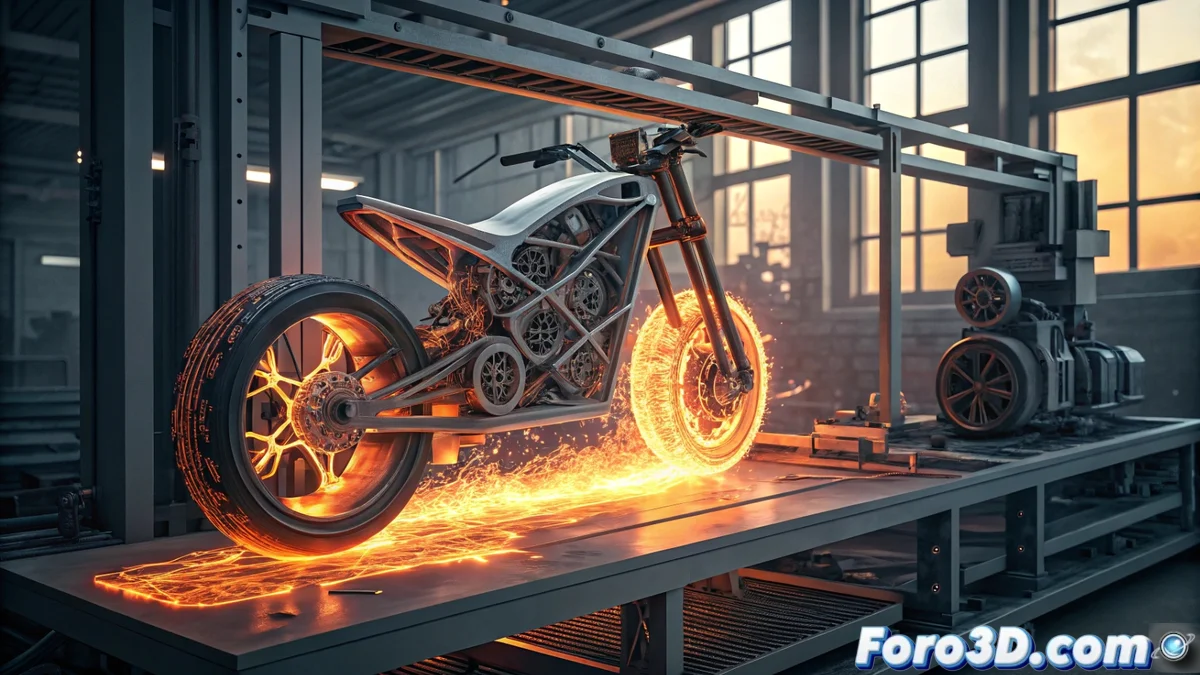
Additive Manufacturing in Metal Revolutionizes the Design of Electric Race Motorcycles
In elite categories like MotoE and among specialists preparing Zero Motorcycles models, additive manufacturing with metals has become the norm. This technology allows building critical structural components, such as chassis and swingarms, with a freedom of design previously unthinkable. The goal is twofold: optimize the motorcycle's overall performance and manage the heat emitted by high-power batteries effectively. The result is structures that are remarkably lighter and stiffer than those obtained by machining or tube welding. 🏍️⚡
Technical Advantages of Layer-by-Layer Construction
The main advantage is total geometric freedom. Engineers can design parts with internal cavities to channel cables or coolant fluids, and use organic shapes that distribute material only where it is needed to support loads. This reduces weight without sacrificing stiffness. Additionally, mounting points for batteries and motors are integrated more directly, simplifying assembly and improving the precision of the overall unit.
Key Benefits of This Method:- Allows complex internal geometries for cooling or cable routing.
- Optimizes the weight-to-stiffness ratio by depositing material only where it is structurally necessary.
- Integrates components and fixings, reducing the number of parts and improving assembly precision.
When your battery has exceptional value, you demand a 3D-printed chassis that protects it with maximum efficiency. Conventional solutions are no longer enough.
Materials and Process for Manufacturing
The process uses aluminum or titanium alloys in the form of fine powder. A high-power energy source, such as a laser or an electron beam, selectively melts the powder following a digital model. After printing the part, it usually requires a heat treatment to relieve internal stresses and achieve the desired mechanical properties.
Fundamental Aspects of the Process:- Metallic powders of specific alloys for high strength are used.
- The energy source melts the material with micrometric precision, layer by layer.
- Generates minimal material waste compared to machining, where up to 90% of a solid block can be lost.
Impact on the Future of Development
This technology not only improves current race motorcycles but also defines the path for the development of high-performance electric vehicles. By allowing integration of functions and optimization of structures in ways that subtractive methods cannot match, additive manufacturing positions itself as a pillar for building more efficient, lighter, and more powerful motorcycles. The shift from welded tubes to 3D-printed geometries marks a before and after in electric motorcycle engineering. 🚀