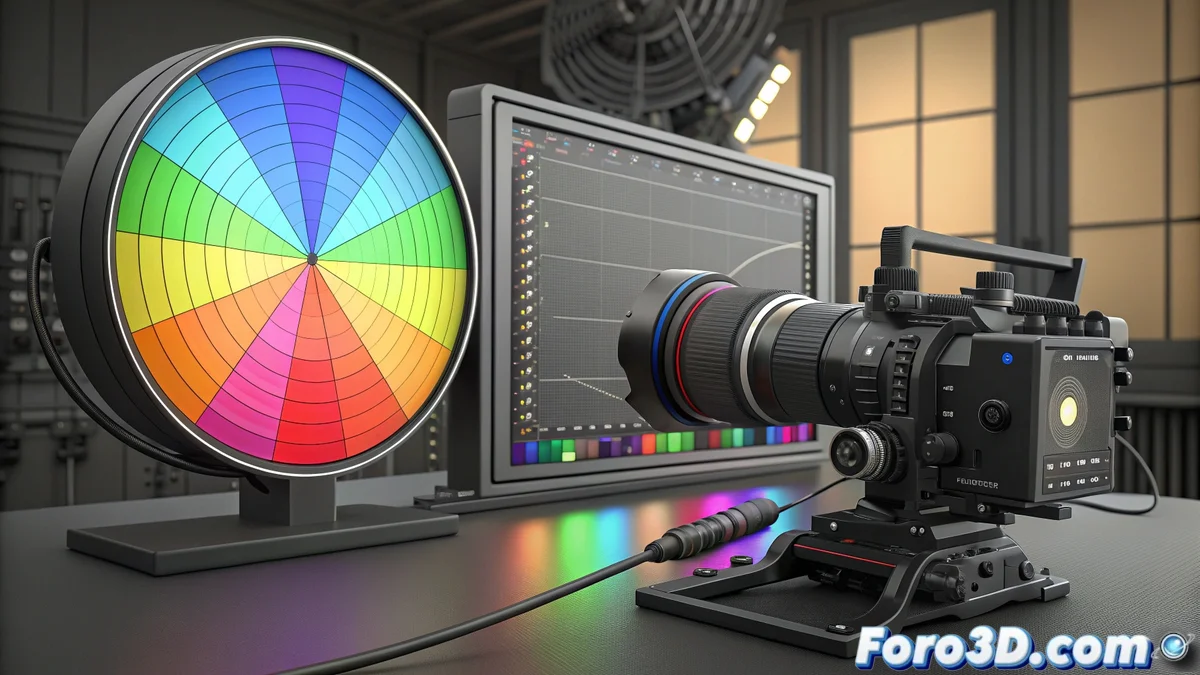
ACES: the open standard for color management in cinema and VFX
The Academy Color Encoding System (ACES) is an open framework that defines how to handle color at every stage of producing cinema and visual effects. 🎬 Its main goal is to preserve the original color intention captured by the camera, keeping it consistent during 3D rendering, compositing, and final mastering. Being a free standard, it eliminates barriers between different programs and teams from various manufacturers.
ACEScg: the color space for creating graphics
Within the ACES ecosystem, the ACEScg space is the most relevant for 3D and VFX artists. It is specifically designed for the operations performed by computer graphics applications. Its color gamut is much wider than that of traditional spaces like Rec. 709 or sRGB. This allows artists to work with purer and more saturated colors, knowing they will later be transformed in a controlled manner for output formats like DCI-P3 for cinema or UHD for television. This workflow avoids clipping or distorting extreme colors.
Key advantages of using ACEScg:- Allows using a superior chromatic range, ideal for complex visual effects.
- Provides a predictable linear working space for rendering.
- Facilitates file exchange between studios without losing color information.
The real challenge is sometimes not mastering ACES, but explaining to the director why the intense red he saw on his home monitor now looks like a different, but correct, red in the calibration room.
The core of the system: RRT and ODT transformations
Implementing ACES relies on using a well-defined set of mathematical color transformations. The Reference Rendering Transform (RRT) converts the image from the ACES space to an output space with a reference cinematic look. Subsequently, the Output Device Transform (ODT) adapts that image for accurate display on a specific device, such as a particular monitor or a cinema room projector. This standardized pipeline replaces ad-hoc color conversions and custom LUTs that used to cause inconsistencies.
Components of the ACES color pipeline:- RRT (Reference Rendering Transform): Applies the base cinematic look.
- ODT (Output Device Transform): Adjusts the image for the final display device.
- IDT (Input Device Transform): Brings the source material into the ACES space (not detailed in the original but implied).
Why adopt ACES in your workflow
Adopting ACES greatly simplifies color management in projects involving multiple softwares and stages. 🎨 It ensures that the colors designed in 3D are the same as those seen in compositing and, finally, on the cinema screen. It reduces errors and reprocessing, and its open nature fosters a more interoperable industry. Although it requires understanding its pipeline, the control and consistency it offers are invaluable for producing high-end visual content.