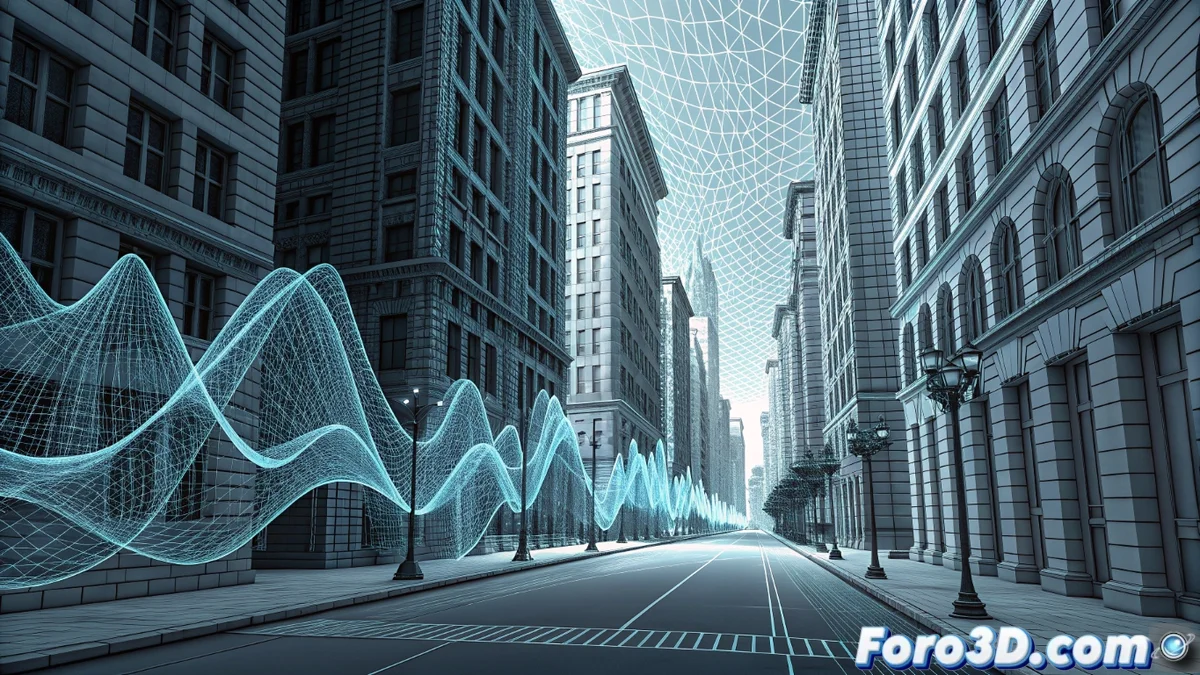
A witness hears a shot and it is verified with a 3D model
In forensic investigations, testimony about the direction of a sound, such as a gunshot, can be crucial. To verify it with scientific rigor, it is now possible to recreate the event in a digital environment. This approach combines 3D capture techniques and sound physics to build a virtual replica where what could or could not have been perceived can be analyzed. 🎯
Recreate the urban scene with millimeter precision
The first step is to generate an exact digital copy of the location. Photographs are processed from aerial or ground sources using software like Agisoft Metashape to create a geometrically faithful 3D mesh. This model is then transferred to applications like Blender or Unreal Engine, where it is cleaned, textures are assigned, and it is prepared for simulation. The goal is for every building, window, and corner of the real scene to be represented, as these elements define how sound travels.
Key phases in the reconstruction:- Photogrammetry: Convert overlapping sets of photographs into a dense point cloud and a textured 3D model.
- Optimize the model: Clean unnecessary geometry and ensure materials have defined acoustic properties for realistic simulation.
- Export for simulation: Prepare the file in a format compatible with specialized acoustic simulators.
The digital city must speak the physical truth; an error in a wall can create an echo that misleads the investigation.
Simulate how sound behaves in the virtual city
With the 3D model ready, the acoustic simulation phase begins. In programs like Odeon or EASE, the precise location of the sound source, the alleged gunshot, is defined. The calculation engine analyzes the propagation of sound waves, taking into account how they bounce off surfaces, diffract around corners, and lose energy when interacting with different materials. The result is not just a sound, but a complete map that predicts sound pressure levels at every point.
What acoustic simulation reveals:- Propagation maps: 2D or 3D visualizations showing how sound attenuates and distributes from the source.
- Ray trajectories: Lines illustrating the direct, reflected, and diffracted paths that sound follows.
- Delays and echoes: Data on how bounces off distant facades can create secondary sounds that a witness might misinterpret.
Contrast the testimony with physical data
The ultimate goal is to confront the human statement with the mathematical model. The simulation indicates what sounds were physically possible to hear from the witness's position and with what characteristics. This allows evaluating the coherence of their account. The precision of the 3D model is fundamental, as a misplaced element can completely alter the acoustic results and lead to an incorrect conclusion. Thus, technology allows the urban geometry to "declare" what could really have happened. 🏙️