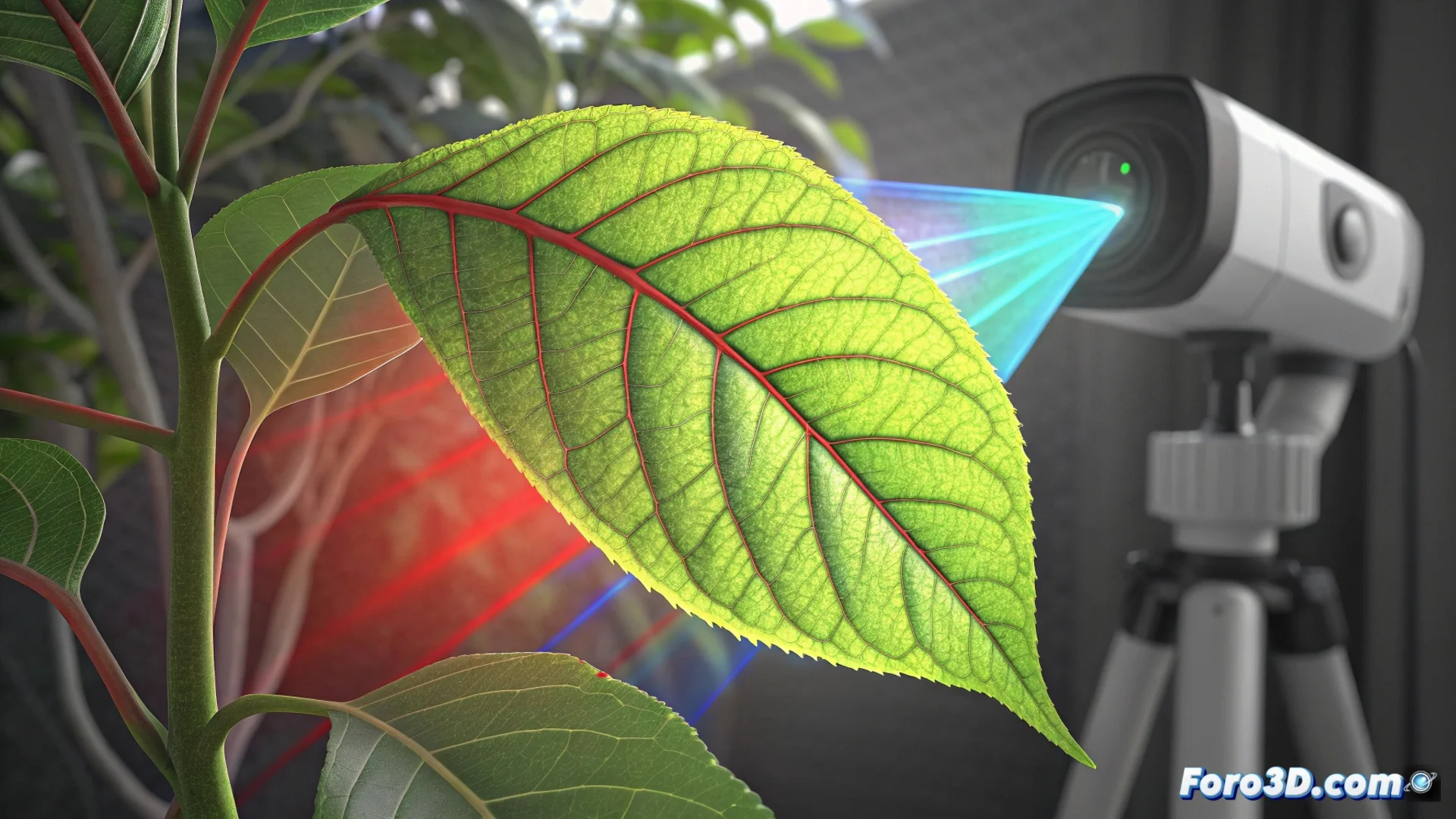
A technology allows seeing a leaf breathe to save water
Agriculture faces the challenge of using water more efficiently. A technological innovation fuses thermal imaging and gas analysis to observe, like never before, the vital processes of plants live. This advance helps optimize an increasingly scarce resource 🌱.
Fusing images and data to see plant life
The method is based on a device that integrates a thermal camera and a gas sensor. While the camera records the leaf's surface temperature—a key indicator of its water stress—the sensor analyzes gas exchanges with the atmosphere. By processing this data instantly, a visual representation is generated that shows the photosynthesis rate, giving the impression of seeing the plant breathe.
Key components of the system:- Thermal camera: Captures the leaf temperature to assess its water needs.
- Gas sensor: Measures CO2 and water vapor exchange to calculate photosynthesis and transpiration.
- Processing software: Combines both data streams to create a composite image in real time.
This technology offers a unique window into plant physiology, transforming complex data into an intuitive image.
From data to smart irrigation
The visual and numerical information is sent to a digital platform. Farmers access detailed maps of their fields that precisely indicate which areas require irrigation and to what extent. This approach avoids the common practice of uniformly irrigating the entire plot, resulting in substantial savings in water and the energy used to pump it.
Practical benefits in the field:- On-demand irrigation: Water is applied only where and when the plant needs it.
- Resource optimization: Water consumption and associated irrigation energy are reduced.
- Precise decision-making: Decisions are based on objective data from the crop's physiological state.
A tool for the agriculture of the future
This system positions itself as a powerful tool for precision agriculture. By allowing monitoring of plant health in a non-invasive and real-time manner, it not only saves water but also improves productivity and the overall health of crops. It represents a further step toward