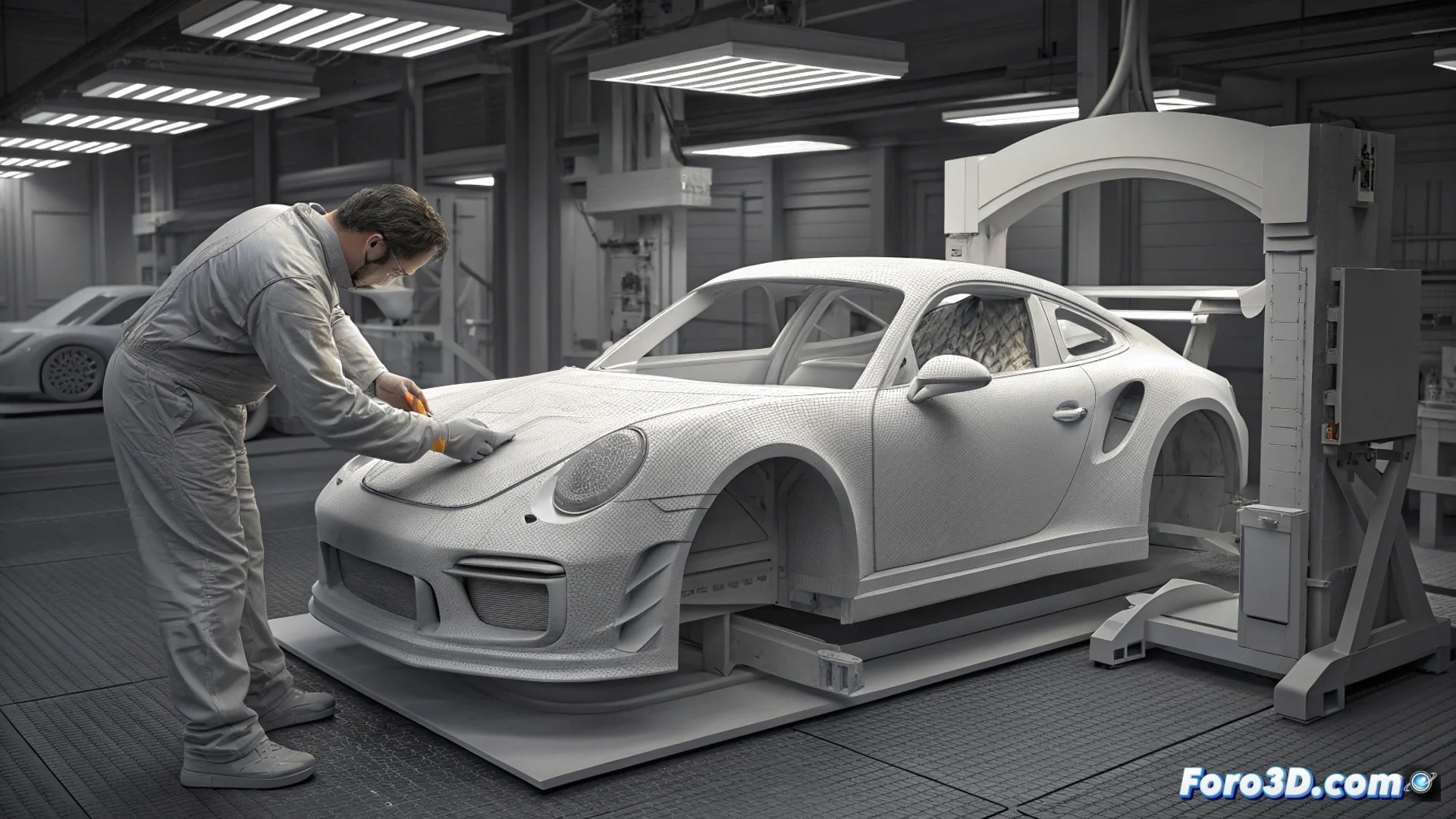
A Team Manufactures the Body of a Porsche 911 GT3 RS Using 3D Printing
A collective of enthusiasts and technicians in digital manufacturing has managed to build the entire external structure of a full-scale Porsche 911 GT3 RS using only 3D printing technology. This initiative underscores the enormous potential of additive methods for generating large-scale parts with intricate geometries. 🚗
Manufacturing and Assembly Method
To carry out this project, large-format 3D printers working with molten filament were used. The process required dividing each body panel into smaller segments to make them printable. Once all the parts were obtained, the team proceeded to join them, apply putty to match the joints and visible layers, and then sand the entire surface until achieving a uniform and smooth texture.
Key Phases of the Process:- Design and Segmentation: Digitally section large panels into printable parts.
- Component Printing: Manufacture each segment with large-volume filament 3D printers.
- Post-Production Finishing: Assemble, apply putty, and sand to achieve a perfect surface for painting.
This project explores the use of 3D printing for rapid prototyping, creating unique parts, or restoring vintage cars where original spare parts are no longer manufactured.
Applications and Future in the Automotive Sector
The purpose of this work is not to replace industrial mass production, but to pave the way for new applications. 3D printing allows on-demand manufacturing with a much lower initial investment than required for traditional injection molds or stamping.
Highlighted Areas of Application:- Rapid Prototyping: Evaluate body designs and shapes quickly and economically.
- Custom or Limited Parts: Create specific components that do not exist on the market.
- Restoration of Classics: Reproduce discontinued parts for historic vehicles.
Final Reflection on the Project
This achievement demonstrates that additive manufacturing can already tackle 1:1 scale challenges in the automotive world. The combination of patience, technical expertise, and this technology results in a viable alternative for niches where conventional manufacturing is not practical or is too costly. The final finish, with the paint and characteristic GT3 RS graphics, achieves an astonishing resemblance to the production vehicle. 🛠️