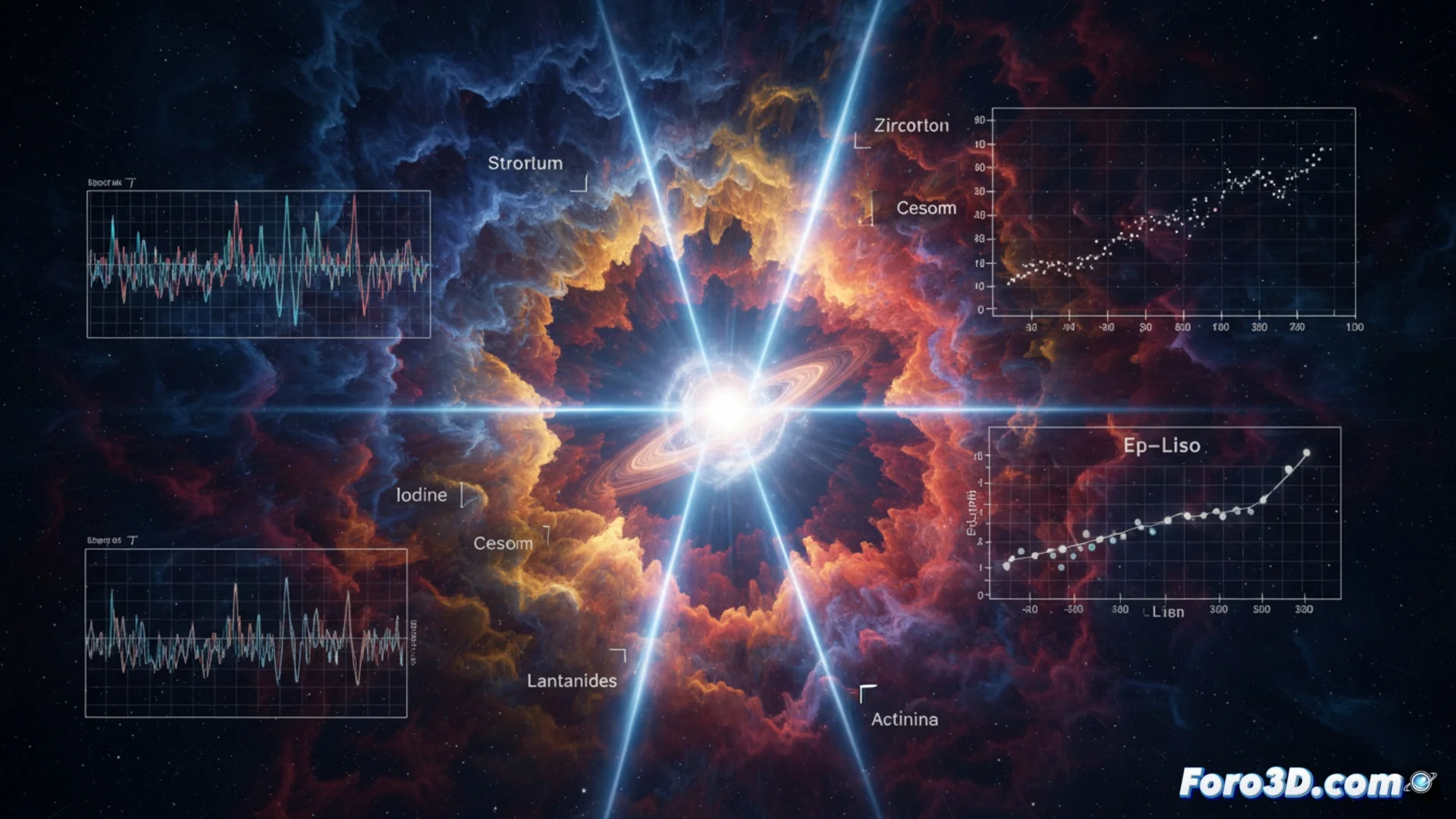
A study reveals a correlation in the spectral evolution of the kilonova AT2017gfo
Astronomers analyze the event AT2017gfo, a kilonova generated by the merger of two neutron stars. Its proximity and the spectra taken over time provide direct evidence of how heavy elements are formed through the r-process. This examination delivers essential data on the chemical composition and physical properties of the material ejected into space. A recent investigation identifies a new link between two key parameters: the peak energy of the spectrum (Ep) and the isotropic equivalent luminosity (Liso) 🔭.
The Ep-Liso relationship transforms over time
Up to about 2.5 days after the merger, the spectrum of this kilonova evolves following a linear relationship on a logarithmic scale connecting Ep and Liso. After that point, the behavior changes: Ep remains practically constant while Liso varies, stabilizing around the value of 1 eV. This two-phase pattern represents a crucial discovery for deciphering the internal physics of kilonovas.
Key findings from the observation:- The initial correlation is linear on a logarithmic scale.
- After ~2.5 days, the peak energy (Ep) becomes constant.
- The luminosity (Liso) continues to evolve independently in the second phase.
The universe may take eons to cook heavy elements and then eject them in a flash that scientists must decipher in a matter of days.
Numerical simulations confirm the pattern
By employing modern radiative transfer simulations, it is verified that the theoretical model of a kilonova naturally predicts this peculiar correlation. This indicates that the Ep-Liso link can serve as an innovative diagnostic tool to compare astronomical observations with model predictions. Future detections of similar events will allow for a deeper exploration of the physical mechanisms controlling this relationship 📊.
Implications of the theoretical model:- Predicts the observed two-phase correlation.
- Provides a new method to validate simulations with real data.
- Opens the door to a better understanding of the dynamics of the ejected material.
Future perspectives in astrophysics
This study not only deepens the understanding of nucleosynthesis in extreme environments but also establishes a framework for analyzing future kilonovas. The ability to directly compare observed spectral evolution with the results of complex numerical simulations marks a significant advance. Each new detected event will enrich our knowledge about the origin of the heaviest elements in the cosmos and the violent physics of compact star mergers 💫.