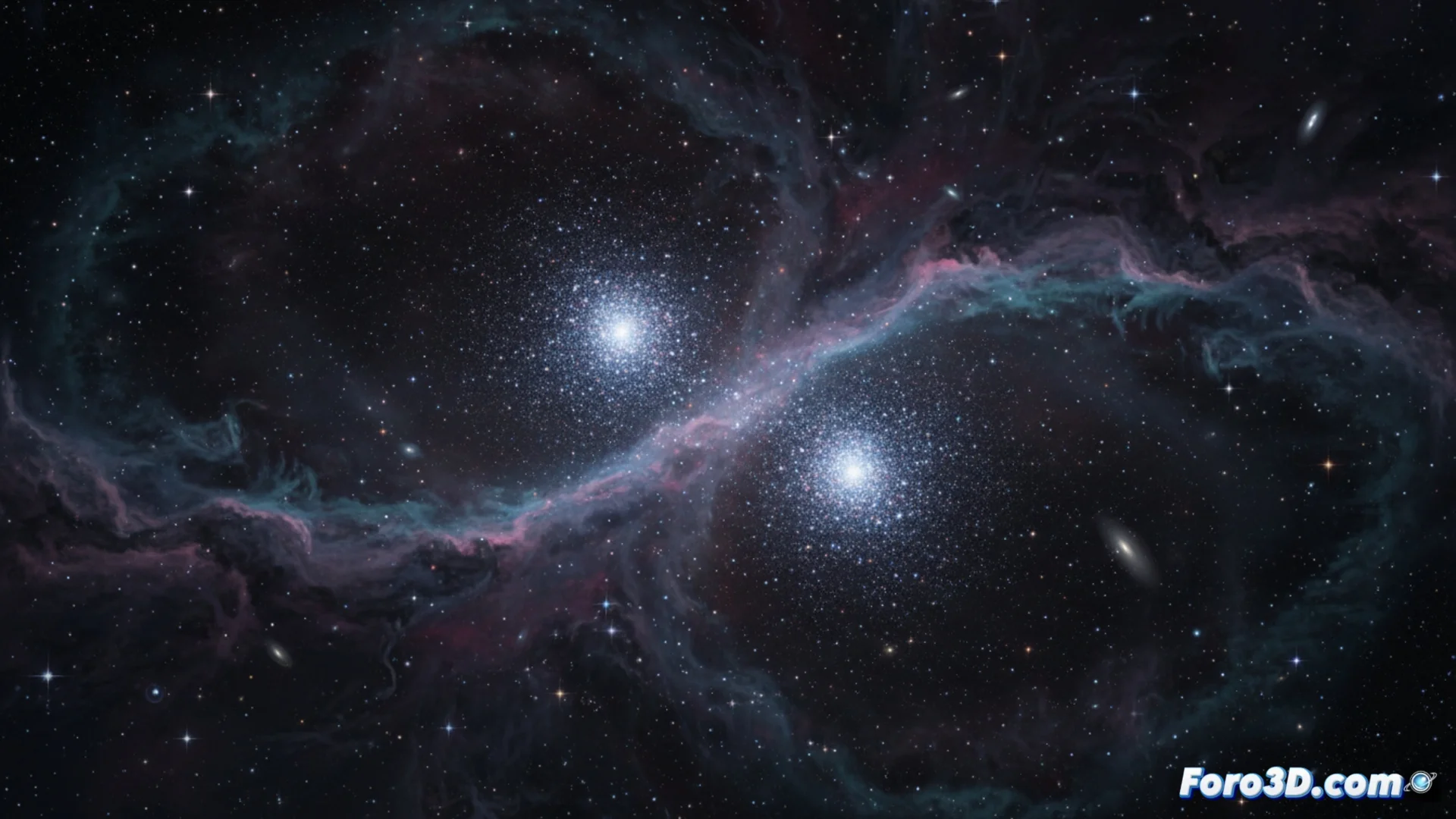
A study examines the shared origin of the NGC 869 and NGC 884 clusters
A detailed investigation focuses on the pair of binary open clusters NGC 869 and NGC 884, also known as the Double Cluster in Perseus. The work uses data from the Gaia mission to investigate their fundamental characteristics and evolutionary history. 🔭
Identifying stellar members with UPMASK
The first key step was to separate the stars that truly belong to each cluster from the galactic background. For this, the UPMASK algorithm was applied to Gaia's precise astrometric data. This process successfully isolated 808 probable stars in NGC 869 and 707 in NGC 884, creating a clean sample to analyze their structure.
Filtering results:- 808 members confirmed in NGC 869.
- 707 members identified in NGC 884.
- This isolation is vital for studying their properties without contamination.
The use of UPMASK allows purifying the sample and studying the system's evolution without the noise of background stars.
Determining parameters with a Bayesian approach
To calculate the astrophysical properties, the study used a Bayesian framework. It combined PARSEC isochrones with the MCMC technique to infer distance, age, and metallicity. The values obtained for both clusters are remarkably similar, pointing to the fact that they formed together. With no spectra available, the spectral energy distribution of the member stars was used to confirm this data. ⚖️
Main findings:- Distances, ages, and metallicities very similar.
- The congruence in parameters supports the idea of a common origin.
- The technique served to compensate for the lack of spectroscopic data.
Orbital dynamics and a future encounter
The analysis of kinematics and galactic orbits shows that both clusters share similar velocities and orbital trajectories. This reinforces the hypothesis that they were born in neighboring regions of the Milky Way. By projecting their movements into the future, the simulation predicts that they could interact dynamically in approximately 11 million years. This data offers valuable perspectives on how binary cluster systems evolve in the galaxy. 🌌
The research concludes that NGC 869 and NGC 884 not only share a past, but their paths could cross again, demonstrating that in the cosmos, even stellar neighbors can have close encounters. The study combines identified members, matching parameters, and convergent dynamics to paint a complete picture of this fascinating binary system.