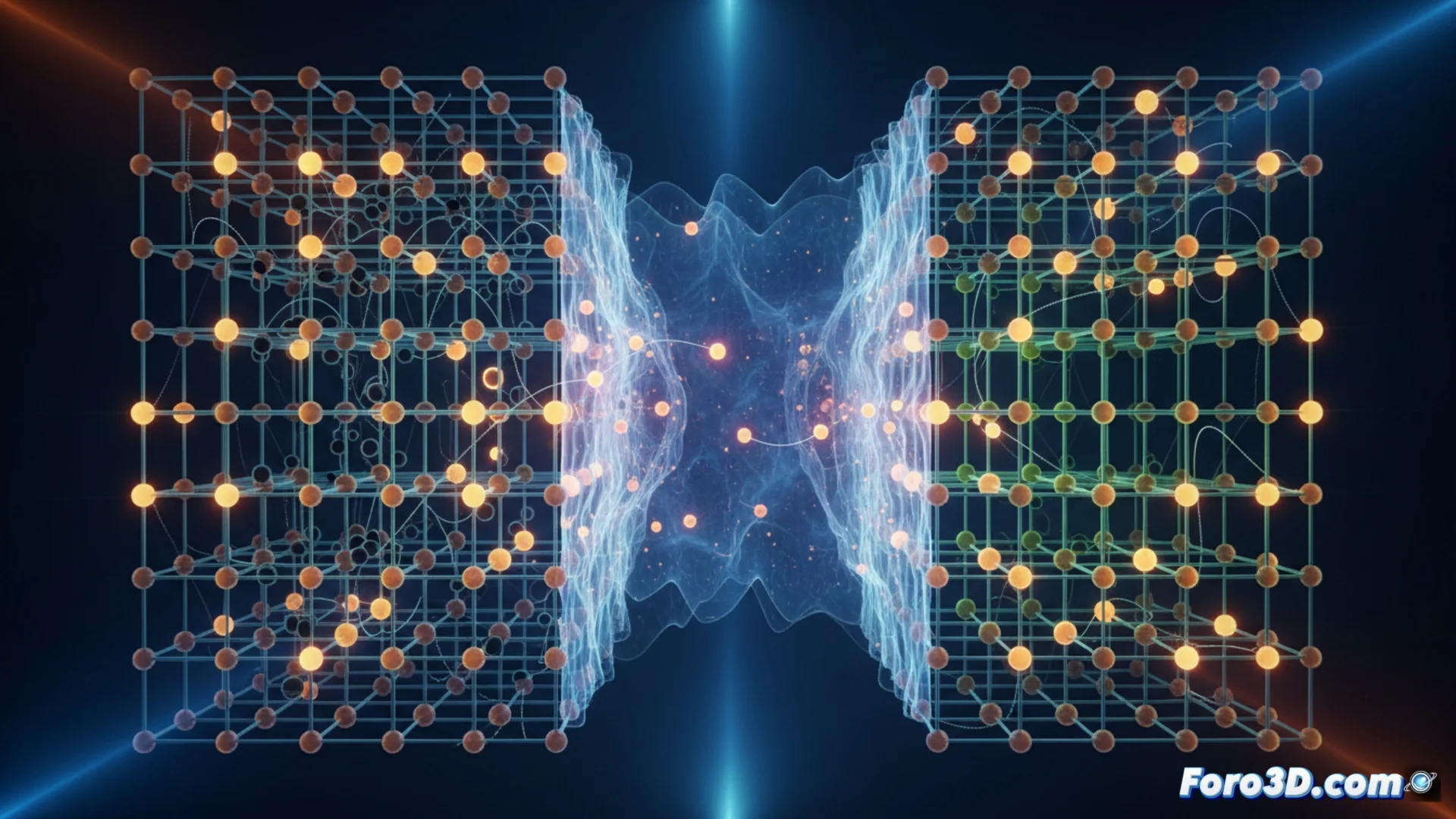
A Statistical Model Explains How Particles Transfer Between Solid Phases
The research delves into the mechanism by which particles of a solute move, thermally activated, between two interstitial solid solution phases. In this environment, rapid diffusion through lattices that preserve their sites allows each phase to achieve internal equilibrium effectively. 🔬
Fundamentals of Applied Statistical Mechanics
By modeling each phase as an ergodic ensemble of particles, the principles of statistical mechanics allow predicting how transition states are occupied at equilibrium. This occupation is not random; it depends directly on the magnitude of the barrier energy, the specific chemical potentials of each phase, and the proportion of vacancies available in each. This approach provides a solid foundation for understanding dynamics at the microscopic scale.
Key Elements Determining the Process:- Activation Energy: The height of the energy barrier that particles must overcome.
- Chemical Potentials: Measure of energy per particle in each phase, crucial for defining the flow direction.
- Vacancy Fraction: The availability of free sites in the crystalline lattice that allow movement.
The formulation of the rate law inherently satisfies the principle of detailed balance, a cornerstone of non-equilibrium thermodynamics.
A New Law for Transfer Rate
A rate law is introduced to describe the transfer when the system is not at equilibrium. This law is based on a constant transition probability between activated states. Unlike classical models such as Butler-Volmer, here the individual chemical potentials of the particles are incorporated explicitly into the equation, not just their net difference. This adds a fundamental layer of precision. ⚖️
Differences with Traditional Approaches:- Explicit inclusion of the individual chemical potentials of each phase.
- The transition probability is considered constant for activated states.
- Automatically complies with detailed balance under equilibrium conditions.
Implications for Composition and Observed Phenomena
This direct dependence on individual potentials and vacancy fractions implies that the density of the exchange flux is intrinsically linked to the equilibrium compositions of the phases. The model offers a robust explanation for experimental behaviors, such as the drastic slowdown when charging metallic hydrides near a phase transformation or a critical point in the miscibility gap. 🧪
Therefore, if a metallic hydride takes longer to charge than expected, it may not be due to an error or failure, but rather faithfully following the dictates of statistical thermodynamics. The model thus connects the macroscopic observation with the underlying microscopic mechanism, closing the gap between theory and practice in materials science.