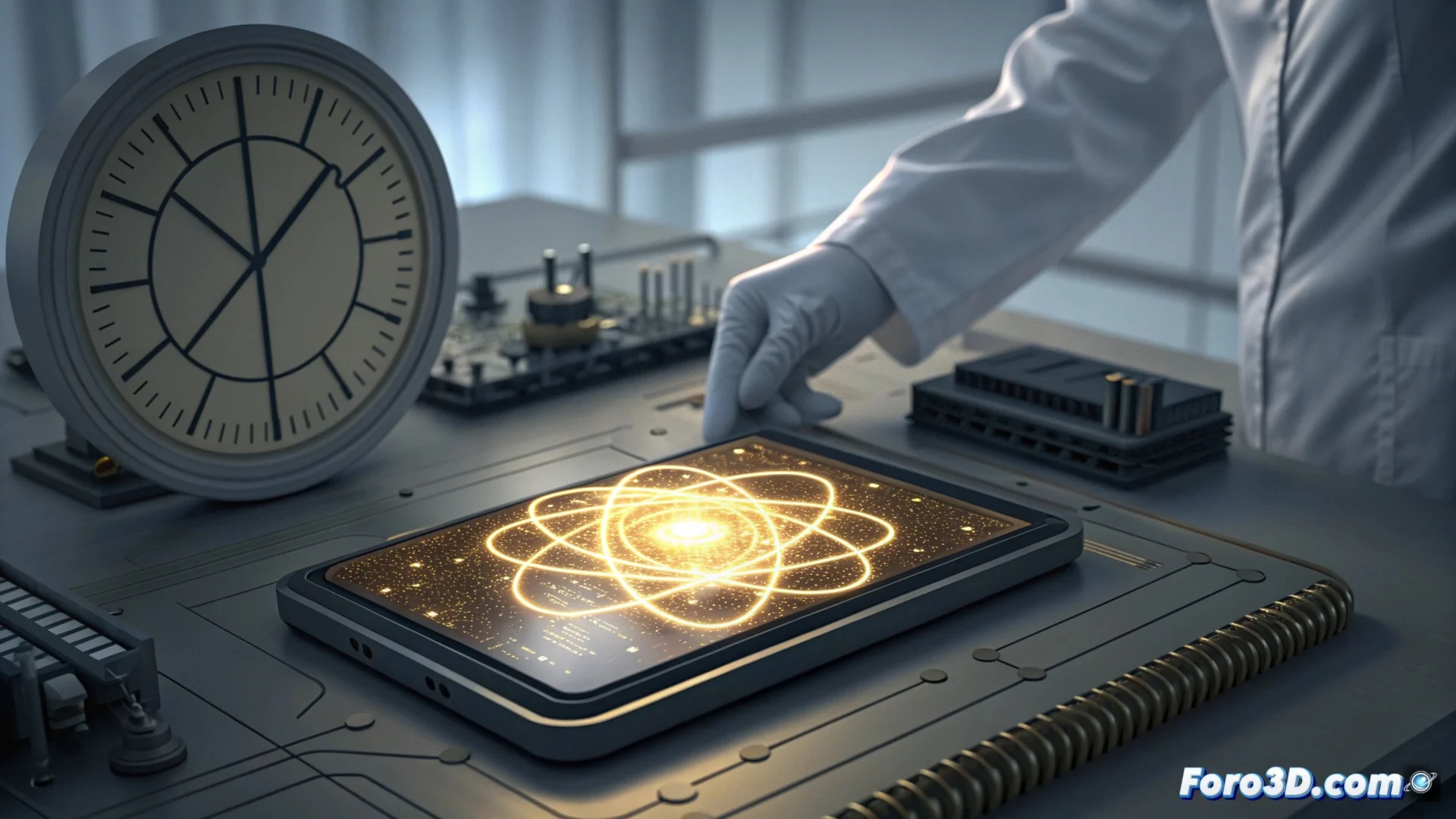
Silicon Atomic Clock for Mobiles Presented at IEEE IEDM
The race to create smaller and more accurate reference clocks has a new milestone. At the IEEE International Electron Devices Meeting (IEDM), researchers presented a silicon clock whose stability rivals that of bulky conventional atomic clocks. This advance is fundamental, as critical systems like GPS or communication networks depend on extreme temporal synchronization to function. ⚡
Technology that miniaturizes precision
Unlike laboratory atomic clocks, which use cesium atoms, this device employs a silicon resonator. The engineers optimized its architecture to vibrate at an ultra-stable frequency, drastically reducing its size and power consumption. This leap allows for its future integration into portable devices, something unthinkable with current technology.
Key features of the prototype:- Uses a silicon resonator instead of cesium or rubidium atoms.
- Achieves temporal stability close to atomic standards.
- Features a miniaturized format and very low power consumption.
This development brings atomic precision to consumer electronics, changing the paradigm of how we measure time in everyday devices.
Impact on devices and connectivity
Integrating this type of clock into a smartphone would transform several of its functions. Satellite navigation would be more precise by calculating the signal travel time more accurately. Additionally, 5G networks and future 6G could synchronize more efficiently, allowing data transfer with less latency and higher performance. 🔋
Potential benefits for the user:- More precise GPS in location and real-time navigation.
- Improved synchronization in mobile networks for calls and data.
- Greater autonomy by replacing less efficient quartz oscillators.
A future with atomic time in your pocket
This advance brings laboratory precision to daily consumer electronics. Although today we use phones for everyday tasks, having a timer of this quality inside would lay the foundation for applications yet unimagined, from a more robust Internet of Things to new ways of interacting with the environment. Time, measured at the atomic level, could soon be in our hands. ⌚