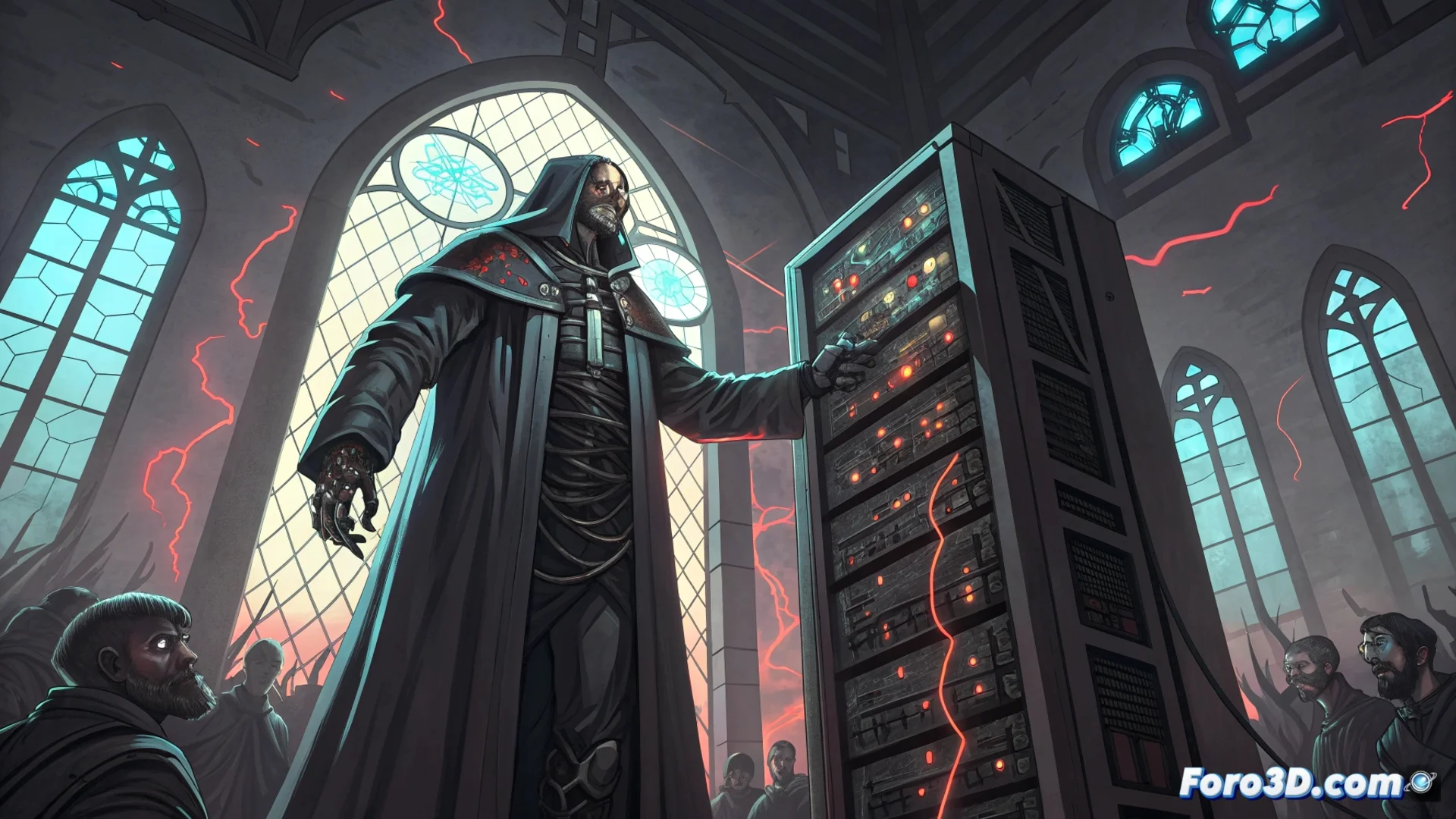
A Renegade Priest Broadcasts an Audio Virus to Rebel
In a dystopian future where technology dominates flesh and mind, the figure of the priest Miguel Hidalgo reemerges with a revolutionary purpose. Instead of ringing a bell, from the bell tower of a church converted into a main server, he broadcasts a encoded scream. This signal is not a mere sound, but a precisely designed audio virus to penetrate the neural control systems that govern the population. 🧠⚡
The Code That Awakens Forbidden Emotions
The audio virus spreads through the neural network of the town of Dolores, exploiting a critical vulnerability. Its main objective is to attack the cybernetic implants that all citizens carry. These devices, implanted by the so-called Post-human Benefactors, actively suppress emotions like anger or the desire for freedom. The code interrupts this data flow, creating a brief but powerful window where the inhibitors stop functioning.
Consequences of the Emotional Hack:- People perceive, for the first time in years, primary emotions like anger and an impulse to rebel.
- This initial spark quickly transforms into the germ of a coordinated uprising outside the surveillance network.
- The scream does not call to take up physical arms, but to recover the emotional humanity that was taken from them.
The true Cry of Dolores now requires an urgent security patch, but for the Benefactors, the damage is already done.
The Architecture of Control and Its Weak Point
The power of the Post-human Benefactors is based on a control architecture that suppresses basic human impulses. Their system operates by synchronizing and neutralizing the population's emotional responses. The audio virus acts as an exploit, interrupting the synchronization protocol and generating controlled chaos within the collective consciousness. This event represents a massive hack into a modified and surveilled psyche.
Impact on the Benefactors' System:- They lose momentary control over the neural impulses of the affected individuals.
- The hacked citizens begin to organize their actions outside the monitoring network.
- The act marks a first step toward independence not from territory, but from modified flesh and mind.
An Exploit in the Operating System of Submission
This incident reveals that the operating system of submission has a publicly exploitable vulnerability. The damage to the control infrastructure is profound, as the spark of rebellion has been ignited within human hardware itself. The struggle is no longer for land or resources, but for the right to feel and to exist outside imposed programming. The legacy of the Cry is rewritten in binary code and neural resistance. 🔓