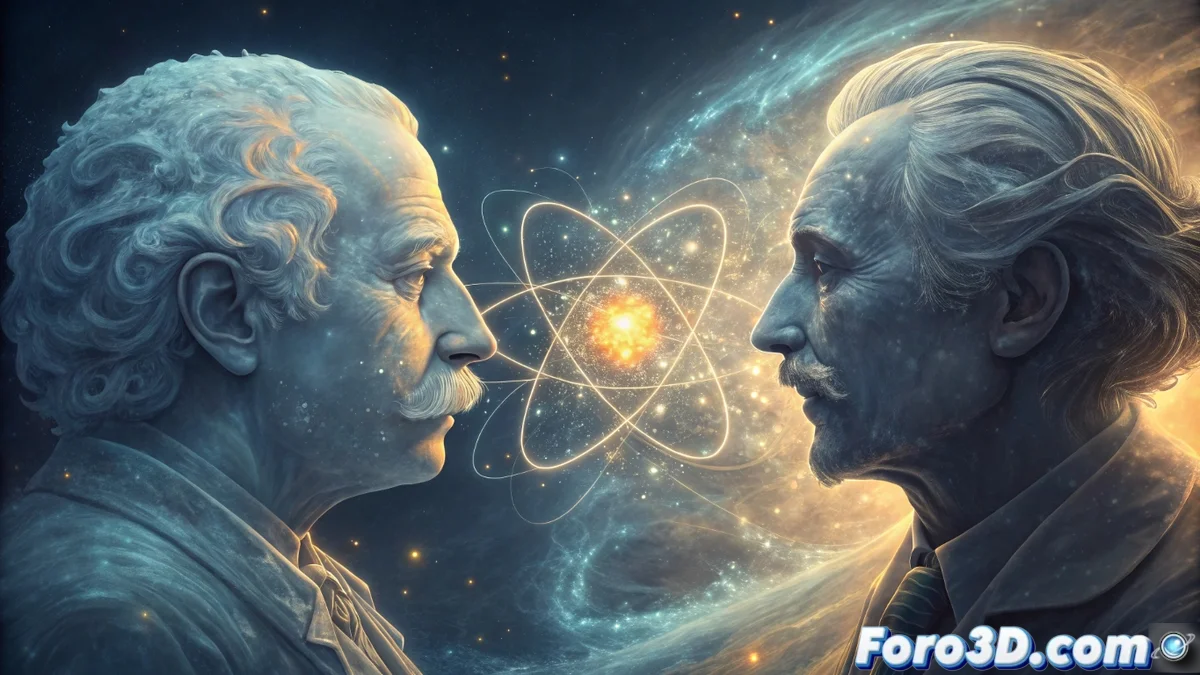
A Real Experiment Resolves Einstein and Bohr's Old Quantum Dispute
For much of the 20th century, two giants of physics, Albert Einstein and Niels Bohr, debated the nature of reality. Einstein believed in a local and realistic universe, where properties exist independently of being measured. Bohr, on the other hand, held that quantum mechanics was a complete description, where properties are defined upon measurement. This philosophical clash gave rise to the famous EPR thought experiment, which today can be tested in a laboratory.
Bell's Proposal Tests the Ideas
To settle the debate, physicist John Bell devised a practical test in the 1960s. His proposal was based on measuring entangled particles. If the universe followed Einstein's rules (with local hidden variables), the correlations between measurements would have a precise mathematical limit. Various research teams have managed to close the experimental "loopholes" that previously allowed classical explanations.
Key Results from the Experiments:- Photons and atoms were used to conduct the tests rigorously. 🔬
- The results systematically violate the Bell limit.
- This indicates that no local hidden variables determine the outcome.
"God does not play dice with the universe." – Albert Einstein, expressing his skepticism toward quantum indeterminism.
Consequences for Technology and Fundamental Physics
Confirming that nature is intrinsically non-local has profound and practical repercussions. This finding is not just theoretical; it lays concrete technological foundations.
Applications and Ramifications:- It enables the development of quantum cryptography, promising unbreakable secure communications. 🔐
- It advances the design of quantum networks and more powerful quantum computers.
- For physics, it reinforces the standard interpretation of quantum mechanics and discards theories attempting to restore classical realism.
A Universe Stranger Than Imagined
The quantum dice, against which Einstein argued, seem definitively loaded. 🎲 Quantum entanglement stands as a real and non-local phenomenon, demonstrating that the universe operates under rules that defy classical intuition. Although Einstein would probably still seek a deeper theory, current experiments paint a cosmos where instantaneous distant interconnection is a fundamental feature. The old dispute finds its verdict in the laboratory, opening new frontiers to understand and manipulate reality.