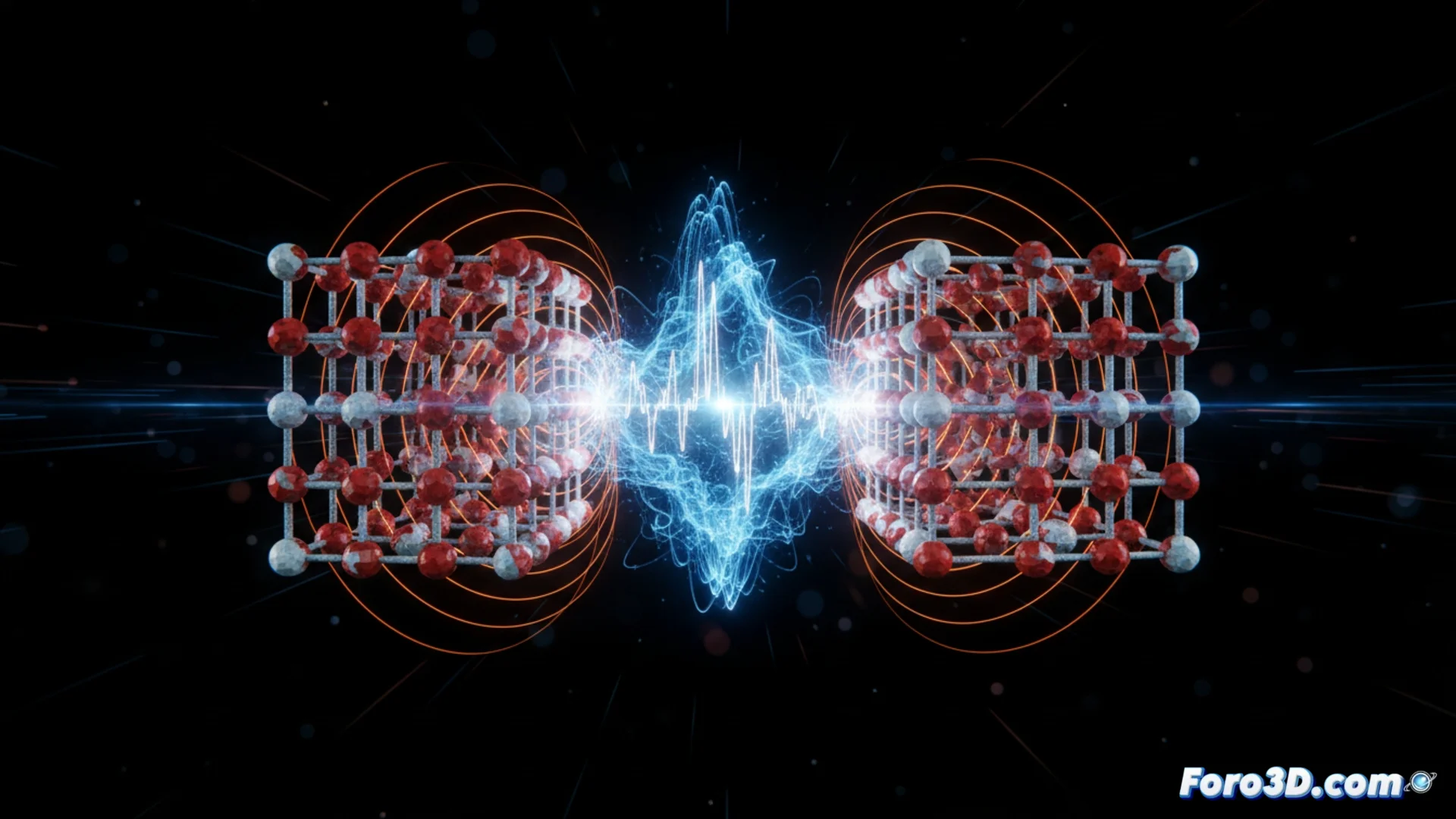
A quantum theory describes how a polaron forms in real time
Observing how a polaron is born in pump-probe experiments requires understanding processes far from equilibrium. This phenomenon arises from ultrafast dynamics where electrons and phonons interact, until a localized quasiparticle state emerges. 👨🔬
A model from first principles
We developed a quantum-kinetic theoretical framework starting from first principles. This model captures how the degrees of freedom of electrons and the atomic lattice evolve in real time when there is strong coupling between them. We implemented this framework to study a reference polar insulator: magnesium oxide (MgO).
Key achievements of the approach:- Determine the characteristic time scales that govern polaron localization.
- Identify the distinctive dynamic signature that this process leaves in measurements.
- Provide a solid basis for interpreting complex signals in ultrafast experiments.
Our results establish clear and experimentally accessible criteria for identifying when a polaron forms.
Implications for experimentation
The findings offer concrete experimental criteria to detect the precise instant when a polaron forms during pump-probe experiments. This is a fundamental tool for deciphering the intricate temporal signals obtained in the field of attosecond physics.
Highlighted practical aspects:- The criteria are clear and measurable, facilitating their application in laboratories.
- The theory helps interpret complex data more accurately.
- It addresses a process so fast that, fortunately, it doesn't take as long as some 3D renders. ⚡
A bridge between theory and observation
In summary, this work builds a direct bridge between microscopic theory and what can be measured. By applying the model to MgO, we not only explain how a polaron forms, but also define what to look for in experiments to confirm its presence and understand its temporal evolution.