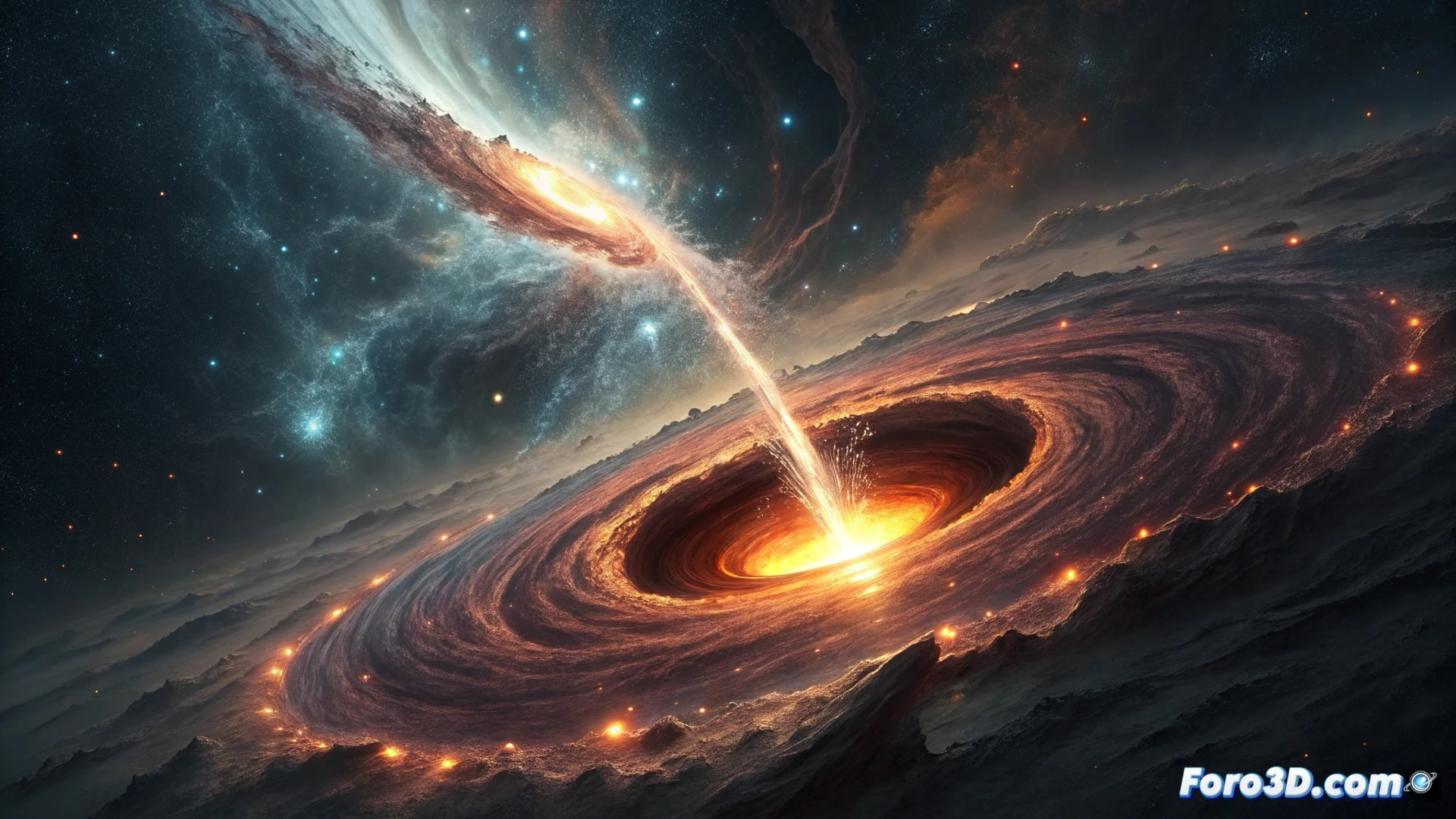
A Primordial Black Hole Challenges Cosmic Formation Models
Astronomy faces a cosmic-scale enigma. Researchers detected a supermassive black hole, designated J1120+0641, whose mass equals ten billion suns. The extraordinary thing is that this colossus already existed when the cosmos was just 770 million years old, a fact that strains to the maximum the explanations of how it could reach that size in such a short time. Its mere presence forces a rethinking of the models that describe how these gravitational monsters are born and grow in the beginnings of the universe. 🕳️⚡
A Problem of Scale and Time
Current cosmological theories propose that supermassive black holes grow mainly in two ways: by absorbing large amounts of interstellar gas or by merging with other black holes. However, the interval between the Big Bang and the era when we observe J1120+0641 seems too short for it to accumulate such a colossal mass through these conventional processes. This mismatch suggests an alternative and more exotic origin.
Possible Formation Mechanisms:- Direct Collapse of Primordial Clouds: It could have formed directly from the gravitational collapse of immense primordial gas clouds, without going through the star stage. This mechanism predicts the so-called direct collapse black holes.
- Hyperaccelerated Growth: Perhaps conditions existed in the early universe that allowed a much higher matter accretion rate than previously thought possible, a cosmic "superfood."
- Massive Initial Seeds: Instead of starting as stellar-mass black holes, the original "seeds" could have already been enormous, drastically shortening the time needed to grow.
Finding a black hole so massive so soon after the Big Bang is like finding a six-foot-tall child in a daycare. It simply shouldn't be there according to our current ideas.
Implications for Our View of the Infant Cosmos
Discovering an object like J1120+0641 is not just a record; it is a window. It implies that the processes that shaped the first cosmic structures were more efficient, faster, or diverse than our models simulated. The light from this black hole, which has traveled more than thirteen billion years to reach us, acts as a messenger from a remote era.
What This Finding Allows Us to Do:- Observe Primordial Conditions: Analyzing its light signature allows direct study of the state of the gas and physical conditions of the infant universe.
- Review Galactic Evolution: Its existence may force a rewrite of how the first galaxies and their active nuclei (AGN) evolved, as central supermassive black holes play a crucial role in galactic dynamics.
- Question the Cosmic Timeline: If gravitational giants were already formed when the universe was a "baby," what role did they play during the subsequent cosmic "adolescence"? Their influence on reionization and star formation may have been greater than estimated.
A Future of Observation and Theory
The ongoing analysis of J1120+0641 and the search for similar objects with next-generation telescopes, such as the James Webb, will be crucial. Each new data point could force adjustments or even reinvention of the initial chapters of cosmic history. This primordial black hole is not just a distant monster; it is a powerful reminder that the early universe still holds fundamental secrets to reveal. 🔭✨