A Powerful M5.1 Solar Flare Does Not Affect Earth
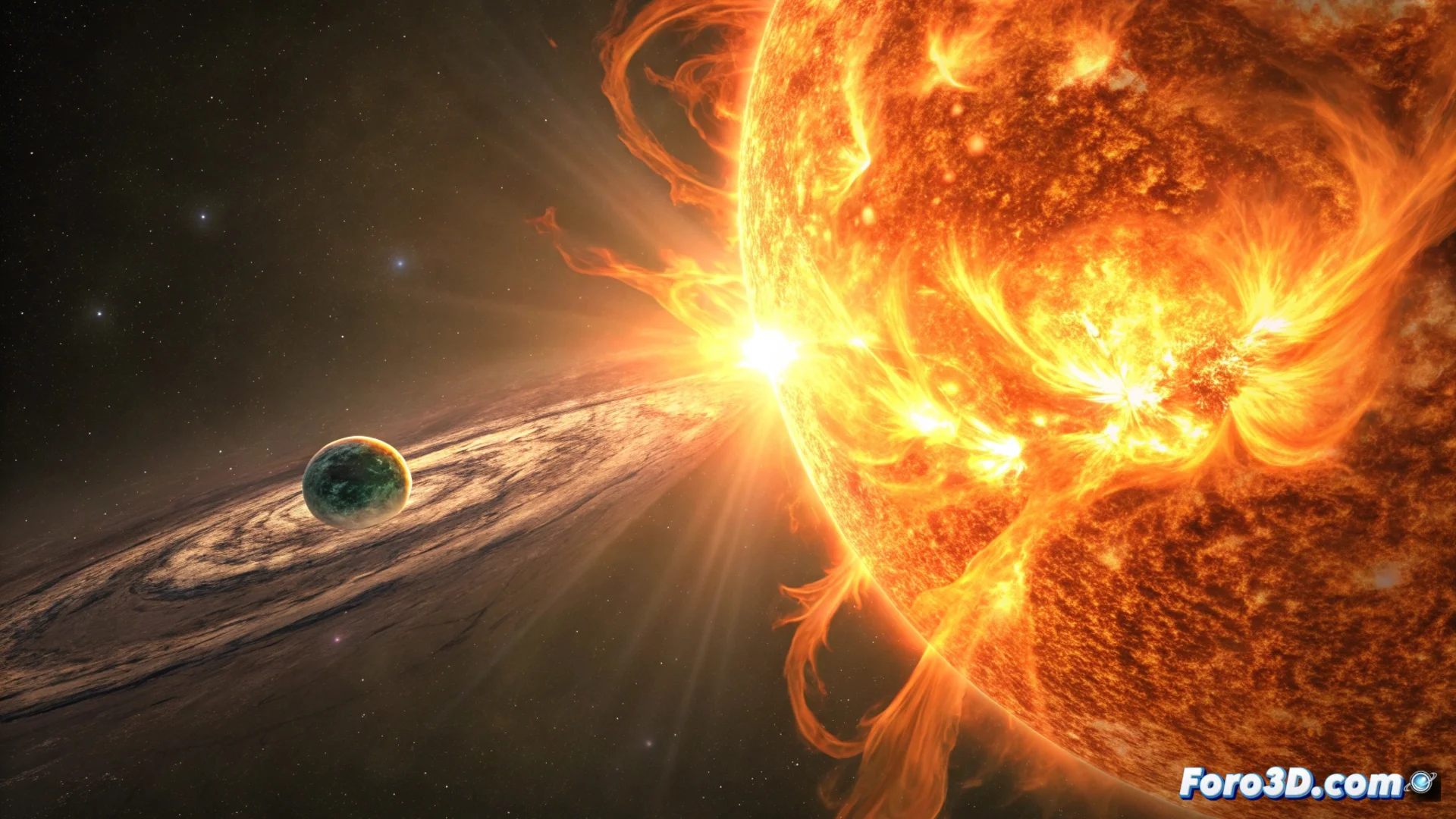
The Sun starred in a significant event on December 27, recording a solar flare classified as M5.1. This phenomenon represents the most powerful explosion observed since the beginning of the month, although its location on the star ensures that its effects do not reach our planet 🌞.
Position is Key to Assessing Impact
The solar flare originated on the eastern edge, or eastern limb, of the solar disk. This location is the determining factor, as when these explosions occur near the center of the Sun facing Earth, energetic particles and coronal mass ejections can travel directly toward us. In this case, most of the expelled material is launched into space in a direction that does not intercept Earth's orbit.
Data Confirmed by Satellites:- NASA and NOAA space observatories monitoring space weather confirmed the trajectory of the ejection.
- The coronal mass ejection (CME) associated with the M5.1 flare is moving away from the Earth-Sun line.
- No significant geomagnetic storm is expected in Earth's magnetosphere.
Not all solar explosions have consequences for Earth. Space weather largely depends on the star's orientation at the time of the event.
No Consequences for New Year's Auroras
This event completely rules out the possibility of intense northern lights or southern lights forming during New Year's celebrations as a direct effect of this flare. Although the Sun shows increasing activity as it approaches the maximum of its 11-year cycle, episodes like this are frequent and remind us of the directional nature of these phenomena.
Context of the Current Solar Cycle:- The Sun is in a phase of increasing activity heading toward its solar maximum.
- M-class events (like the M5.1) and X-class events are more common during this period.
- However, only eruptions pointing toward Earth can trigger visible auroras at polar latitudes and affect satellites.
A Reminder of Solar Dynamics
Thus, while our star launches one of its strongest flares of the month, on Earth we can perceive tranquility. This episode serves as a reminder that space weather is unpredictable and that geometry plays a fundamental role. We can enjoy the holidays without anticipating an unscheduled light show at the poles, at least on this occasion 🔭.