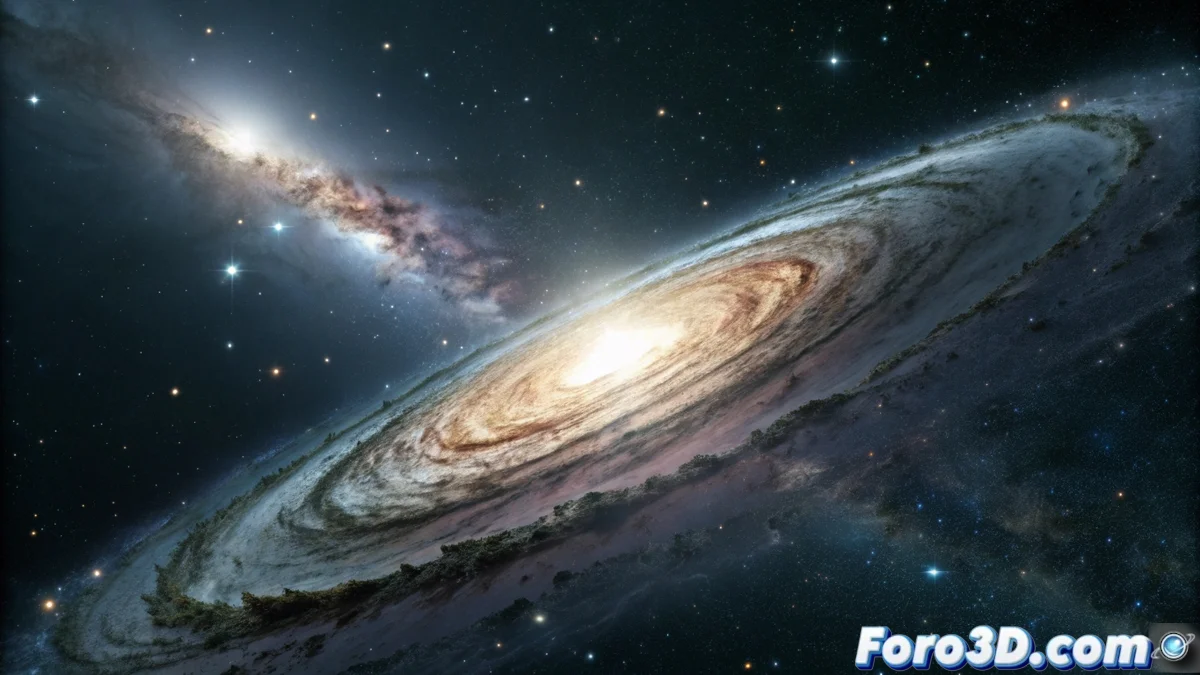
A Police Radar for the Universe Measures Cosmic Expansion
An international scientific team, led from the University of Tokyo and within the framework of the TDCOSMO project, has presented a revolutionary technique. This approach, metaphorically named cosmic police radar, aims to calibrate with unprecedented accuracy the speed at which the cosmos is expanding, a fundamental parameter in cosmology. 🚀
The Mechanism of Gravitational Lensing
The methodology is based on the phenomenon of strong gravitational lensing. Instead of measuring distances directly, it observes how light emitted by a distant quasar is curved and distorted when passing near a massive object, such as a galaxy. This distortion, which can create multiple images of the same quasar, acts as a natural measuring ruler. By precisely analyzing the time delay between the arrival of light from these images, astronomers can deduce cosmological distances in an independent and more robust way.
Key advantages over traditional methods:- Minimizes systematic errors by integrating data from multiple lens systems.
- Provides a direct measurement of distances, without the need for a complex cosmic "distance ladder."
- Offers an independent way to calculate the Hubble constant (H₀).
This cosmic radar could be the tool that resolves the tension in measurements of the universe's expansion.
Implications for Fundamental Physics
The main motivation of this research is to address the persistent Hubble tension, the discrepancy between H₀ values obtained from the early universe and local measurements. A more precise and reliable measurement could have profound consequences.
Possible scientific ramifications:- Confirm or rule out the need for new physics beyond the Standard Model of cosmology.
- Shed new light on the properties of dark energy that accelerates expansion.
- Refine our understanding of the distribution and nature of dark matter.
The Future of Observational Cosmology
If the promises of this technique materialize, cosmologists will have a galactic "traffic cop" to monitor expansion. Rather than issuing fines, this advance will accelerate our ability to test theories and unveil the deepest mysteries of the cosmos's structure and evolution. The universe may soon reveal its most intimate secrets. 🌌