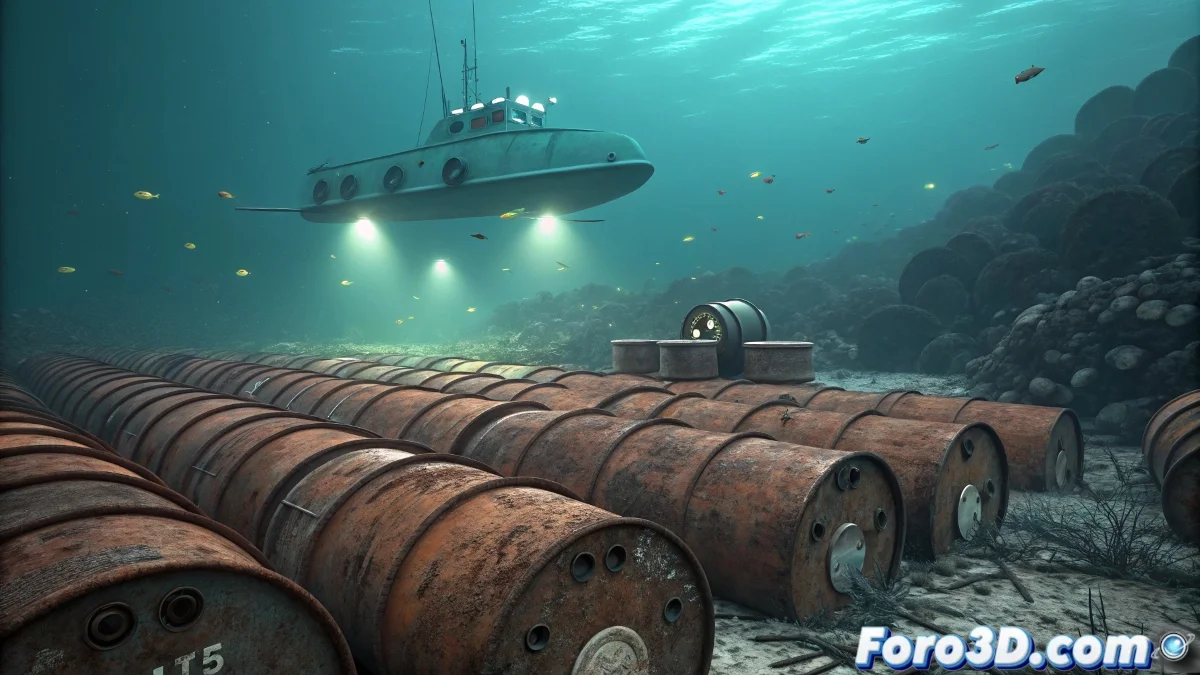
A Nuclear Cemetery 650 km from Galicia
Off the coasts of Galicia, in the middle of the Atlantic and at more than 3,000 meters deep, lies a rather uncomfortable problem: more than 200,000 barrels containing nuclear waste that have been down there for decades. These drums were dumped between 1946 and 1990, in an era when nuclear waste management was… let's say… less delicate than it is now.
The NODSSUM Mission is Searching for the Invisible
To locate these barrels, the French oceanographic vessel L’Atalante has begun a mission that seems straight out of a simulation project in Blender or even an underwater scene made in Houdini. In its first days of work, they have already managed to locate 1,000 of these drums. A small number if we think that they are searching for more than 200,000. The project, named NODSSUM-I, will last approximately one month.
James Cameron-Style Exploration Technology
The team uses a 4.5-meter autonomous submarine called Uly X, equipped with cameras and sensors that allow mapping the seabed and taking photographs of the barrels. All this strongly resembles a mix of 3D modeling and VFX work, but here the render is in real time… and under 5,000 meters of water. For the next phase, NODSSUM-II, they plan to use ROVs like the Victor or even the minisubmarine Nautile, which seems taken from a Subnautica DLC.
Encapsulated Barrels and Low Radioactivity (or so they say)
The drums contain low- and medium-activity waste, sludge, contaminated metals, and even office remains. The American Nuclear Society assures that many of these materials were encapsulated in cement or bitumen to withstand the pressure. To date, much of the radioactivity should already have decreased… although of course, long-lived isotopes that could still be active remain. As they say: the radioactivity shader doesn't have such quick keyframes for turning off.
Assessing the Impact: Silent Contamination?
In addition to locating the drums, the team is collecting samples of water, sediments, and marine life. The goal is to study whether local ecosystems are showing traces of radioactive isotopes. They also want to understand how these elements are transported by currents and sediments, in a kind of particle simulation… but in an oceanic version and without an undo button.
A Slow Render Full of Uncertainties
The search for these barrels has barely begun. If this were an animation, we're still in the blocking stage. There's still much to discover and quite a bit to clean up… if they ever decide to do it. Meanwhile, the barrels remain down there, like forgotten props in the viewport of European nuclear history 🌊.