A new theoretical model explains how observers agree on physical reality
A team of physicists has devised a theoretical framework that clarifies why individuals acting independently tend to agree when measuring the properties of the material world. This approach seeks to resolve a fundamental paradox in quantum theory, where the mere act of observing appears to alter the state of the observed. The proposal suggests that observers establish agreement on what is real by interacting with each other and their surroundings, a mechanism that consolidates the facts they perceive. 🔬
The observer paradox at the quantum scale
In the realm of the very small, particles can exist in a superposition of states until the moment someone measures them. This raises a profound question: how is it that different people, using different instruments, describe the same result when performing an experiment? If reality seems to depend on who looks at it, how does an objective and common world emerge for everyone? The new model attempts to harmonize the intrinsically probabilistic nature of the quantum realm with our daily experience of a single, unchanging reality.
Key points of the dilemma:- Particles do not have a defined state until they are measured.
- Measurement appears to "collapse" the possibilities into a single result.
- The apparent lack of an objective fact before measurement challenges intuition.
Does reality exist independently, or do we create it by looking at it? The new framework suggests it is a process of constant negotiation.
Agreement arises from interaction
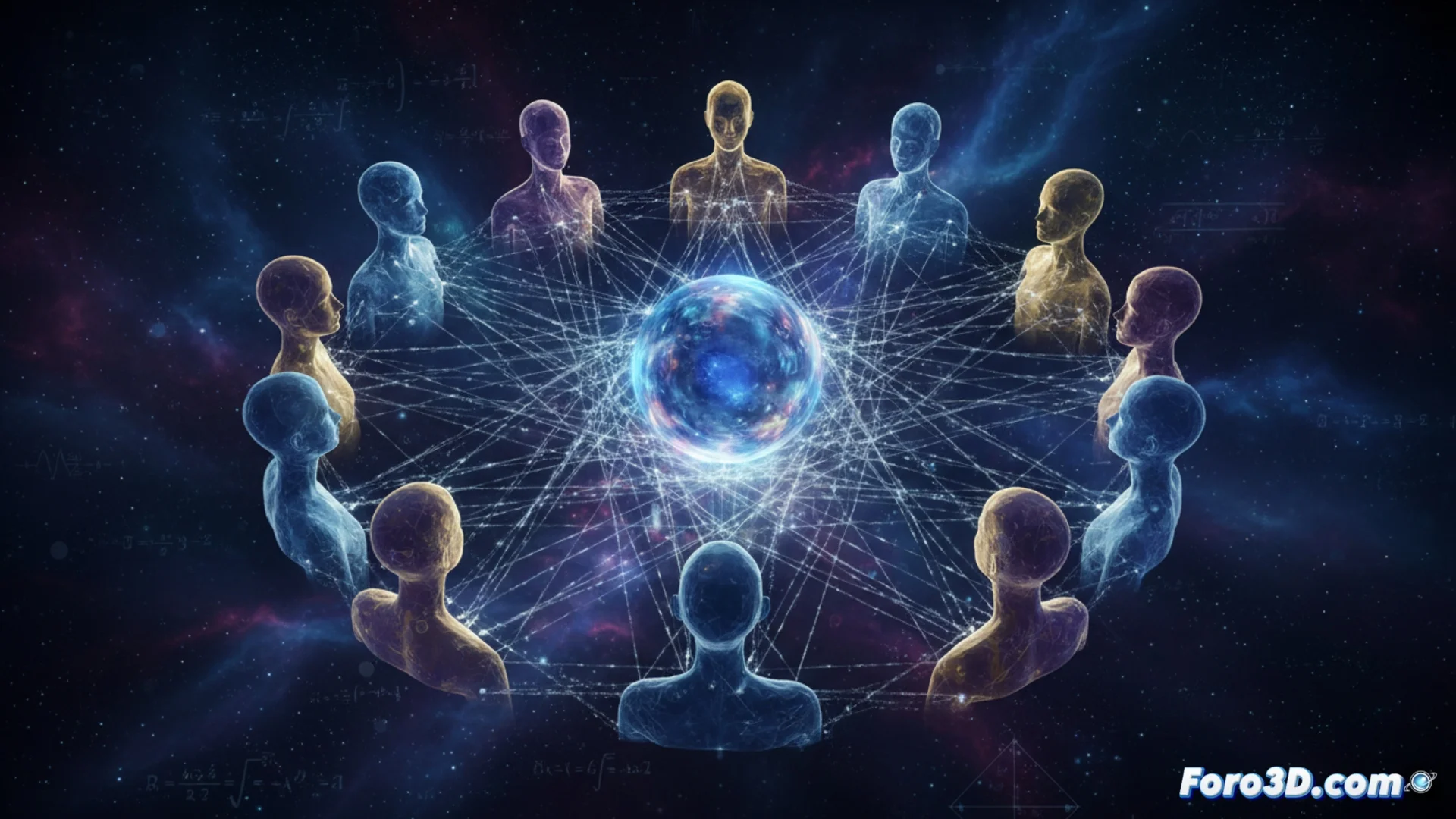
The core of the idea posits that observers are not isolated islands. When measuring a system, they also connect indirectly with other observers through the shared environment. These connections intertwine their viewpoints and, after numerous measurements, their descriptions of the system tend to converge on a single result. The mathematical formalism demonstrates how this quantum consensus process emerges naturally, without requiring special rules beyond the known physical laws. 🤝
Mechanisms driving consensus:- Indirect interaction between observers through the environment (such as air, light, or instruments).
- Entanglement of the information each one obtains.
- Progressive convergence after multiple cycles of measurement and interaction.
Implications beyond the laboratory
So, if at some point you argue about the shade of a color or what you heard someone say, think that, in essence, you might be waging a quantum battle to establish an agreed fact. At least now there is a theory proposing that, with enough exchange of information, you are likely to eventually reach a common understanding. This model not only illuminates the foundations of physics but also offers a powerful metaphor for how we construct shared reality in our social life. 🌍