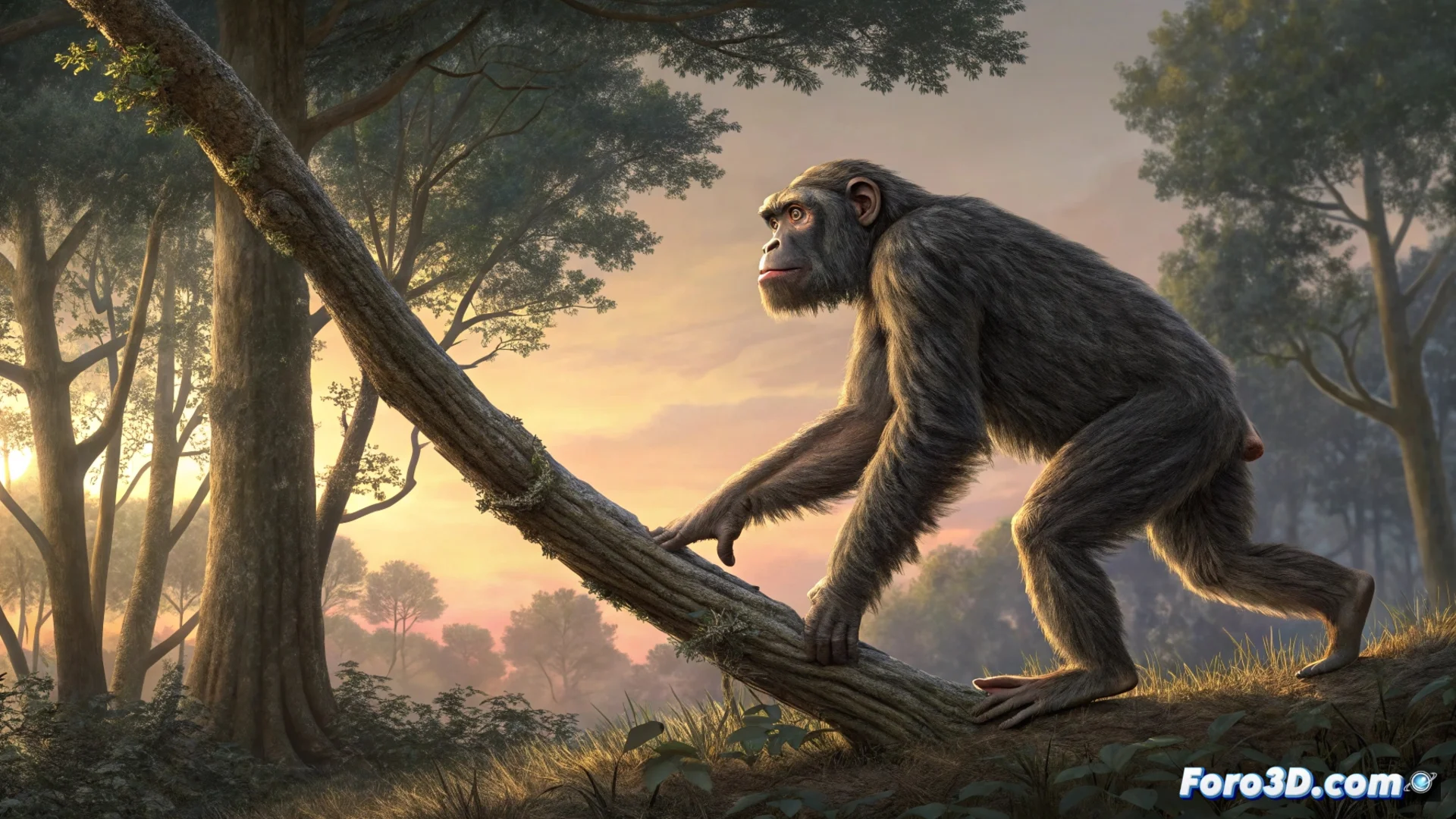
A New Study Questions How the Oldest Human Ancestor Walked
A recent analysis of the hand bones of a key fossil, Ardipithecus ramidus, suggests that this early human ancestor may have walked upright on the ground. This finding challenges previous ideas that suggested it moved by knuckle-walking, like modern apes, and reignites the discussion on how and when bipedalism emerged in our lineage 🦴.
The Internal Architecture of Bones Speaks
The researchers didn't just look at the external shape. They used micro-computed tomography to scan the bones of the fossil nicknamed Ardi. This technique allows viewing the density and orientation of the internal spongy bone tissue. The patterns they discovered resemble those of upright-walking primates, like humans and bonobos, and differ from the typical patterns of knuckle-walking apes, like chimpanzees and gorillas. The internal bone structure records the habitual forces it endured during life.
Key Findings from the Internal Analysis:- The bone stress patterns in Ardi's hand do not match those of an animal that walks on its knuckles.
- The orientation of the spongy tissue suggests that forces were distributed in a way compatible with an upright posture.
- This method offers a direct view of how the bone adapted to daily mechanical loads.
The internal architecture of the bone is a record of the forces it endured. In Ardi, this record tells a different story from that of knuckle-walking apes.
A Debate That Remains Unresolved
This study does not settle the issue. Some experts point out that the external shape of Ardi's bones still shows clear adaptations for climbing, indicating it probably spent a lot of time in trees. The discussion now focuses on interpreting whether the internal evidence is conclusive for claiming fully bipedal walking on the ground or if it reflects an upright posture used mainly when moving between branches.
Controversial Points on Ardi's Locomotion:- The external morphology of its hands suggests great ability for gripping branches.
- It is unclear whether bipedalism was its main mode of movement on the ground or just one of its capabilities.
- The study provides a new type of data, but the puzzle of human evolution remains complex.
Rewriting the First Steps
This finding adds a novel piece to the debate on the origin of our characteristic posture. It seems that, even after millions of years, determining whether an ancestor walked with style or dragged its knuckles generates as much discussion as the most technical topics. The study demonstrates that combining analysis of the external shape with the internal structure is crucial for understanding the behavior of extinct species and rewriting the history of our first steps 🚶♂️➡️🧍.