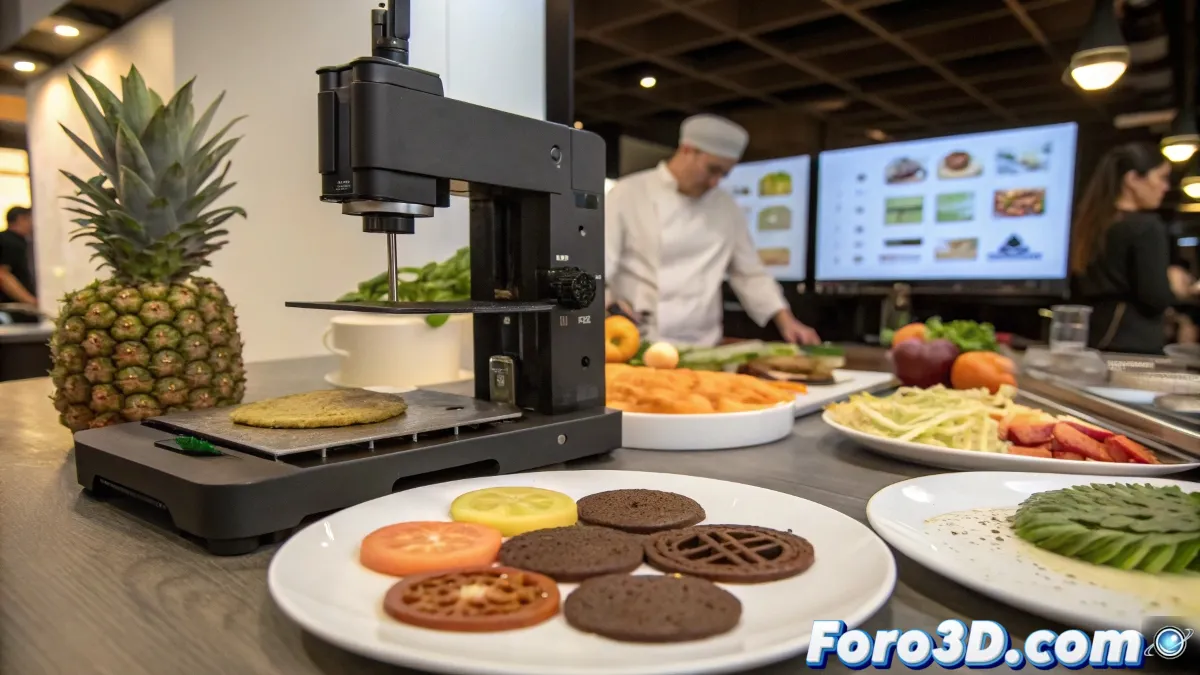
3D Printing Transforms the Kitchen and the Way We Eat
3D printing technology has arrived in the kitchen, and not just to create decorative objects or utensils, but to revolutionize the way foods are prepared and presented. A group of researchers has developed a technique that allows printing foods in 3D with customized textures and shapes, using natural ingredients without the need for artificial additives. This advance is not only a technological achievement but also an opportunity to explore new forms of nutrition and feeding.
A Technology that Redefines the Kitchen
The key to this innovation lies in manipulating the physical properties of foods, such as their viscosity and elasticity, to create complex structures that would be impossible to achieve with traditional methods. Using specialized 3D printers, researchers can design dishes with innovative shapes and unique textures, opening up a range of possibilities for chefs and consumers. Additionally, this method allows precise control over portions and nutrients, which could be especially useful in specific diets or for feeding people with special needs.
Benefits that Go Beyond the Visual
One of the most interesting aspects of this technology is its potential to reduce food waste. By using only the necessary amount of each ingredient and optimizing its placement, waste is minimized. Additionally, 3D food printing could facilitate the creation of personalized meals, tailored to each person's tastes and nutritional needs. This not only improves the gastronomic experience but also promotes more conscious and sustainable eating.
"3D food printing is not just a technological novelty, but a tool that could transform the food industry."
Challenges and Future of 3D Printing in Gastronomy
Despite its advantages, 3D food printing still faces some challenges. One of the main ones is the limitation in the variety of ingredients that can be processed by current printers. However, researchers are working to expand this range, exploring how different foods can adapt to this technology. Another challenge is printing time, which currently can be longer than traditional preparation methods. Nevertheless, it is expected that, with technological advances, these obstacles will be overcome in the near future.
A Revolution that is Just Beginning
3D food printing is not just a technological curiosity, but a tool with the potential to transform the food industry. From high-end restaurants to catering services and clinical nutrition, the applications are vast and promising. This technology not only allows creating visually impressive dishes but also addresses global problems like food waste and malnutrition. Undoubtedly, we are at the beginning of a new era in which technology and gastronomy unite to offer innovative and delicious solutions.
- Personalization: Meals adapted to tastes and nutritional needs.
- Sustainability: Reduction of food waste.
- Innovation: Creation of textures and shapes impossible with traditional methods.
In summary, 3D food printing is not only changing the way we cook but also how we think about eating. It is a technology that promises a more sustainable, personalized, and creative future in the kitchen.