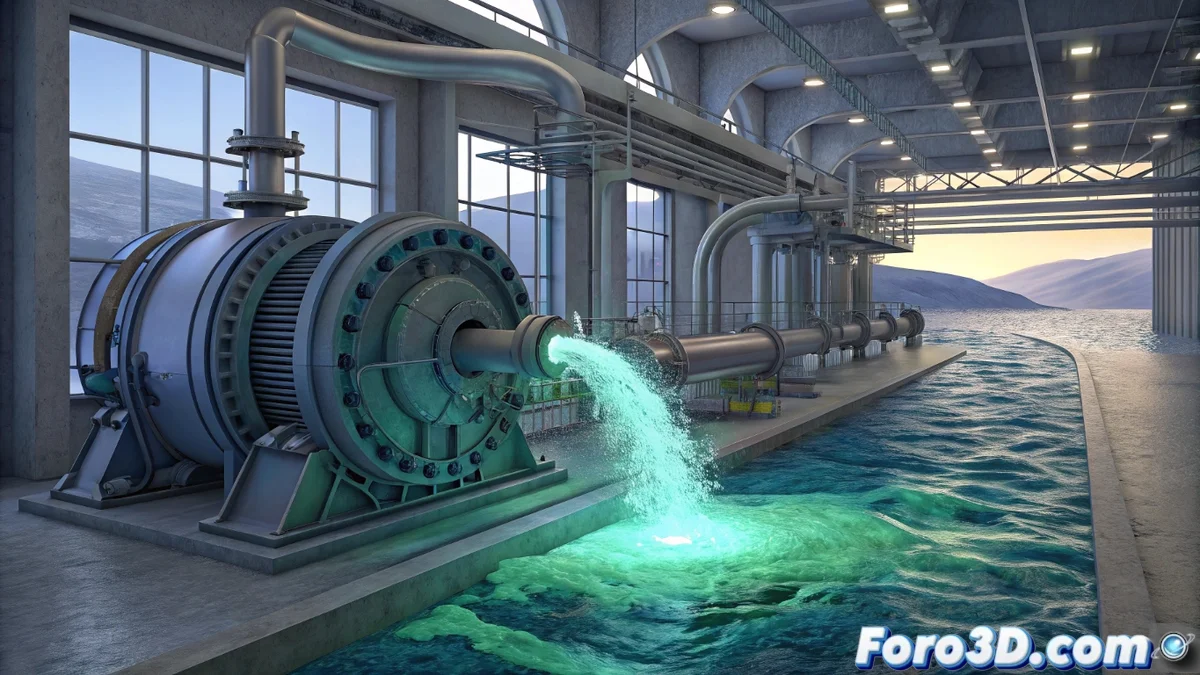
A New Approach to Generating Renewable Energy from the Salinity Gradient
In the race to find clean and constant energy sources, attention turns to fundamental physical phenomena. Beyond the sun and wind, the salt concentration difference between seawater and river water hides enormous energy potential. The technology known as Pressure Retarded Osmosis (PRO) is responsible for capturing this energy, offering a fascinating perspective for emission-free electricity generation. 🌊⚡
The Physical Principle Behind the Magic
The natural process of osmosis is the starting point. When two solutions with different salinity concentrations are separated by a semipermeable membrane (which only allows water to pass), the solvent (fresh water) flows spontaneously toward the more concentrated solution (salt water). PRO technology does not fight against this force but channels and controls it. By applying an external pressure lower than the natural osmotic pressure on the salt water side, the flow is slowed down. The water that manages to pass through the membrane arrives with elevated pressure, sufficient to be directed to a turbine connected to a generator, thus transforming chemical energy into electricity.
Key Components of the PRO System:- Advanced semipermeable membrane: The most critical element, designed to be water-selective, reject salt ions, and withstand extreme pressures.
- Dual feed system: Requires a constant source of fresh water (e.g., a river) and another of salt water (the sea), typically in an estuary.
- Turbine and generator: Convert the pressure energy of the water flow into mechanical energy and, subsequently, into usable electrical energy.
PRO represents an elegant way to extract useful work from a natural process that would otherwise simply equalize concentrations.
Promises and Obstacles on the Path
The main advantage of this technology is its ability to function as renewable base-load energy. Unlike solar or wind, it does not depend on variable weather conditions; it can produce electricity continuously, 24 hours a day, as long as the salinity gradient exists. Its direct environmental impact is low, and its infrastructure can be integrated into coastal areas with a reduced visual footprint. However, the path to large-scale commercialization is fraught with considerable technical challenges.
Main Challenges for PRO Viability:- Membrane durability: Biological fouling (biofouling) and particle accumulation quickly clog pores, drastically reducing efficiency and lifespan.
- Material costs: Manufacturing robust, high-performance membranes at a competitive price remains a major economic barrier.
- Water pretreatment: The need to filter and clean incoming water to protect delicate membranes adds operational complexity and additional costs to the system.
The Future of Blue Energy
Although it sounds like the ideal solution for populated coastal regions, the current reality is that PRO technology is still in an intensive development and research phase. Achieving a membrane that survives years, not just months, in the relentless marine environment is a materials engineering challenge comparable to the most complex ones. The promise of clean and constant energy from the mixing of rivers and seas is powerful, but it demonstrates that even the most ingenious solutions must learn to coexist with the obstacles that nature inevitably presents at micro and macro scales. The potential is there, waiting for innovation in materials to overcome the final hurdles. 🔬🌍