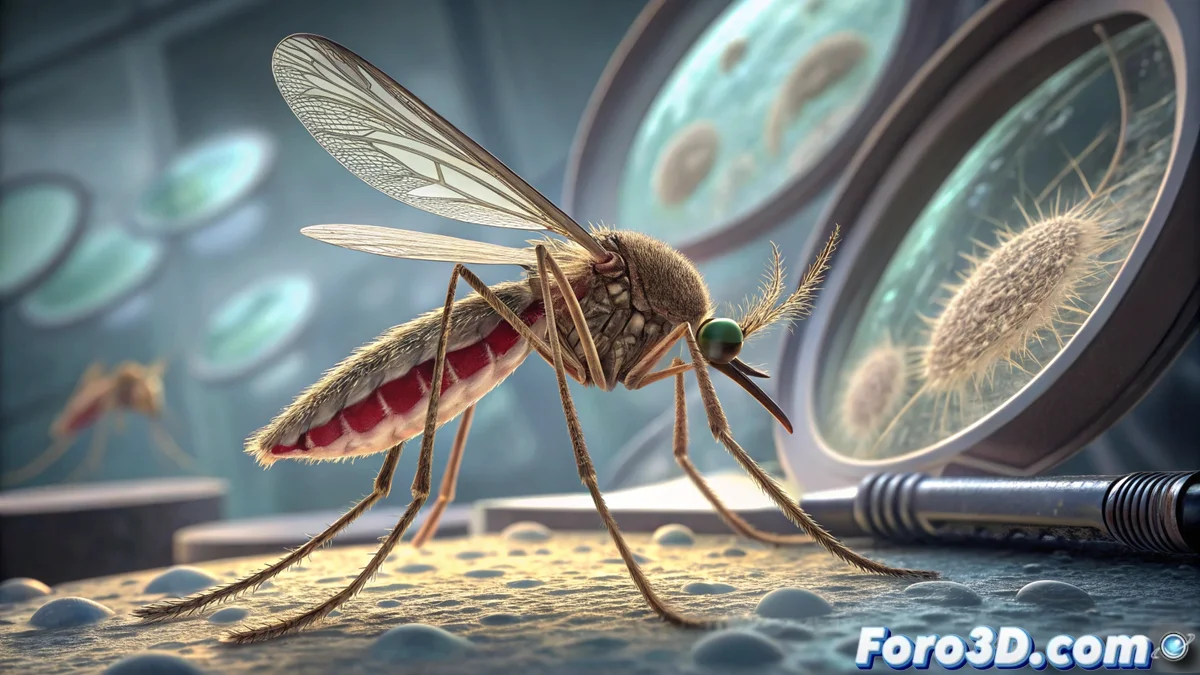
A laboratory study successfully tests a gene drive against malaria
A large-scale experiment with Anopheles gambiae mosquitoes confirms the potential of a radical strategy to control malaria. Scientists use a gene drive to spread a gene that prevents the malaria parasite from developing inside the insect. This approach seeks to modify wild populations so they lose their ability to transmit the disease, a paradigm shift from current methods. 🧬
The mechanism that challenges the laws of inheritance
The gene drive system is designed to bypass standard Mendelian inheritance rules. While a normal gene has only a 50% chance of passing to offspring, this technology uses the CRISPR editing tool to cut and copy its DNA sequence onto the homologous chromosome. This ensures that nearly all progeny inherit the modification, allowing the anti-malarial trait to spread rapidly in a population.
Key features of the gene drive:- Overcomes traditional Mendelian inheritance, ensuring transmission above 50%.
- Uses the CRISPR system to precisely and self-propagatingly edit the genome.
- Designed to spread a gene that blocks the development of the Plasmodium parasite in the mosquito.
To eliminate a global health problem, we must first successfully protect and spread the mosquitoes themselves, but only a modified version of them.
Results in simulated environments: total population suppression
In the trial, researchers introduced mosquitoes carrying the gene drive into cages with established populations of normal mosquitoes. The edited gene spread effectively, completely suppressing the target population in just a few generations, as the system also compromises female fertility. This step is crucial, as it validates viability in a controlled environment that mimics more realistic conditions than previous small-scale studies.
Highlights of the cage experiment:- The modified gene successfully spread in an established population in a confined environment.
- Total mosquito population suppression was achieved in a short number of generations.
- The system affects female fertility, contributing to vector population control.
A promising future for genetic control of vectors
This study marks a milestone by demonstrating that it is possible to alter entire vector populations through genetic engineering. The success of the gene drive in a complex laboratory setting brings this technology closer to potential field applications. It represents a powerful and specific strategy to combat malaria, a disease that affects millions of people worldwide. The path ahead still requires rigorous evaluation of safety and ecological impact before any environmental release. 🦟➡️🧬