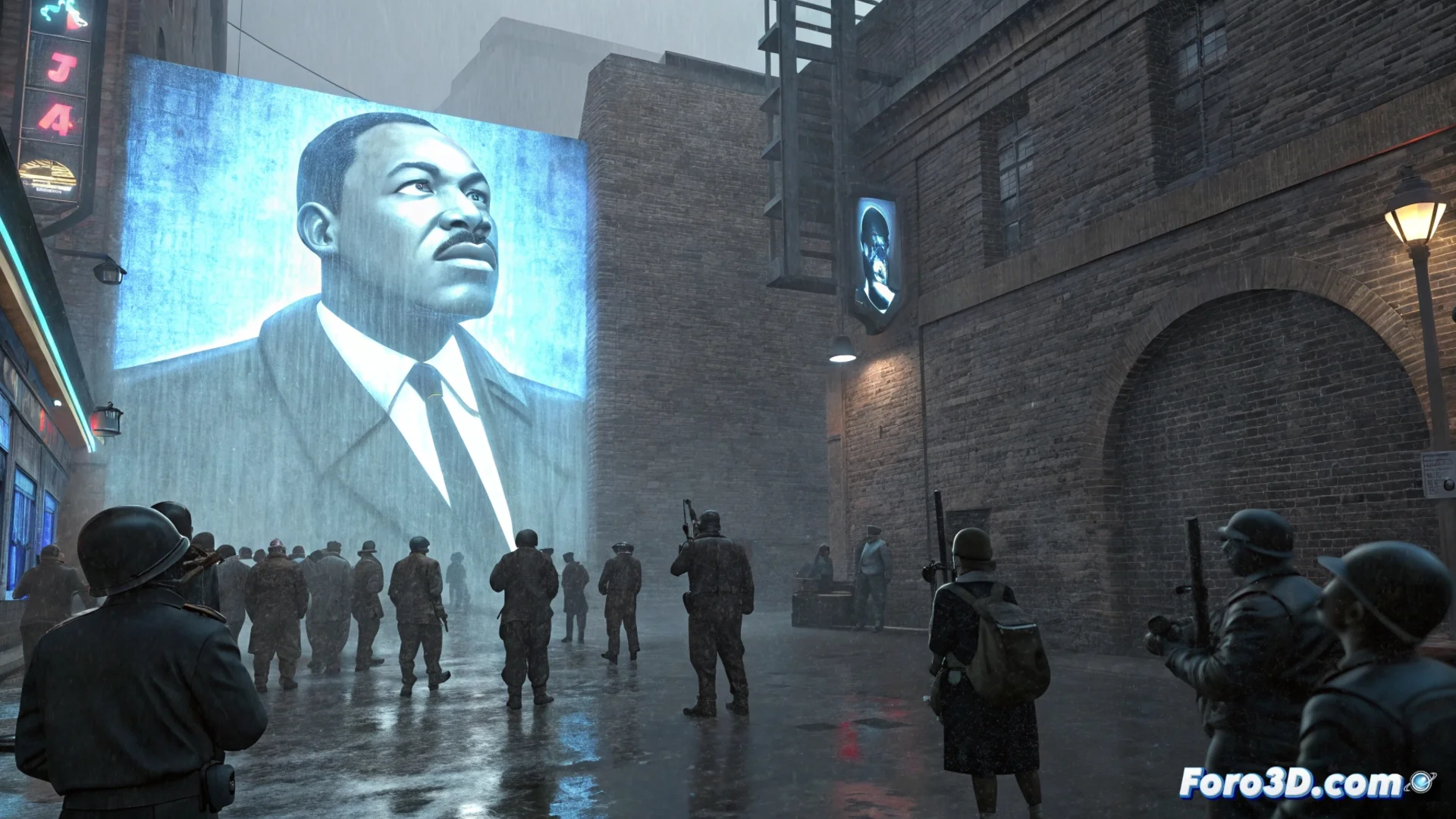
A Hologram of Martin Luther King Jr. Delivers a Dystopian Speech
The action takes place in the historic sector Anacostia-Beta. On a ruined wall, an unauthorized holographic projection of Martin Luther King Jr. comes to life. His figure flickers erratically and his voice breaks, affected by the signal inhibitors deployed by the authorities. The message he emits is radically transformed. 🎭
The Context of Control and Technological Distortion
This event occurs in an area where narrating the past is a regulated and commercialized activity. The official jammers or blockers attempt to suppress the transmission, generating digital artifacts in the audio and image. This act of protest uses a historical icon as a vehicle to spread a new idea. The archive to which the hologram refers represents a truth that the system cannot fully appropriate and that is distributed clandestinely.
Key Elements of the Scene:- Symbolic Location: Anacostia-Beta, a district under strict narrative surveillance.
- Interference: Signal inhibitors deliberately fragment the projection and sound.
- Vector of Resistance: The image of a historical figure is used to evade censorship and connect with the public.
"I have no dream... because dreams are now intellectual property of DreamCorp."
Interpretation of the Corrupted Message
The statement "I have no dream" completely subverts the original symbol. By rejecting the concept of the dream, it exposes a future where even the most basic aspiration has a corporate owner. By offering a damaged archive, it implies that collective memory is corrupted, but still retains value and can be transmitted. The act of uploading this file to the network turns every witness into part of a chain of distribution of prohibited information.
Meanings of the Altered Narrative:- Criticism of Property: It satirizes the extreme commercialization of ideas and hopes.
- Memory as Archive: Collective memories are treated as data that can be corrupted, but also copied and shared.
- Collective Action: The public stops being a passive spectator to become an active node in a counter-information network.
Final Reflection on the Narrative
In this fictional scenario, dreaming requires a license and distributing memories is equated to committing cognitive piracy. The visual piece explores how technology can serve both to control the historical narrative and to crack it, using distortion itself as a form of art and protest. The hologram, though damaged, fulfills a powerful function: planting an archive of doubt and alternative memory in the minds of those who observe it. 💾