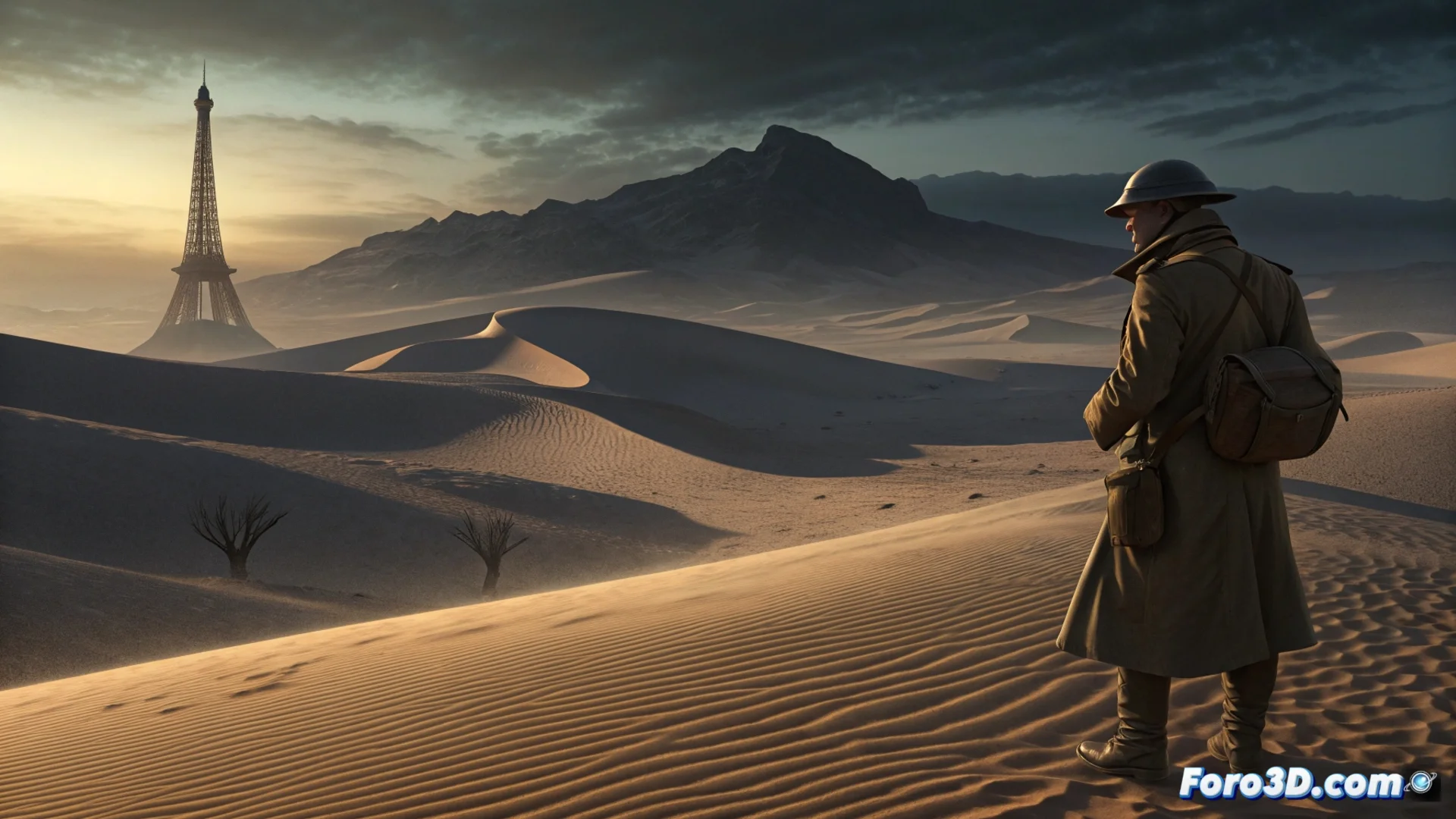
A French Corporal Describes a Giant Meteorite in the Sahara in 1916
The story begins during World War I, when Corporal Gaston Ripert returns from a mission in the Algerian Sahara. He brings with him an astonishing account: a local guide showed him a mass of pure iron larger than a house emerging from the sand. This object, according to his description, measured about 40 meters and weighed 100 tons. For Ripert, it could only be a colossal meteorite. However, when presenting his report, the military authorities showed skepticism. The lack of precise coordinates and physical proof condemned his story to become a desert legend 🏜️.
A Fruitless Search That Lasted Decades
For over a hundred years, the supposed giant meteorite became a Holy Grail for geologists and meteorite hunters. Numerous expeditions scoured the vast Adrar region in Algeria without finding the slightest trace of the described colossus. The impossibility of verifying the corporal's unique testimony led the scientific community to officially dismiss the case. Ripert stuck to his version until his death, taking the exact location secret with him. Thus, the enigma persisted, fueling debates and speculations.
Key Points of the Mystery:- Unique Testimony: Only Corporal Ripert claimed to have seen the object, with no other witnesses to corroborate it.
- Lack of Physical Evidence: No samples were recovered, nor was the location documented with reliable methods.
- Exhaustive Searches: The area was repeatedly scanned with modern technology without any success.
"Sometimes, looking for a needle in a haystack seems simple compared to searching for a mountain of iron in an ocean of sand."
A New Theory Rethinks the Enigma
Recently, German twin brothers Carl and Franz Angst, meteorite experts, proposed an innovative solution. After investigating historical archives and local oral traditions, they suggest that Ripert did not find a monolith, but a strewn field of smaller meteorites. Their hypothesis points to the fragments belonging to the Chinguetti meteorite, of which only a few pieces were recovered in the early 20th century.
Elements of the New Hypothesis:- Reinterpretation of the Find: Several large pieces grouped together could have been perceived as a single huge mass.
- Environmental Factors: Desert optical conditions and mirage effects could have magnified the perceived size.
- Historical Context: The narrative was influenced by the astonishment of the moment and the lack of reference points.
A Mystery That Transforms Perception
The Angst brothers' proposal does not deny Ripert's honesty, but reinterprets what he might have seen. It offers a plausible explanation that reconciles the historical account with the absence of evidence for a single object. This case illustrates how a persistent testimony can hide a different truth and how science advances by reevaluating past enigmas with new perspectives. The search for the giant meteorite may have ended, but its legend continues to teach about the limits of observation and evidence 🔍.