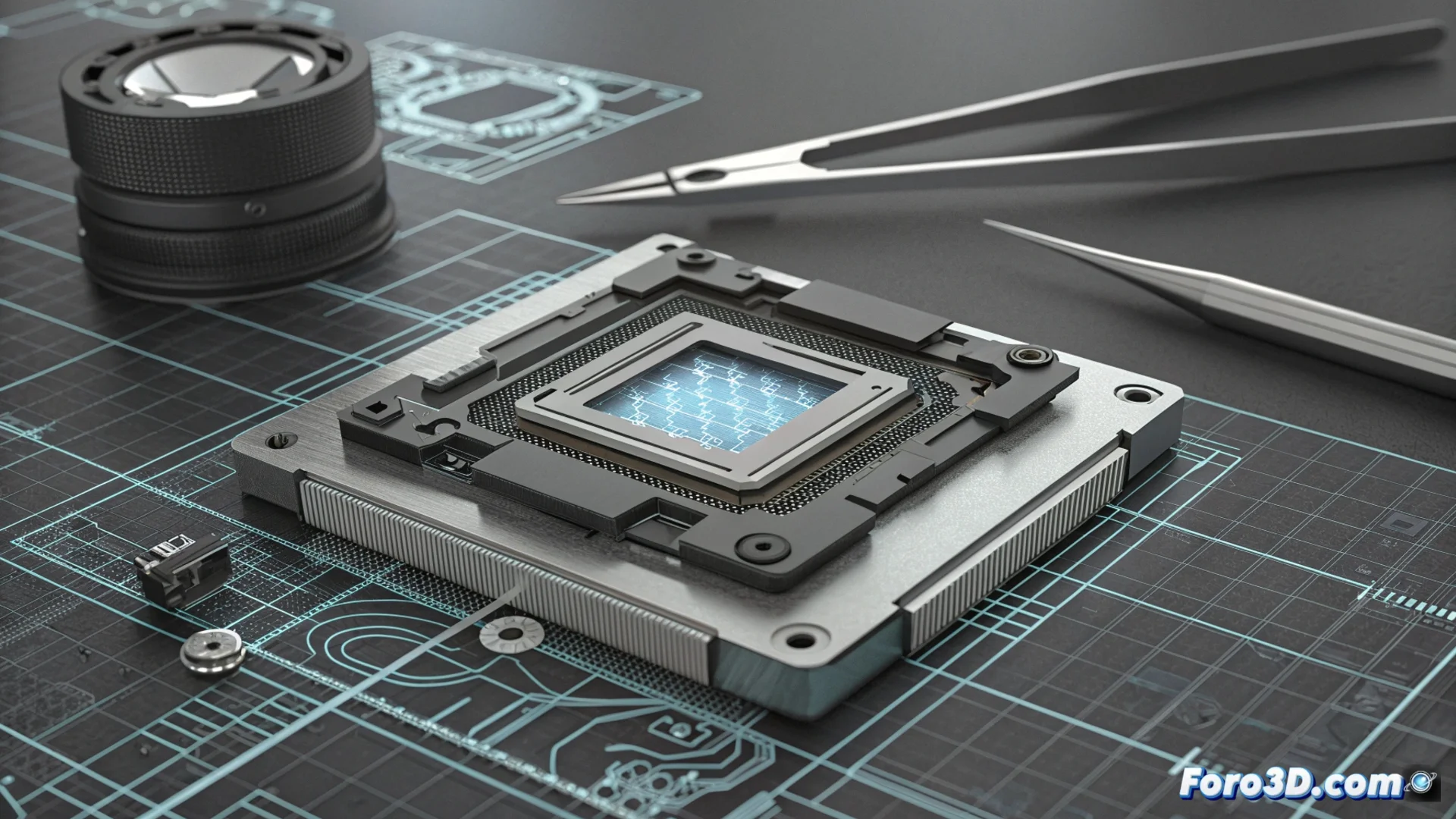
A Flat Lens System Can Transform How We Manufacture Cameras
A team of scientists has created a new type of optical lens that is completely flat. This system, developed in collaboration between universities in the United States and Australia, uses nanotechnology to deflect and focus light, eliminating the need for the bulky curvatures of traditional lenses. The result is an extraordinarily thin profile that promises to revolutionize the design of devices that rely on cameras. 📸
The Technological Foundation: Metalenses and Nanopillars
The heart of this innovation is a metalens. This is not a polished glass lens, but a flat surface coated with an array of millions of silicon nanopillars. Each of these pillars is smaller than the wavelength of the light it attempts to manipulate. By precisely varying their diameter and how they are arranged on the surface, researchers can control the phase of the light passing through them, achieving the same focusing effect as a thick curved lens. This field is known as metamaterial optics.
Key Advantages of This Approach:- Reduce Thickness: The entire lens assembly is flat, which radically contrasts with the depth of current camera lenses.
- Correct Optical Defects: The nanoscale design can be configured to compensate for aberrations such as astigmatism, improving the clarity and fidelity of the resulting image.
- Lighten the Weight: By eliminating much of the glass or plastic material, the final devices can be much lighter.
This principle of metamaterial optics replaces physical curvature with a nanoscale design.
From Prototype to Market: Challenges and Future Applications
Although the functional prototype demonstrates the concept, the path to commercial implementation has obstacles. Researchers are now working to optimize the system and prepare it for mass production.
Main Challenges to Overcome:- Scale Manufacturing: Creating these nanometric structures with the precision and consistency needed for large-scale production is complex.
- Expand the Spectrum: The current prototype operates efficiently with infrared light; the next step is to make it work just as well with the visible light spectrum for use in common cameras.
- Increase Efficiency: The amount of light the lens transmits must be maximized to avoid dark images.
A Future with Thinner and More Versatile Cameras
If these technical challenges are resolved, the impact could be widespread. We could see mobile phones with cameras that do not protrude from the body, lighter drones and satellites with high-quality sensors, and medical tools like endoscopes that are less invasive and more maneuverable. This technology not only seeks to make devices thinner, but also to improve their optical performance in spaces where size and weight are critical limitations. The future of imaging could be perfectly flat. 🔬