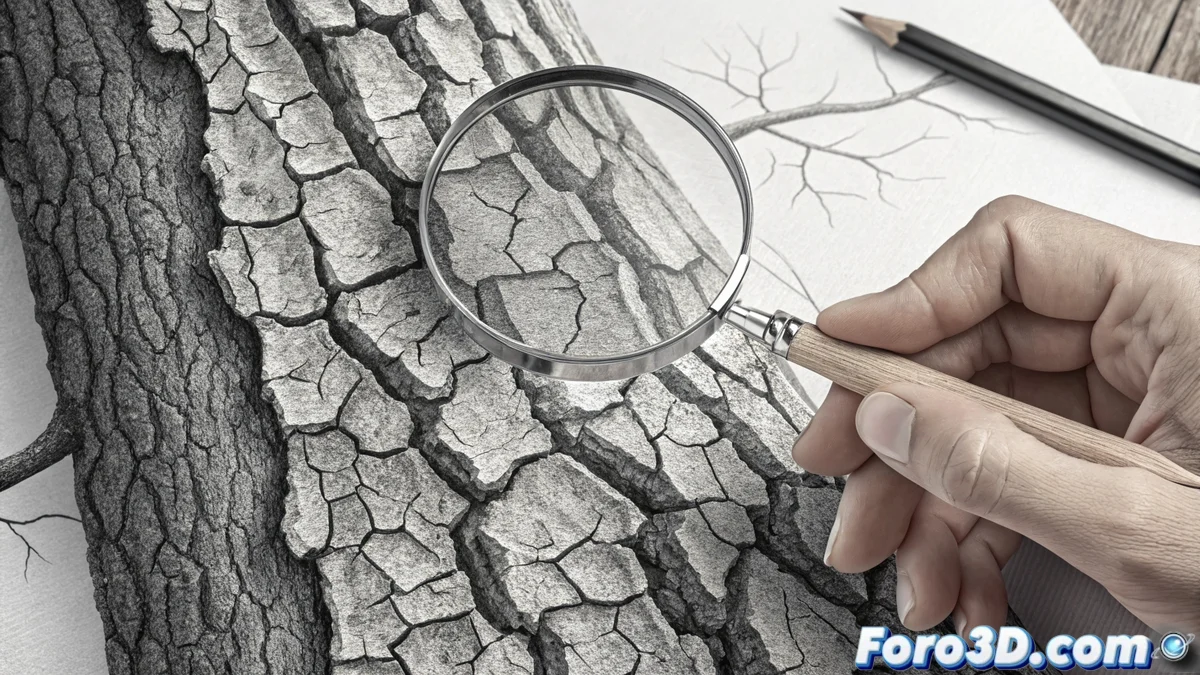
A Drawing Exercise That Enlarges a Tiny Detail
This drawing method invites exploration of what is invisible to the naked eye. It consists of isolating a fragment of just one square centimeter from an object and representing it at a much larger scale. The main objective is to train the eye to perceive the complexities of textures, the smallest reflections, and details that the eye normally ignores. This process forces deep analysis, turning a tiny portion into a complete universe to discover 🔍.
Prepare the Object and Define the Frame
The first step is to select an object with a surface that offers visual richness, such as the skin of a fruit, a piece of rusted metal, or a fabric with an intricate weave. Then, it is crucial to delimit the exact area to be studied, using a cardboard viewfinder or simply fingers to mark a one-centimeter square. This framing action establishes the boundaries of the world to be drawn. It is recommended to immobilize the object to avoid movements and use a magnifying glass if necessary to clearly distinguish the micro-elements that compose it.
Key Steps to Begin:- Choose an object with a varied surface full of visual information.
- Physically mark the one-centimeter square that will serve as the model.
- Secure the object in a fixed position to maintain a constant viewpoint.
This exercise can make you question whether you really know the objects around you, when one centimeter of their surface becomes an unknown landscape full of surprises.
Translate What You See onto Paper
When drawing, the challenge lies in processing pure visual information, setting aside preconceived knowledge about the object. It is about translating onto paper with precision the cracks, specks of dust, subtle tone transitions, and light glints that interact with a rough surface. The difficulty is in capturing all the complexity of that micro-world without falling into simplifications. Proceed with patience, working layer by layer, and constantly compare the drawing with the enlarged reality to adjust proportions and light-dark values.
Keys During the Drawing Process:- Focus solely on the information provided by sight, not on what is known.
- Fidelity represent every irregularity, value change, and light effect.
- Work methodically, overlaying layers and constantly checking the model.
The Value of the Exercise
This method not only improves technical drawing skills, but fundamentally sharpens the observation capacity. By forcing the artist to immerse in such a reduced space, a more intimate understanding of the structure and essence of materials develops. It is a practice that reveals that even in the smallest fragment there exists a complex landscape worthy of exploration and representation 🎨.