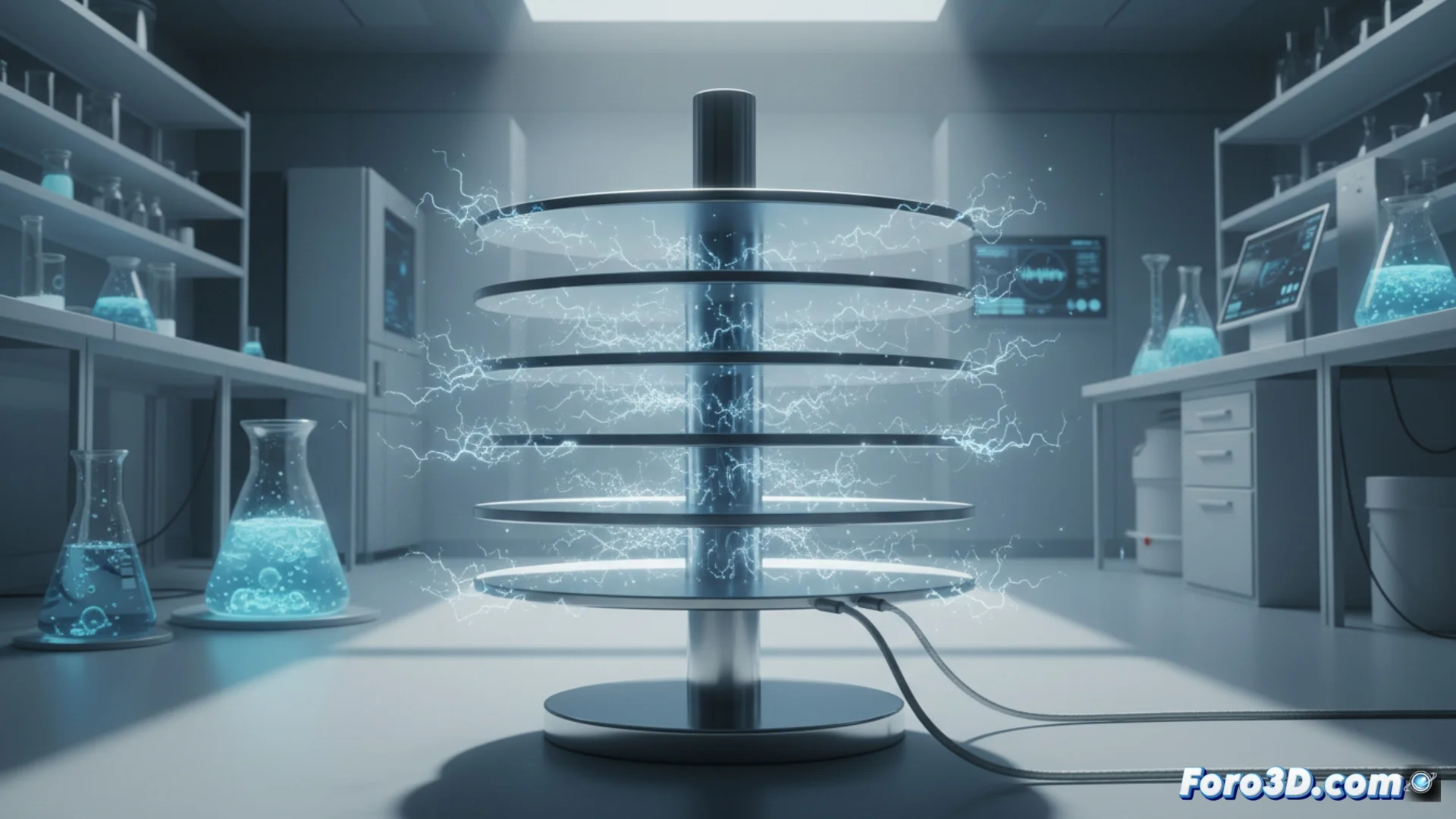
A Bladeless Electric Generator Inspired by Tesla
A global scientific consortium has presented an innovative approach to generating electrical energy. This device revives Nikola Tesla's pioneering design of the bladeless turbine. However, it replaces water or steam with compressed air that circulates through a central shaft. The fundamental innovation lies in the method of converting fluid energy into usable electricity. ⚡
Transforming Airflow into Electric Current
The device consists of multiple polished metal disks assembled on a shaft. When pressurized air is passed between them, they do not rotate like in a conventional turbine. Instead, the friction of the high-speed gas against the disk surfaces generates an electrostatic phenomenon. This effect, which arises at the boundary between the metal and the gas, induces an electric charge that can be captured and used.
Key features of the mechanism:- Uses smooth, stationary disks instead of moving blades or propellers.
- Energy generation occurs through an electrostatic principle rather than rotational mechanical motion.
- Extracts electricity directly from the interaction between a moving gas and a solid surface.
A century later, a visionary idea from Tesla comes to life with a practical and direct application for generating electricity.
Potential Advantages in Durability and Practical Uses
By avoiding rotating blades and intricate gear systems, this simplified design drastically reduces components subject to friction and wear. This could translate into less need for repairs and greater operational longevity. Scientists identify opportunities to implement this technology in facilities that already have compressed air networks, such as numerous manufacturing plants, to harness energy that would otherwise be wasted.
Possible areas of application:- Pneumatic systems in manufacturing industries to recover residual energy.
- Environments where reliability and low maintenance are priorities.
- Integration into existing infrastructures without major modifications.
A Legacy that Ignites New Possibilities
It seems that, after decades, a Tesla concept finally finds a concrete application for producing energy, this time in a simpler way and without requiring the enormous transformers or coils from his most famous experiments. This development underscores how ancient ideas can be reinterpreted with modern knowledge to solve current energy efficiency challenges. 🔬