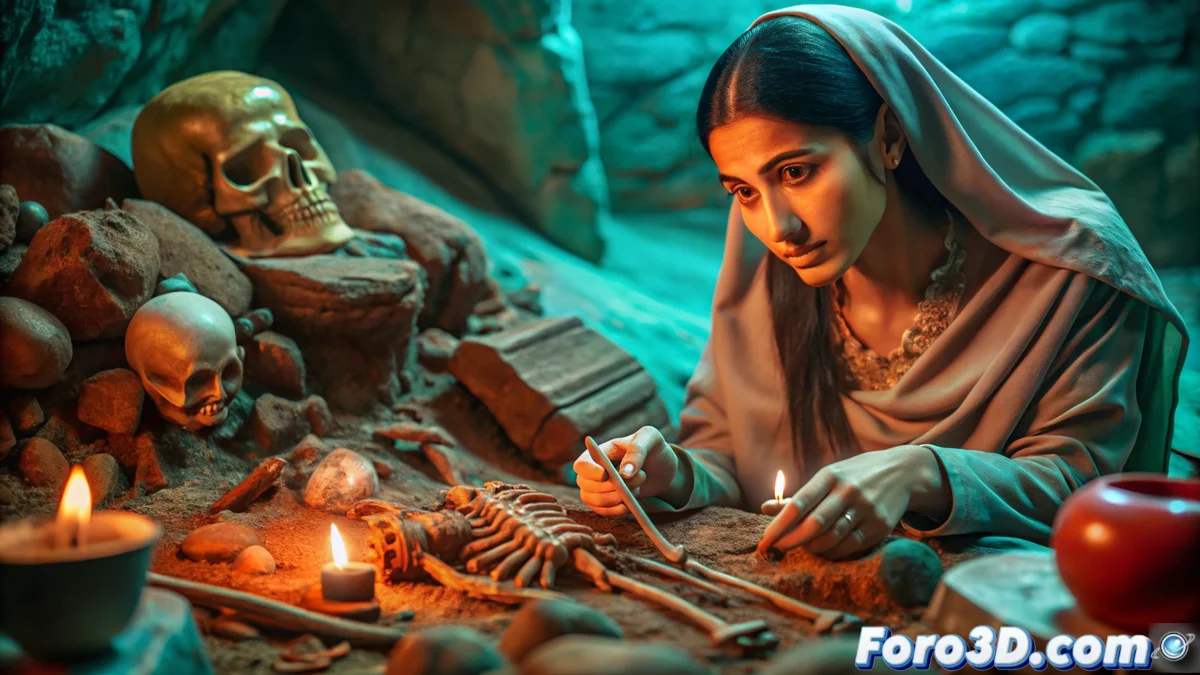
The Forgotten Bronze Age Warrior
An archaeological discovery in Afghanistan has turned our understanding of ancient societies upside down: a 4000-year-old tomb containing the remains of a woman buried with a funerary kit consisting of an axe, a knife, and arrowheads. ⚔️ This finding directly challenges the traditional narrative that relegated women to passive roles, suggesting that some may have held warrior or leader status. For 3D artists, this scene offers a unique opportunity to recreate a crucial historical moment using Autodesk Maya tools, combining archaeological precision and visual narrative.
Setting the Scene: The Archaeological Excavation
The first step in Maya is to build the tomb environment. Start by modeling an irregular terrain that simulates an excavation trench, using the Sculpt Geometry Tool to create uneven levels and soil strata. 🏺 It's important to add contextual details like loose stones, pottery fragments, and roots to bring realism. Texturing with dry earth and sand materials, applying displacement maps to generate micro-reliefs, will establish the ancient earthen base on which the remains rest.
Modeling the Skeleton and Its Historical Pose
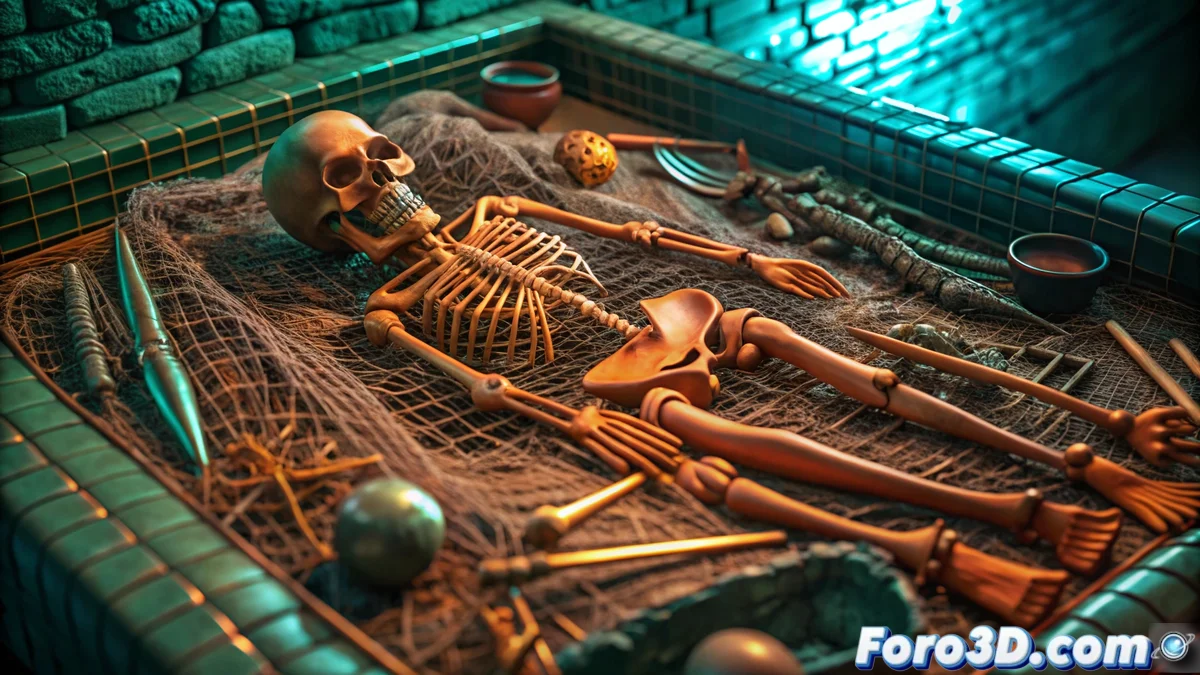
The centerpiece of the scene is the skeleton. It can be modeled bone by bone from polygonal primitives or import a base mesh to modify it. The key is to articulate it in a believable resting pose, respecting human anatomy. 🦴 The assigned materials must simulate the appearance of ancient, fossilized bone, using textures with cracks, discoloration, and embedded dirt. The position of the arms and legs should suggest the original ceremonial burial arrangement.
Recreating an archaeological find is an exercise in historical respect and visual rigor.
The Weapons That Tell a New Story
Modeling the weapons—the axe, the knife, and the arrowheads—requires research on Bronze Age metallurgy. They are modeled with polygons, seeking simple but effective shapes. 🔥 Texturing is crucial: shaders are applied to simulate oxidized copper or bronze and worn wooden handles. The placement of these objects around the skeleton must follow archaeological documentation, telling a visual story about the deceased's status. It is these details that transform a 3D model into a historical statement.
Dramatic Lighting: The Light of Discovery
The lighting is the narrator of this scene. A main directional light, simulating midday sun, must enter diagonally, as if illuminating the newly discovered tomb. 💡 This light will create long, dramatic shadows that accentuate the volumes of the bones and weapons. Soft fill lights (Area Lights) help illuminate shadow areas without eliminating contrast. The goal is to create an atmosphere that evokes awe and solemnity, similar to that of an archaeologist at the moment of discovery.
Some key technical aspects for an optimal result are:
- Clean topology: Essential for precise modeling of bones and weapons.
- Properly unwrapped UVs: To apply textures realistically without distortions.
- Use of Arnold Renderer: To manage global illumination and materials photorealistically.
- Depth of field: Used strategically to direct the viewer's attention.
Render and Post-Production for the Final Impact
For the final render with Arnold, sufficient samples are configured to eliminate noise and effects like depth of field are activated. In post-production, contrast and saturation levels can be slightly adjusted, perhaps adding a subtle vignette effect to center the composition on the skeleton. 🎨 The result should be an image that is not only technically correct but also conveys the historical weight of the discovery.
This finding demonstrates that history is often more complex and fascinating than we were told. While academics rewrite the textbooks, 3D artists have the privilege of giving a face back to a woman who defied her time, even if digital. And who knows, perhaps her greatest feat was not wielding a weapon, but ensuring, four millennia later, that we talk about her again. A true lesson in legacy. 😊