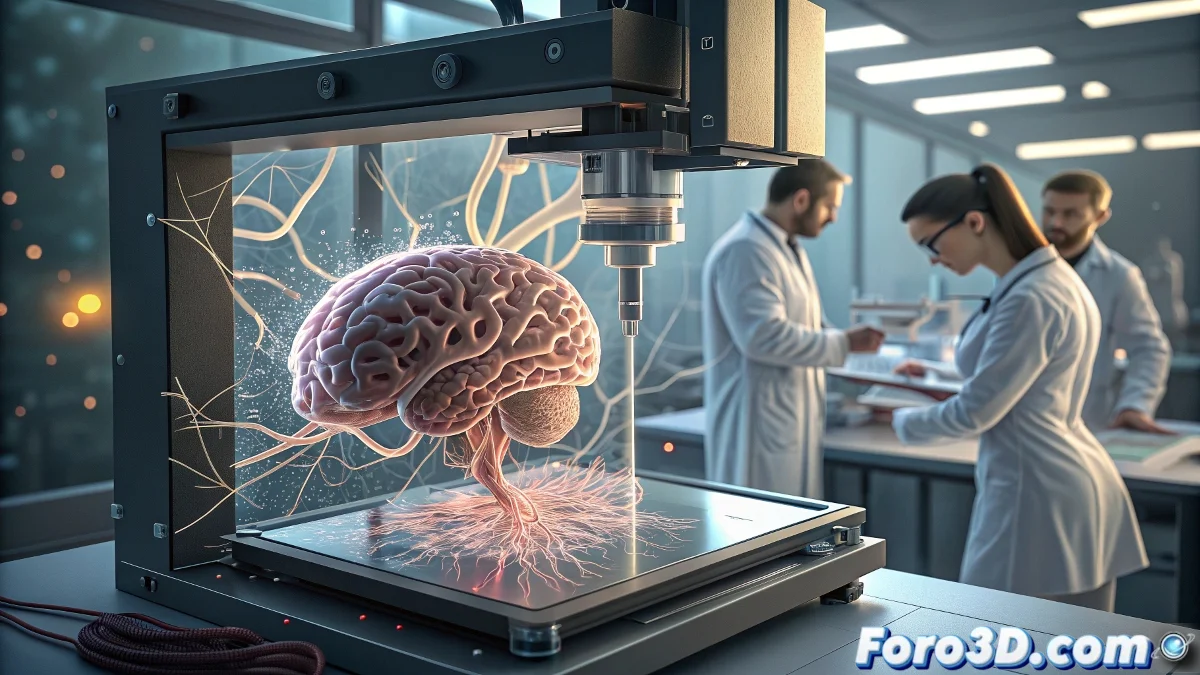
When 3D Printing Writes the Future of Neurology with Living Cells
The University of Wisconsin-Madison has crossed a boundary that seemed reserved for science fiction. For the first time, a 3D printer has created fully functional human brain tissue, capable of developing and forming neuronal connections just as it would in a natural brain. This achievement, documented in Nature Communications, not only represents a technical triumph of bioprinting but also opens doors previously closed to understanding and treating neurological diseases that affect millions of people.
The developed methodology solves one of the greatest challenges of neural tissue engineering: keeping the printed structures alive and functional long enough to mature and establish meaningful connections. Unlike previous attempts where printed brain cells tended to become disorganized or die, this approach allows neurons to communicate, form networks, and exhibit coordinated electrical activity. The resulting tissue could become the most accurate model ever created for studying the human brain. 🧠
Printing functional human brain tissue is like writing the source code of consciousness with bio-ink
The Engineering Behind the Neural Miracle
The success of Wisconsin-Madison lies in an innovative combination of materials and printing techniques that mimic the natural brain microenvironment.
- Specialized bio-ink that provides structural support without interfering with cellular communication
- Layered printing architecture that replicates the three-dimensional organization of brain tissue
- Integrated nutrient systems that maintain cell viability during tissue development
- Precise cell density control to optimize the formation of neuronal connections
The ability to print different types of neural cells in specific arrangements allows for creating models that reproduce characteristics of particular brain regions, something impossible with traditional cell cultures.
Applications That Will Transform Neurological Medicine
This breakthrough has immediate and far-reaching implications for the research and treatment of neurological conditions.
- Personalized disease modeling using cells from specific patients
- Drug testing on human brain tissue without the ethical risks of animal experimentation
- Study of neural development and the mechanisms behind neurodevelopmental disorders
- Research on brain repair after injuries or cerebrovascular accidents
For conditions like Alzheimer's, Parkinson's, or epilepsy, these printed tissues could dramatically accelerate the discovery of treatments by providing more accurate testing platforms than current animal models.
The Ethical and Scientific Future of Printed Brains
Although we are still far from printing a complete brain, this achievement raises fascinating questions about the limits of neural tissue engineering.
The ability to create functional brain tissue brings closer the possibility of repairing brain damage or replacing areas affected by diseases. However, it also opens ethical debates about the nature of consciousness and the limits of neural manipulation. What is undeniable is that neurology has just acquired a transformative tool. 🔬
And if we can print functional brain tissue, soon neuroscientists might have more study models than a teenager has awkward conversations... though probably with better neuronal connectivity 😉
You can visit the official site: here