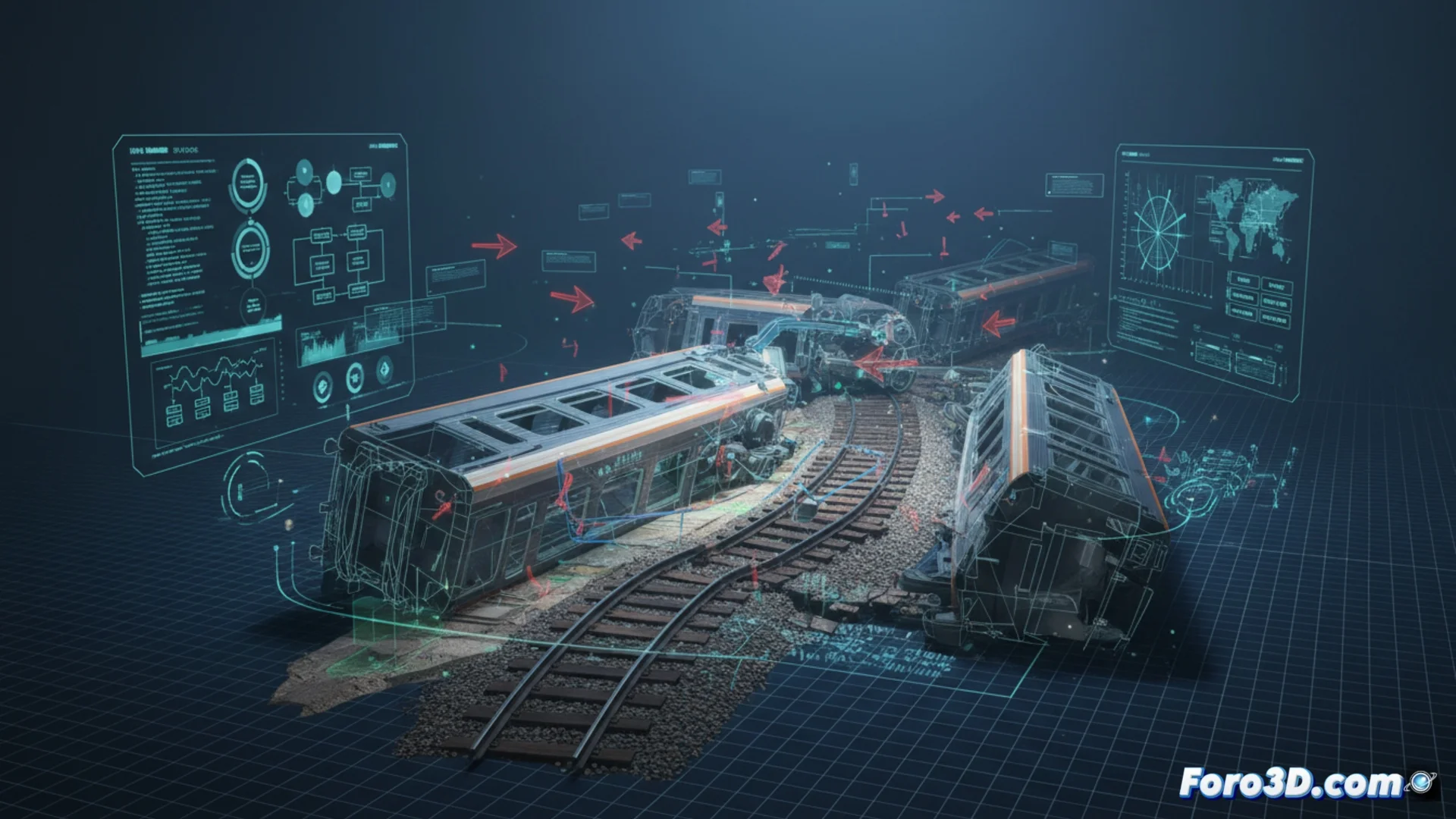
A 3D Forensic Workflow Reconstructs a Train Accident
Experts in digital forensics apply a three-dimensional workflow to investigate a railway derailment case. This innovative method allows recreating the scene with a high degree of precision to uncover the causes. 🔍
Capturing and Building the Virtual Environment
The process begins by documenting the scene. To do this, they use laser scanners and photogrammetry techniques with drones. These systems collect millions of data points that technicians then process. The result is a detailed point cloud and a digital model of the terrain. Subsequently, they incorporate the CAD plans of the locomotive and cars into this virtual space. The ultimate goal is to produce an exact copy where what happened can be studied.
Key Phases of the Reconstruction:- Document the site with laser and aerial technology.
- Process the data to generate precise three-dimensional models.
- Integrate the CAD designs of the train components into the scenario.
The fidelity of the 3D model is crucial for the subsequent analysis to be valid and objective.
Simulating the Accident Dynamics
With the digital replica ready, specialists use multibody simulation software. They input various variables into the system, such as the train's speed, track wear, and weather conditions at the time. The physics engine calculates all the forces at play and reproduces the derailment sequence. Investigators adjust the parameters to examine different causal hypotheses. This stage allows seeing how the cars separated and overturned. 💥
Variables Analyzed in the Simulation:- Train speed and trajectory.
- Condition of the railway infrastructure.
- Recorded atmospheric conditions.
Communicating Results Effectively
The final 3D model becomes a very powerful communication tool. Experts can show a clear animation of the event to other investigators and in court. It is possible to isolate specific components, such as a damaged brake or a switch, to explain their role in the accident. Interactive visualization facilitates exploring the scene from any perspective. This approach brings clarity and objectivity to traditional forensic analysis. Often, the main challenge is not modeling the crash, but managing simulation files that can have a digital weight greater than the real train. ⚖️