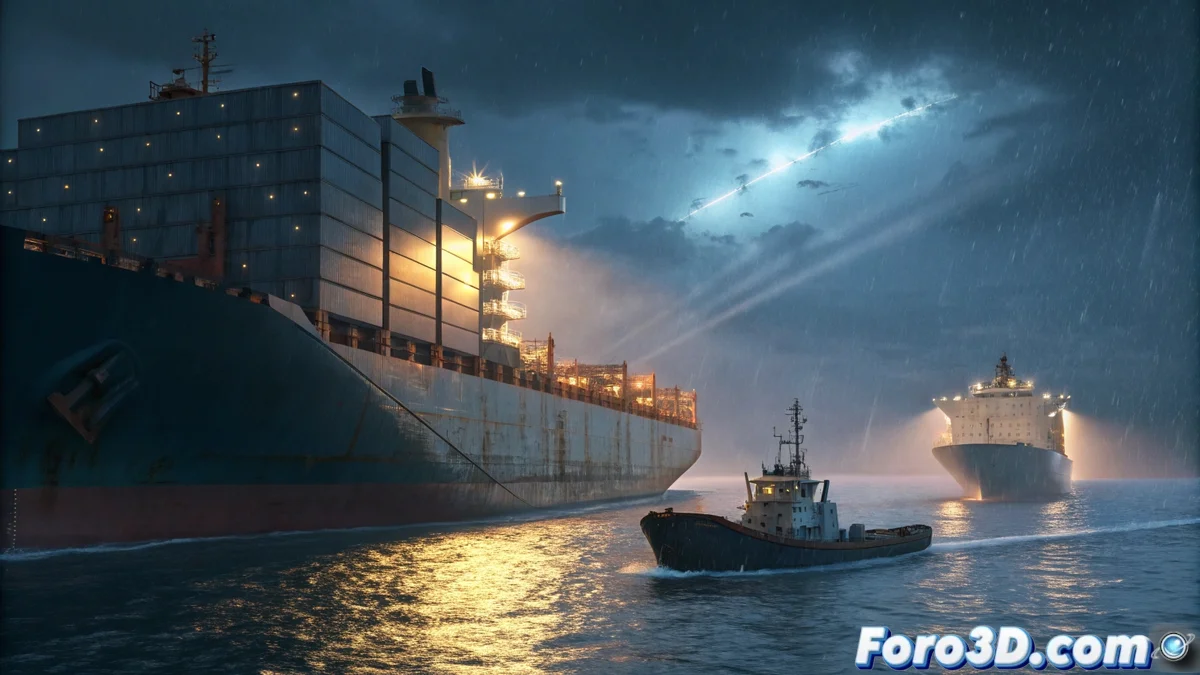
A 3D Forensic Pipeline Analyzes the Collision of Two Cargoships
When two large cargoships collide in the open sea, the statements of their captains often contradict each other. To uncover the truth, investigators turn to three-dimensional digital forensics. This technical methodology reconstructs the facts with irrefutable data, transforming servers into key witnesses. 🚢⚖️
Capturing and Processing Physical Evidence
The first step involves documenting the damage on the vessels. Experts use a FARO Focus laser scanner to accurately record dents and paint transfers between the hulls. The resulting point cloud is imported into software like PolyWorks to measure and quantify each metal deformation. In parallel, data from the voyage recorders, equivalent to aviation black boxes, is recovered.
Initial Analysis Phases:- Laser Scanning: Impact areas of both cargoships are digitized to obtain a precise 3D model.
- Process the Point Cloud: In PolyWorks, experts analyze the deformed geometry and contact marks.
- Recover Navigation Data: Course, speed, and time are extracted from onboard recorders.
The 3D scanned physical evidence and navigation data form the objective basis for reconstructing the accident.
Simulate to Reconstruct the Collision Dynamics
With the analyzed 3D models and navigation parameters, a computational simulation is created. Tools like Orca3D are used to model hydrodynamics and LS-DYNA to simulate the structural collision. The simulation calculates forces and reproduces the impact from multiple angles and possible speeds.
Comparison with Real Evidence:- Simulation results are compared with the actual dents measured in the scan.
- Matching with the pattern of paint transfer marks between the hulls is verified.
- The simulated scenario that fits all physical evidence is identified as the one that occurred.
Conclude the Analysis and Assign Responsibilities
This technical forensic process allows reconstructing the minutes prior to the accident with a high degree of certainty. The final report establishes the collision angle, the speed of each vessel at the moment of impact, and ultimately assigns responsibilities according to international standards for preventing collisions. The 3D digital evidence thus becomes an objective testimony that resolves the dispute between the parties, being key in legal and maritime insurance processes. Sometimes, the truth is not at the bottom of the sea, but in a render server.