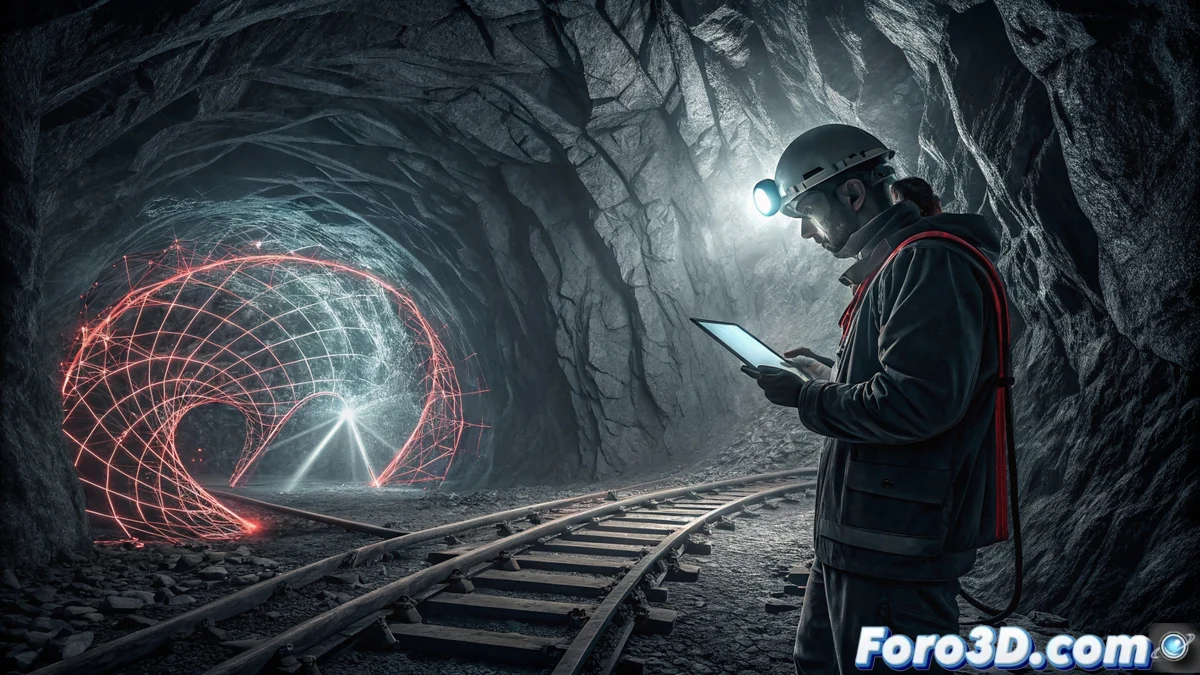
A 3D Forensic Pipeline Analyzes the Collapse of a Mining Tunnel
When a mining tunnel collapses and traps workers, discovering the exact cause is vital. A forensic workflow that uses 3D technology allows investigating these incidents with great precision. The method starts by scanning the inside of the mine, before and after the event, to generate a three-dimensional digital model of reality. This model slices through the complex geology and serves as a base for simulating how the rock behaves under pressure. The goal is to clarify whether the failure started in an unforeseen geological discontinuity or if the planned tunnel support system was insufficient. 🏔️
Laser Scanning Documents the Real Geology
The first step is done by a laser scanner like the Leica RTC360. This equipment records millions of points on the rock surfaces, creating a dense point cloud that copies the exact shape of the tunnel and its fractures. By comparing scans done before and after the collapse, the volume of material that fell and the areas where the structure failed are identified. This point cloud is taken to geological modeling software, like Leapfrog, to interpret and visualize the veins, faults, and rock types in the accident area.
Key Forensic Scanning Process:- Capture the exact geometry of the tunnel and its discontinuities with a high-speed laser scanner.
- Generate a dense point cloud that serves as a three-dimensional digital record of the excavation state.
- Compare pre- and post-collapse models to quantify the collapsed volume and locate the initial failure points.
The rock sometimes interprets your tunnel design as a mere negotiable proposal.
Geotechnical Simulation Validates Theories
With the 3D geological model ready, it is transferred to analysis programs like Rocscience RS3 or FLAC3D. Here, engineers simulate the forces acting on the rock and the tunnel supports. They reproduce the existing stress conditions before the collapse to evaluate whether the excavation shape, combined with the rock properties, exceeded its natural resistance. They also test if the support design, such as bolts or trusses, was correct. The simulation shows the most likely failure mechanism, providing objective technical evidence for the investigation. ⚙️
Stages of Failure Simulation:- Import the 3D geological model into finite element or difference analysis software.
- Recreate the in-situ loading and stress conditions that preceded the collapse event.
- Test different hypotheses about the support system capacity and the stability of the rock mass.
Data Integration for a Technical Verdict
The power of this 3D forensic pipeline lies in integrating real-world data with computational models. It's not just about making a pretty model, but creating a dynamic digital replica that can be subjected to virtual stress. This approach transforms the investigation of a collapse from a primarily deductive task to one based on quantifiable evidence. The final result is a report that not only points to a probable cause, but can be used to redesign supports, adjust excavation methods, and ultimately make future mining operations safer. The 3D model becomes the centerpiece of an irrefutable technical argument. 🧩