A 3D Forensic Analysis Reconstructs an Accident with a Folder
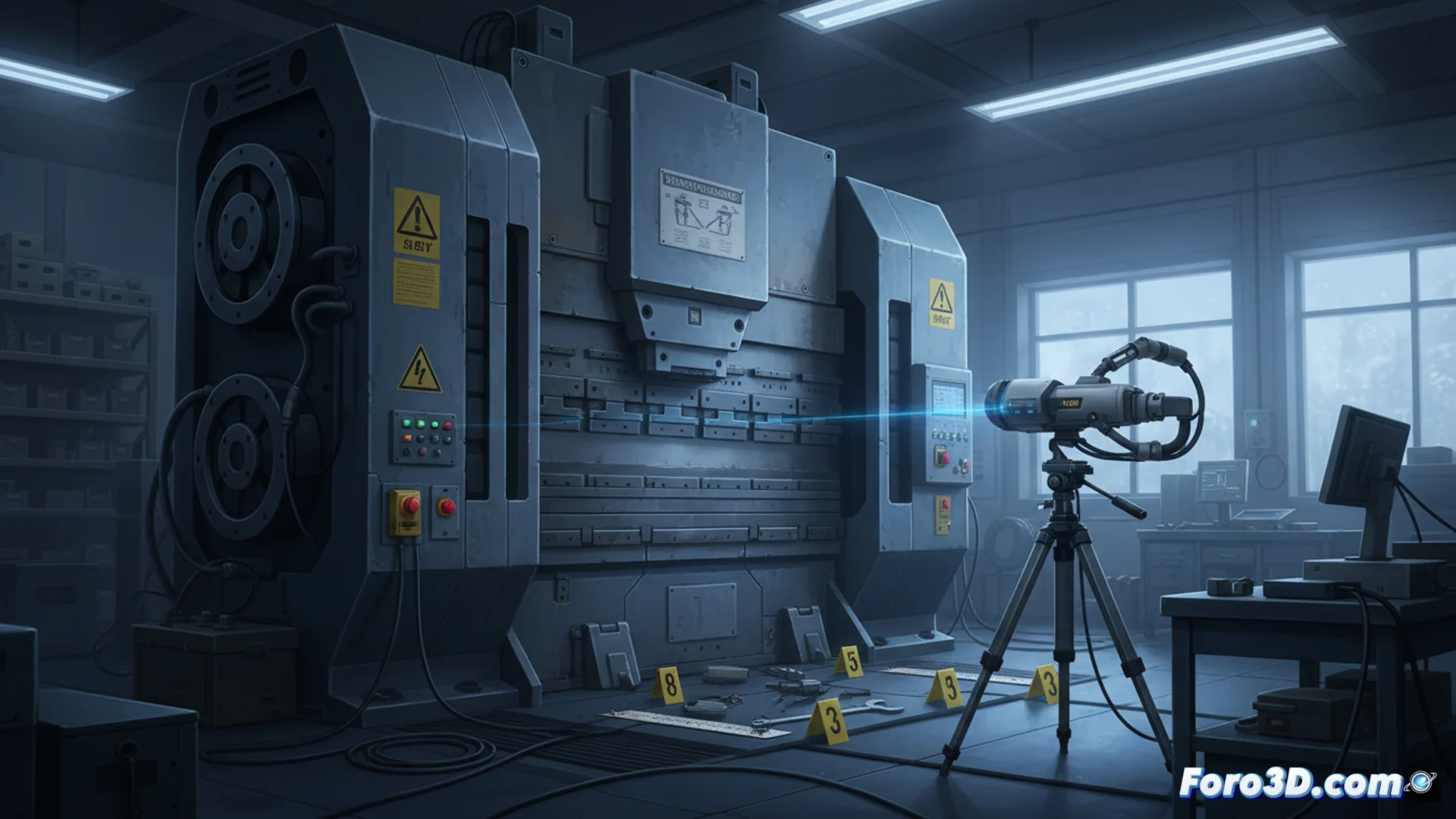
A worker lost his life after being trapped by the mechanisms of a sheet metal folder. To discover what happened, investigators activated a three-dimensional forensic technical workflow. This method collects and processes information from the scene to produce an exact and neutral virtual recreation. Its main goal is to examine how the incident occurred, identify the causes, and check if there were failures in the protection systems or in the way the machine was operated. 🔍
Documenting the Scene of the Incident
The initial stage consists of recording the entire environment. Experts use 3D laser scanners and photogrammetry techniques to capture the machine, its placement, the state of the controls, and the precise position of the victim. Multiple photographs and recordings are taken from all perspectives. This raw data is combined to generate a detailed point cloud and a textured three-dimensional model of the workshop and the folder, which serves as an unalterable base scene.
Key Steps in Data Capture:- Use laser scanning technology for precise measurement.
- Apply photogrammetry to obtain real textures and colors.
- Create a permanent digital file of the accident scene.
The machine, created to bend steel with precision, ended up bending the most basic safety protocol. A system that was supposed to prevent human errors failed before the most unexpected human factor.
Recreate and Examine the Sequence of Events
With the 3D model of the scene ready, simulation begins. A digital avatar with the worker's body measurements is introduced. Dynamics and motion specialists animate the sequence according to the evidence and testimonies. Various hypotheses are tested: whether the worker pressed a button, whether the machine activated on its own, or if there was a mechanical failure. The simulation allows viewing trajectories, entrapment points, and risk areas that were not visible to the naked eye.
Central Elements of the Simulation:- Integrate a human model with correct anthropometric dimensions.
- Test different scenarios to validate the most likely hypothesis.
- Visualize critical angles and danger zones on the machine.
The Value of Digital Evidence
This 3D forensic process offers an objective and powerful tool for understanding complex accidents. It allows experts to analyze interactions between the worker and the machine in a way that traditional methods cannot. The final result helps determine responsibilities, improve safety devices, and update work procedures, with the ultimate goal of preventing similar tragedies in the future. 🛡️