When Rendering Meets Interplanetary Exploration
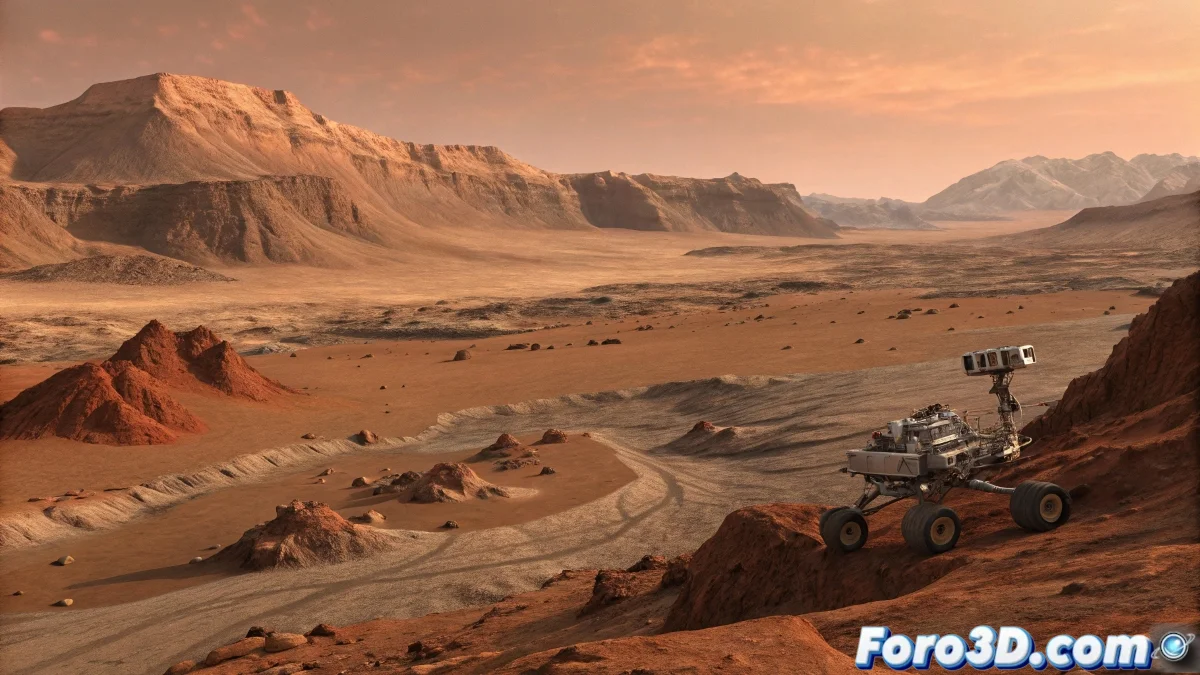
NASA's recent announcement about possible traces of ancient microbial life on Mars represents one of the most exciting scientific discoveries of our era. 🚀🔴 In 3ds Max, we can recreate this historic moment, visualizing the Jezero crater as it was billions of years ago—a potentially inhabited lake—and the Perseverance rover performing its crucial sample collection work. This visualization not only communicates science; it inspires awe and curiosity about our place in the universe.
Martian Project Setup
Upon starting 3ds Max, the project is configured with metric units to maintain the real scale of the elements—the Perseverance rover measures approximately 3 meters long and the Jezero crater 45 kilometers in diameter. 🗺️ Layer organization is essential: Martian_Terrain, Rover_Perseverance, Sedimentary_Rocks, and Environmental_Effects keep the scene manageable. Importing real references from the rover's cameras ensures scientific accuracy in the recreation.
3D visualization of planetary discoveries serves as a crucial bridge between complex science and the general public, transforming raw data into understandable and inspiring visual narratives.
Recreation of the Jezero Crater
The Martian terrain is modeled using displacement maps based on real NASA topographic data. 🏜️ The crater's unique geological features—ancient river deltas, sediment banks, and eroded rock layers—are recreated with editable poly and sculpting tools. Sedimentary rocks are distributed procedurally, with variations in size and orientation that reflect ancient aquatic deposition processes.
Modeling and Animation of the Perseverance Rover
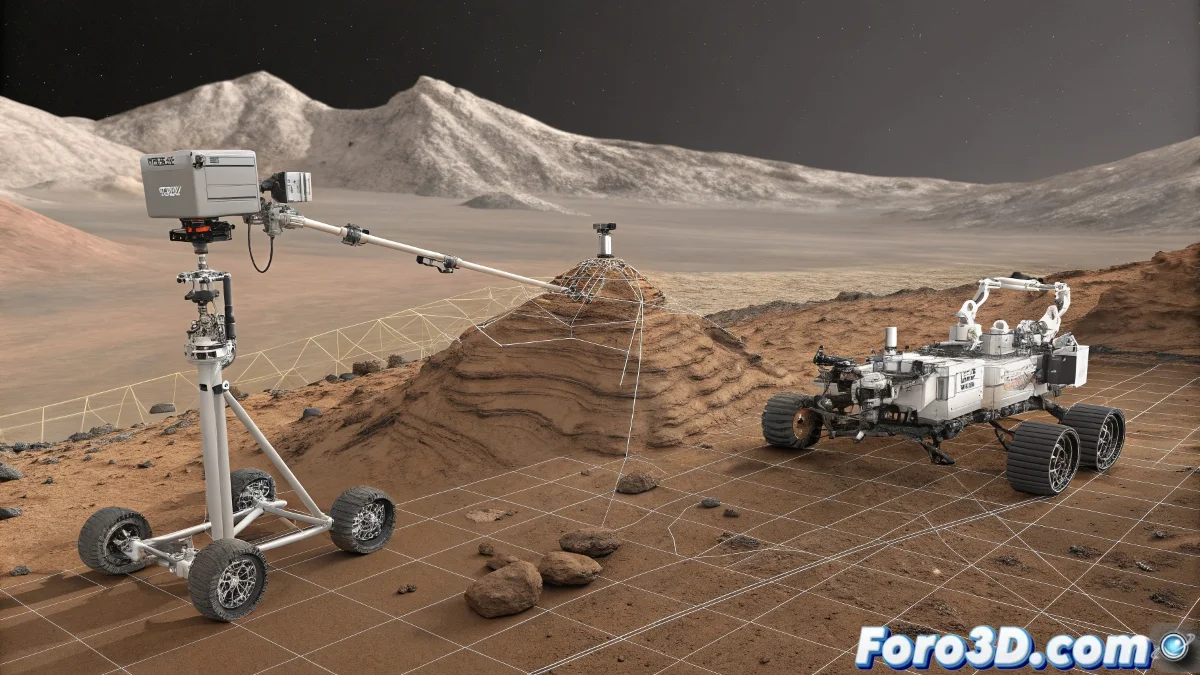
- Precise Modeling: The rover is recreated with its main components—chassis, wheels, robotic arm, mastcam—using primitives and subdivisions to balance detail and performance.
- Scientific Rigging: The robotic arm is rigged with IK controls for precise animation of the sampling process, including deployment, rock contact, and drilling.
- Sampling Animation: The full sample collection sequence is animated—from approach to sample storage—based on real mission data.
Martian Lighting and Atmosphere
The lighting replicates Mars' unique conditions—weaker sunlight than on Earth, atmosphere with dust particles creating reddish scattering. 🌅 A Sunlight system is used with adjusted color temperature (approximately 5900K but with increased red channels) and environment fog to simulate the thin atmosphere. The rover's work lights are added with subtle volumetrics for visible light rays in the suspended dust.
PBR Materials and Texturing
The materials follow PBR principles for scientific realism: 🪨 Martian regolith with high roughness and reddish albedo, rover metals with weathering and dust accumulation, and sedimentary rocks with visible stratification via normal maps. Drilling samples show internal color variations suggesting different chemical composition.
Rendering and Post-Production
Rendering is done with Arnold or V-Ray for cinematic quality, using AOVs for compositing control. 🎬 Depth passes allow adding atmospheric haze and depth of field in post-production, while emission passes isolate the rover's lights. Color grading emphasizes characteristic reddish tones while maintaining details in shadows and highlights.
Applications Beyond Visualization
These recreations serve as educational tools, materials for documentaries, and assets for virtual reality experiences. 🎓 The ability to visualize complex scientific processes helps engineers and scientists plan future operations and communicate findings to non-technical audiences.
Thus, while we await the samples' arrival on Earth for definitive confirmation, 3D recreations allow us to explore the possibilities… though polygons will never be as fascinating as the potential real life they represent. Because in scientific visualization, the only thing that should be alien is the imagination, not the results. 😉