A team of scientists from Xi'an Jiaotong University, in China, has achieved an innovative creation: a light beam generator that is not only efficient, but also cheap and small, printed in 3D. This device can generate vortex beams, a type of light that rotates, allowing it to carry much more information than conventional light beams. This could transform future wireless communications, increasing their capacity and reliability.
The Challenge of High-Capacity Networks
Today, communication networks, such as 5G and 6G, have to handle massive amounts of data and resist interference. However, current systems for generating vortex beams face problems like low efficiency and high costs. This new generator solves many of these obstacles, offering a more economical and efficient solution for high-capacity data transmission.
How the Vortex Beam Generator Works
The researchers used 3D printing to create a generator that produces high-capacity vortex beams, ideal for advanced communications. Additionally, this device has a key feature: an integrated filter that helps amplify desired signals and block interference, ensuring clear transmission.
Improving Connectivity in Large Events
This device is not only useful for 5G and 6G networks, but also for applications such as remote sensing and imaging. According to researcher Yuanxi Cao, this generator could be key to improving connectivity in high-attendance events, such as concerts or sports games, where traditional networks become overloaded.
Gain Filtering to Minimize Interference
The 3D printed generator features a power divider that distributes the signal and eliminates unwanted frequencies. This filter reduces interference and makes other external components unnecessary. Additionally, the air-filled metallic structure helps improve the device's efficiency.
Precise Operation to Generate Vortex Beams
The device divides the input signal into several parts and adjusts its phase to create the vortex beam with the necessary characteristics. Then, the signals are transmitted through a series of antennas arranged in a circle to generate the rotating light beam.
Device Testing and Manufacturing
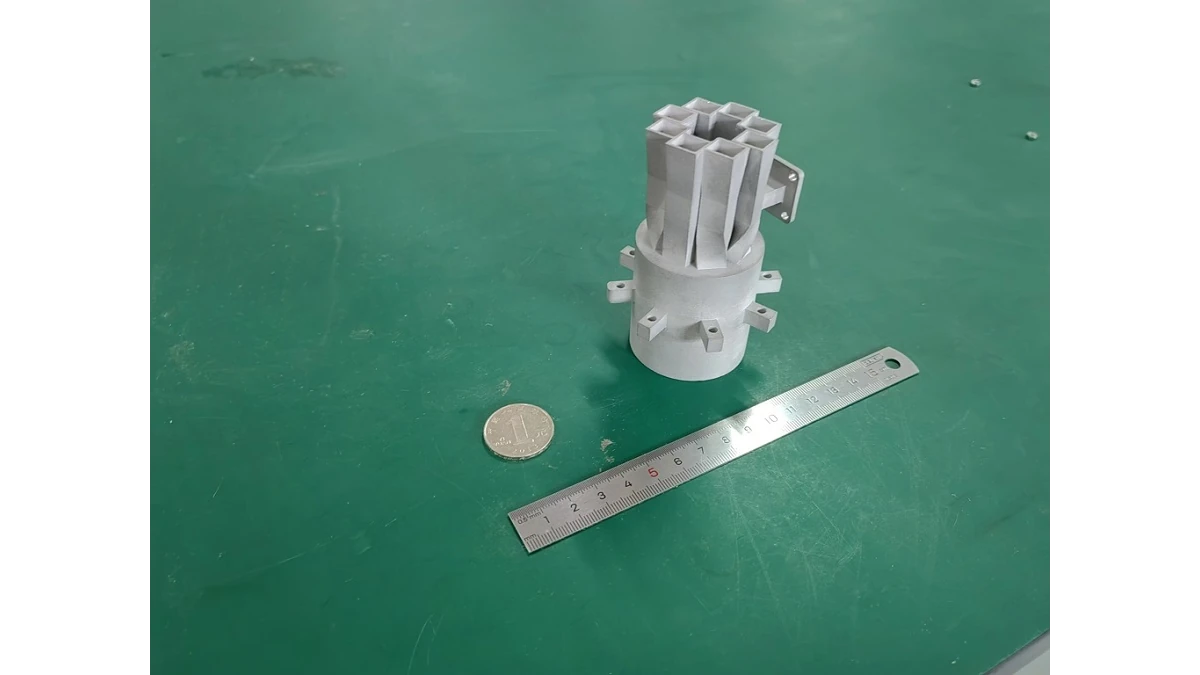
To manufacture the device, the researchers used an advanced 3D printing technology called selective laser fusion. This process allowed the creation of a prototype with very precise materials, ensuring its ideal operation in high-frequency applications.
Promising Results and Successful Tests
The tests conducted showed that the vortex beam generator meets the desired standards, offering a signal purity of 80% and a reduction in interference of more than 30 dB. This demonstrates that the device is capable of transmitting signals efficiently and free of interference.
Towards a More Efficient and Accessible Future
The researchers are working to further improve the generator's performance, aiming to optimize gain, efficiency, and signal filtering. In the future, they plan to explore new applications for the device, such as communications at higher frequencies, like terahertz. They are also considering its commercialization, which will involve perfecting 3D manufacturing to produce it on a large scale and adapt it to existing systems.