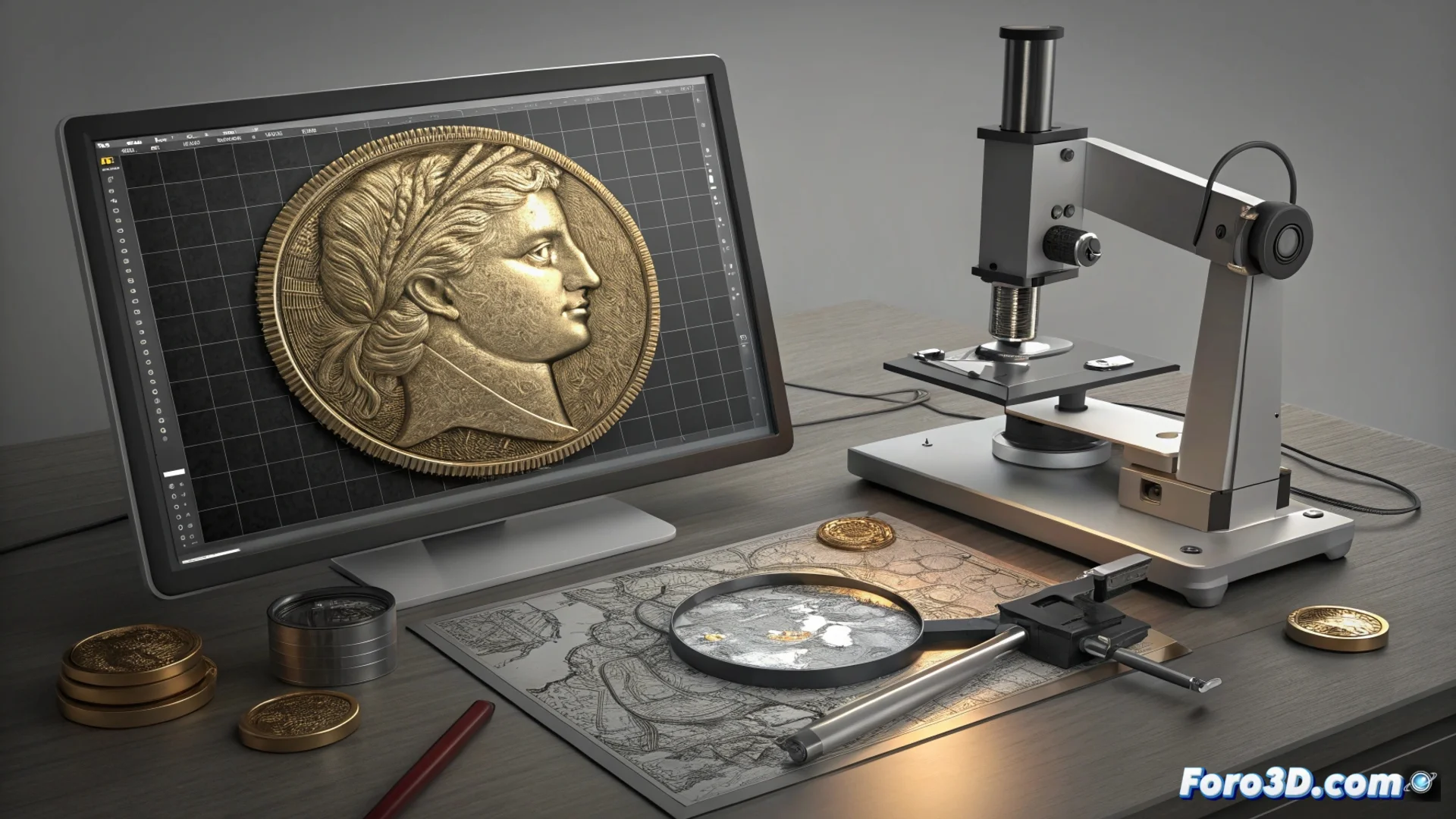
3D Technology Unmasks Fake Coins
The world of numismatics adopts advanced digital tools for a historic challenge: identifying forgeries. The key is no longer just the magnifying glass, but a high-resolution 3D scanner that acts as a digital microscope. This equipment captures with micrometric precision every detail of a coin's surface, from the smallest relief to the cracks of age. The result is an exact three-dimensional model that becomes its unique and unrepeatable digital fingerprint. 🔍
Reading the hidden history in the metal
This technology allows analyzing imperfections that the human eye cannot perceive. Authentic coins, created with historical techniques like hammering, have random and specific wear and manufacturing marks. In contrast, fake reproductions, often produced by modern casting, leave distinct traces. 3D scanning identifies the fingerprints of current methods, such as porosities, mold lines, or trapped air bubbles. Simultaneously, it detects the absence of the fine striations and the characteristic metal flow of real ancient minting.
Details that reveal the truth:- Porosity and bubbles: Typical signs of a piece cast in contemporary molds.
- Mold lines: Linear imperfections that betray the modern manufacturing process.
- Lack of metal flow: Uniform texture and lack of random marks from hammer minting.
The surface of a coin tells a microscopic story that only 3D technology can read completely.
A scientific comparison process
The workflow for authentication is systematic and based on objective comparison. First, the coin in question is digitized with the 3D scanner. Then, specialized software compares the generated model with an extensive database containing verified and documented specimens. The system searches for and quantifies discrepancies in key parameters.
Key comparison parameters:- Depth and definition of reliefs: Analyzes whether the engraved details match historical precision.
- Symmetry and alignment: Evaluates deviations that would not be typical of the original technique.
- Surface texture and topography: Compares the metal's "skin" at the micrometric level.