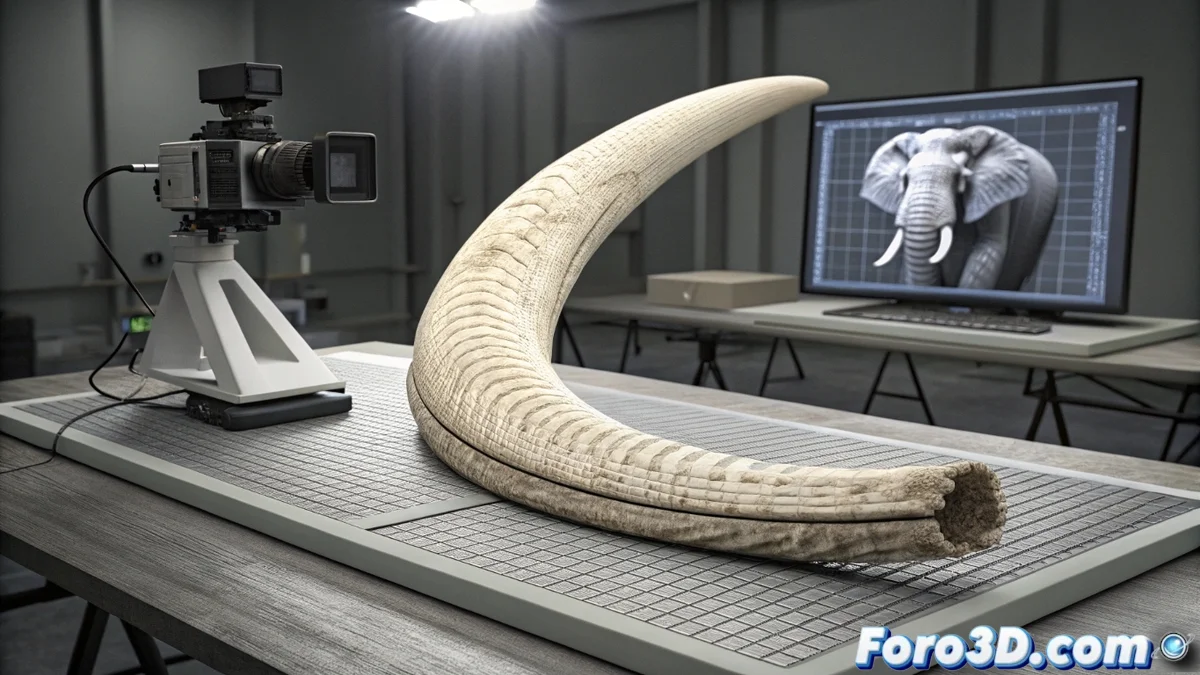
3D Technology in the Fight Against Ivory Trafficking
The seizure of an ivory shipment is merely the first act of a highly complex forensic investigation. To trace the tusk back to its origin and dismantle criminal networks, experts employ a highly precise digital workflow. This process transforms physical evidence into an irrefutable digital witness 🦷.
Millimetric Digitization: The First Link
The digital chain of custody begins with the three-dimensional capture of the seized tusk. Structured light 3D scanners, such as models from the HandySCAN series, are used to record with submillimetric accuracy the complete geometry, surface texture, and, critically, the natural curvature of the specimen. This digital replica serves as the foundation for all subsequent analyses.
Key Advantages of Initial Scanning:- Preserves the original evidence without destructive manipulation.
- Generates a permanent and accurate file for study.
- Captures essential curvature data for morphological comparison.
While poachers believe they are selling a piece of ivory, they are actually handing over a 3D model of geolocated evidence that points to them.
Forensic Analysis in Virtual Space
With the 3D model in software like Geomagic Design X, investigators perform an internal examination impossible with the naked eye. The focus is on the Schreger lines, a unique pattern in elephant ivory that functions as a species fingerprint. The three-dimensional version allows precise measurement of the intersection angles of these lines in space, a determining forensic datum.
Implications of Schreger Lines Analysis:- Legal distinction between African elephant and Asian ivory.
- Vital information for threatened species conservation efforts.
- Creation of a reference profile for the forensic database.
Data Cross-Referencing and Origin Geolocalization
The final phase uses tools like Tusk Virtualization. This software not only archives the evidence but enables morphological data cross-referencing. The 3D curvature and shape of the seized tusk are compared with a database of scans from known origins and even photogrammetry of live elephants. By superimposing these shapes in three dimensions, the animal's population of origin can be inferred.
This process narrows down the geographic area of poaching, providing vital leads for law enforcement. 3D technology thus transforms each tusk into a silent but powerful piece of evidence, closing the circle from seizure to crime identification 🌍.