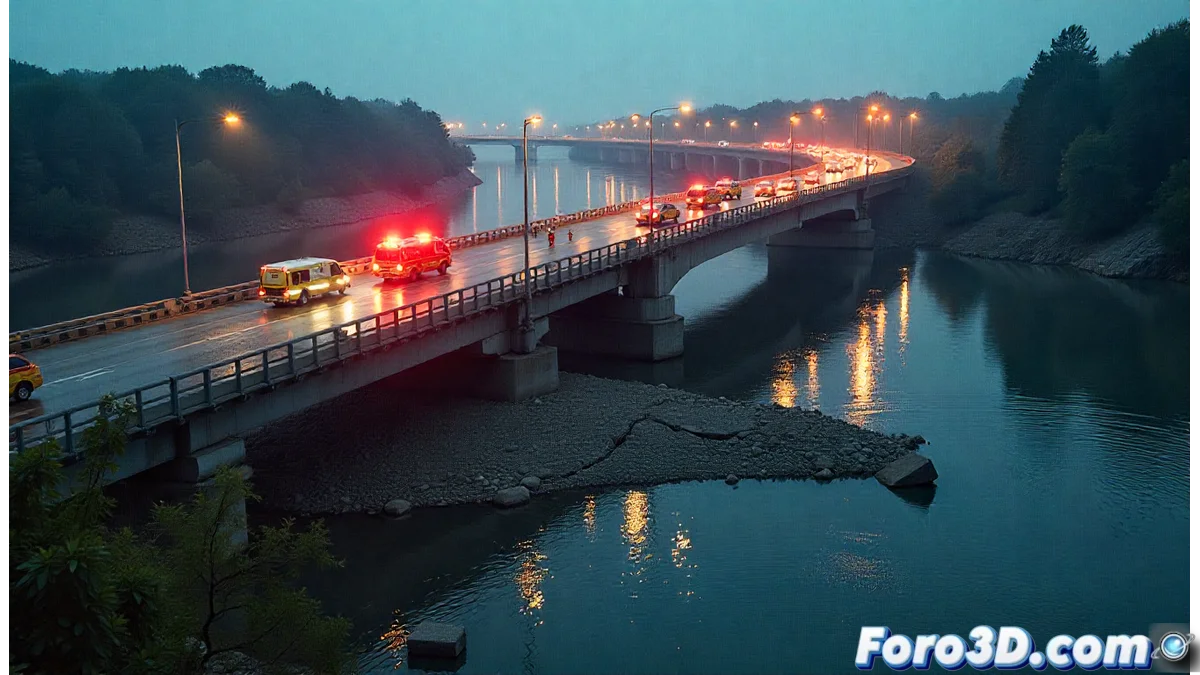
Forensic Investigation of the Silver Creek Bridge Collapse Using 3D Technology
The catastrophic collapse of the Silver Creek bridge during peak traffic hours has triggered an urgent technical investigation that employs advanced digital methodologies to clarify responsibilities and root causes. Teams specialized in forensic engineering deploy massive data capture technologies using terrestrial laser scanners and unmanned aerial vehicles to meticulously document the accident scene before physical evidence degrades or is altered. This exhaustive documentation forms the basis for virtually recreating both the original structural configuration and the critical events immediately preceding the collapse, integrating multisensory information, eyewitness testimonies, and vehicle flow records. 🏗️🔍
Data Capture and 3D Processing
The FARO Scene platform records the actual geometry of the collapsed bridge using terrestrial laser technology, while drones equipped with high-resolution capture systems obtain multilayer aerial images that complement the documentation. These captures are processed using Agisoft Metashape to generate georeferenced point clouds that are subsequently refined in Autodesk ReCap, eliminating artifacts and fusing different datasets. The final result is a millimeter-precise representation of the post-collapse scenario that preserves even the smallest structural details, including fracture patterns, plastic deformations, and spatial arrangement of structural components.
Documentation Workflow:- Terrestrial laser scanning with FARO Scene for precise geometric capture
- Aerial photogrammetry with high-resolution drones for complete coverage
- Processing in Agisoft Metashape for point cloud generation
- Data refinement and unification in Autodesk ReCap
Millimeter precision in forensic documentation is crucial for determining the true causes of the structural collapse
Virtual Reconstruction and Scenario Analysis
Geomagic Design X transforms point clouds into high-precision parametric CAD models that recreate the bridge's original configuration, identifying design deviations and preexisting damage undetected in conventional inspections. These models are imported into simulation platforms like Ansys and Abaqus, where finite element analyses are run to evaluate structural behavior under various load conditions, including the critical scenario with the suspected heavy vehicle. Blender integrates all results into cinematic visualizations that sequentially show the propagation of structural failures, from the initial crack to total collapse, allowing identification of the origin point and validation or dismissal of the vehicle overload hypothesis as the primary trigger.
Structural Analysis Stages:- Conversion of point clouds to parametric CAD models with Geomagic Design X
- Finite element simulations in Ansys and Abaqus for load evaluation
- Cinematic recreation of failure propagation with Blender
- Validation of hypotheses on triggering causes
Reflections on Maintenance and Structural Inspection
It is particularly revealing to discover that the weakest link in the infrastructure was a bridge that had been showing evident signs of deterioration for years, while routine inspection protocols were limited to superficial observations such as the presence of bird nests on its beams, mistakenly considered as indicators of structural stability. This situation underscores the urgent need to implement continuous monitoring systems and advanced diagnostic technologies that can proactively detect structural vulnerabilities before they lead to catastrophic collapses. 🚧⚠️