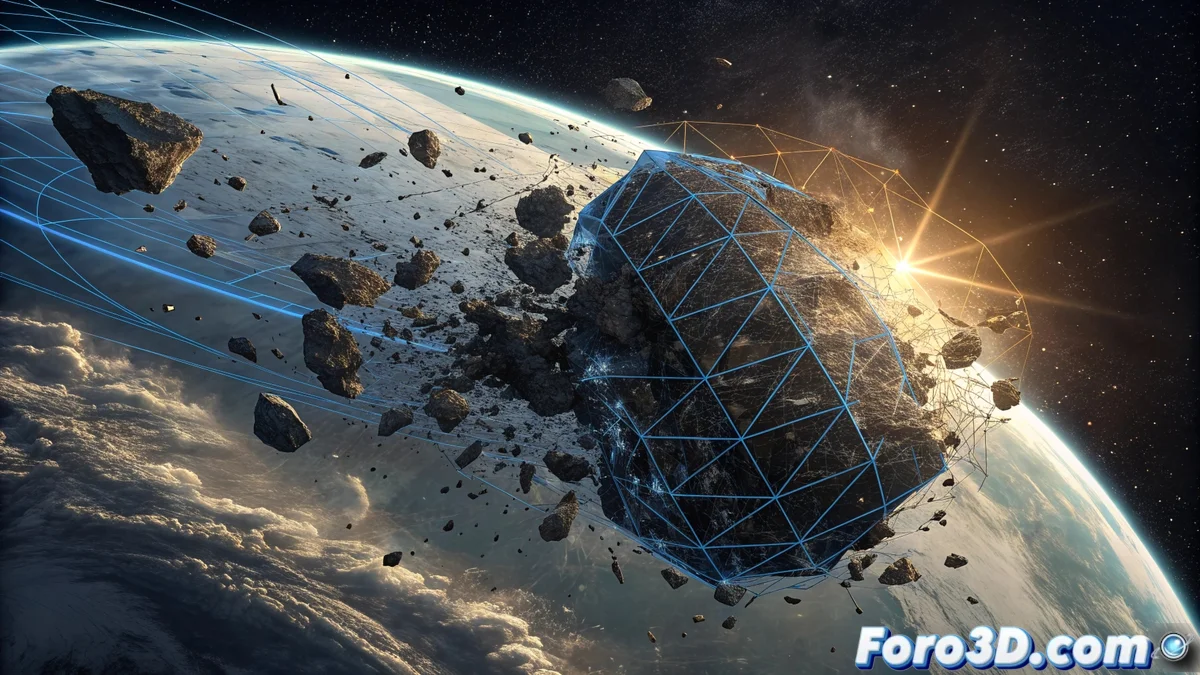
3D Space Forensics: Reconstructing Orbital Collisions with Data and Software
A satellite collision in orbit is not the end, but the beginning of a complex investigation. 🛰️💥 A debris cloud is generated that puts other space assets at risk, immediately activating a 3D forensic pipeline. This process seeks to understand the past to protect the future.
The Reverse Analysis Process
The core of the investigation is reverse analysis. Experts start from the effects (the scattered fragments) to deduce the original cause. To achieve this, they integrate multiple data sources. Ground radars track the position and velocity of thousands of fragments. If pieces are recovered, they are 3D scanned to obtain precise digital models. The ultimate goal is to accurately calculate the relative trajectory and velocity at the moment of impact. Determining these parameters is key to knowing whether it was a failure or a deliberate act, and to model how the dangerous debris cloud will expand.
Key data feeding the pipeline:- Radar data: Provide the position and initial velocity vectors of the fragments after the collision.
- 3D scans of fragments: Capture the exact geometry and impact marks on recovered pieces, essential for understanding the collision mechanics.
- Material models: Inform about how satellite components fracture under extreme stress.
What begins as an investigation to understand the past becomes a vital tool for protecting current and future space operations.
The Software that Makes Reconstruction Possible
This forensic analysis would not be possible without a set of specialized software tools. Each one performs a specific function in the pipeline, allowing to simulate, analyze, and visualize the event from multiple angles.
Essential tools in orbital forensics:- STK (Systems Tool Kit): Models orbital dynamics and simulates different collision scenarios. It allows testing hypotheses about impact angles and velocities.
- GOM Inspect: Analyzes the 3D models of scanned fragments. It looks for deformations, contact marks, and fracture vectors, providing direct physical evidence.
- Hypervelocity simulation software: Custom programs that recreate the extreme conditions of the collision (kilometers per second). They help understand how specific satellite materials behave and break.
Beyond Finding Culprits: Protecting Space
The main result of this 3D forensic reconstruction is not just a verdict on the cause. The most valuable product is an accurate database with the position and velocity of each significant fragment. This data feeds debris propagation models that predict their future movement. This information allows alerting satellite operators and planning evasive maneuvers in advance. Thus, a technical investigation transforms into the foundation for mitigating risk and making the space environment safer for everyone. The next "shooting star" you see might well be a satellite fragment that, thanks to this work, others were able to dodge.